What characteristic defined later computer input cards that differed from Hollerith's initial census cards?
Answer
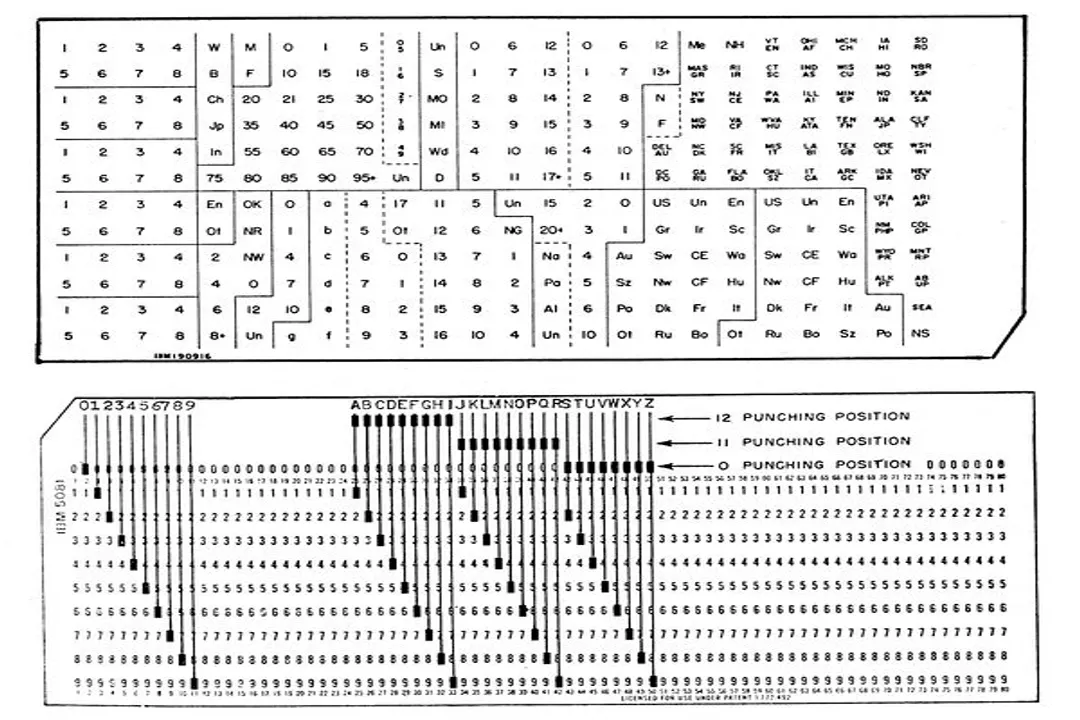
They often adopted an 80-column standard where each column encoded one character of data
The core concept of the perforated card evolved significantly beyond the initial designs used for census work. As these cards transitioned into serving as the dominant method for data entry and program instruction in early mainframe computing, such as with the IBM 1401, a specific physical configuration became common. This configuration involved cards structured into 80 distinct columns, where each specific column location was designated to represent a single character of data or an instruction element for the computer program.
Related Questions
What established industry first used perforated cards to automate complex woven patterns?What administrative crisis spurred Herman Hollerith to develop his electromechanical tabulating system?How did Hollerith's innovation fundamentally advance the function of the punched card over Jacquard's system?What was the approximate time reduction achieved by Hollerith's system for the 1890 US Census processing?What key business, established by Hollerith in 1896, eventually evolved into IBM?What pivotal prerequisite for machine compatibility did Hollerith impose on nationwide census data collection?When did Joseph Marie Jacquard refine the mechanical use of punched cards for loom control?What was the labor shift involved when moving from the 1880 Census process to Hollerith's mechanized system?What characteristic defined later computer input cards that differed from Hollerith's initial census cards?Who is recognized for providing the 'idea of perforated control' versus Hollerith's application to systematic data recording?