How did Hollerith's innovation fundamentally advance the function of the punched card over Jacquard's system?
Answer
Hollerith paired the card mechanism with electricity to actuate relays and counters for tabulation
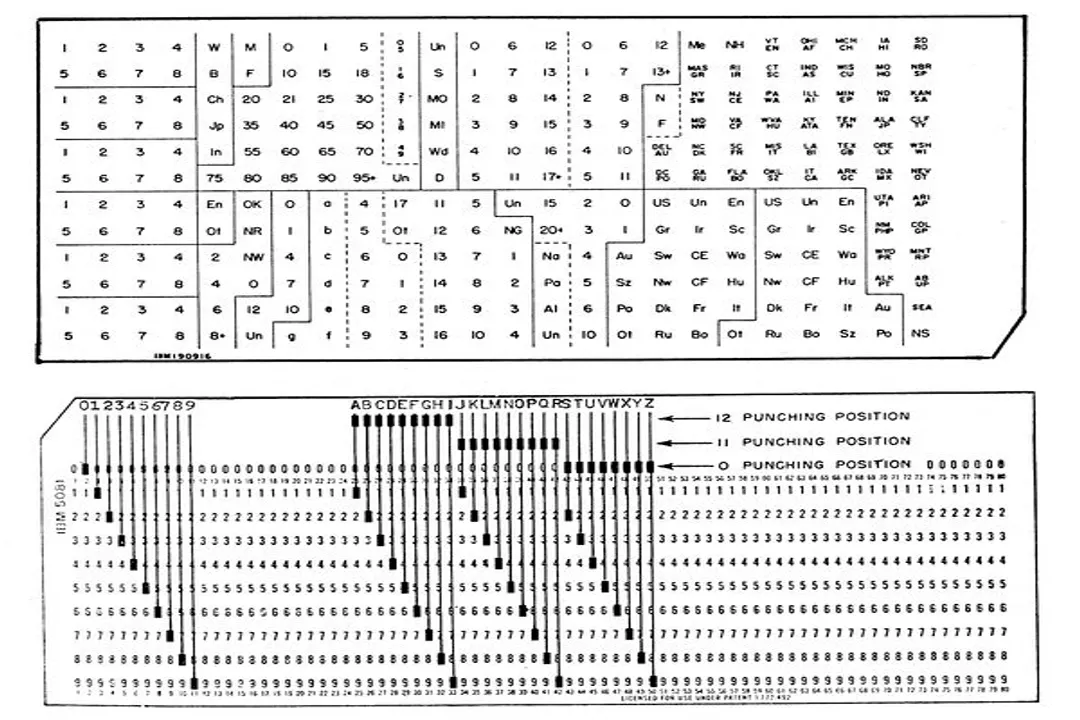
While Jacquard used punched cards for mechanical actuation—physically controlling the warp threads on a loom—Herman Hollerith introduced the crucial element of electricity. Hollerith developed an electromechanical tabulating machine where an electrical circuit was completed when a reader made contact through a hole in the card. This electrical contact, in turn, activated internal relays or counters within the machine, allowing for the systematic counting and tabulation of demographic data rather than just mechanical sequencing.
Related Questions
What established industry first used perforated cards to automate complex woven patterns?What administrative crisis spurred Herman Hollerith to develop his electromechanical tabulating system?How did Hollerith's innovation fundamentally advance the function of the punched card over Jacquard's system?What was the approximate time reduction achieved by Hollerith's system for the 1890 US Census processing?What key business, established by Hollerith in 1896, eventually evolved into IBM?What pivotal prerequisite for machine compatibility did Hollerith impose on nationwide census data collection?When did Joseph Marie Jacquard refine the mechanical use of punched cards for loom control?What was the labor shift involved when moving from the 1880 Census process to Hollerith's mechanized system?What characteristic defined later computer input cards that differed from Hollerith's initial census cards?Who is recognized for providing the 'idea of perforated control' versus Hollerith's application to systematic data recording?