What were the major inventions in the textile industry?
This is the start of the article with introduction paragraph and is not a heading. It should immediately begin the text.
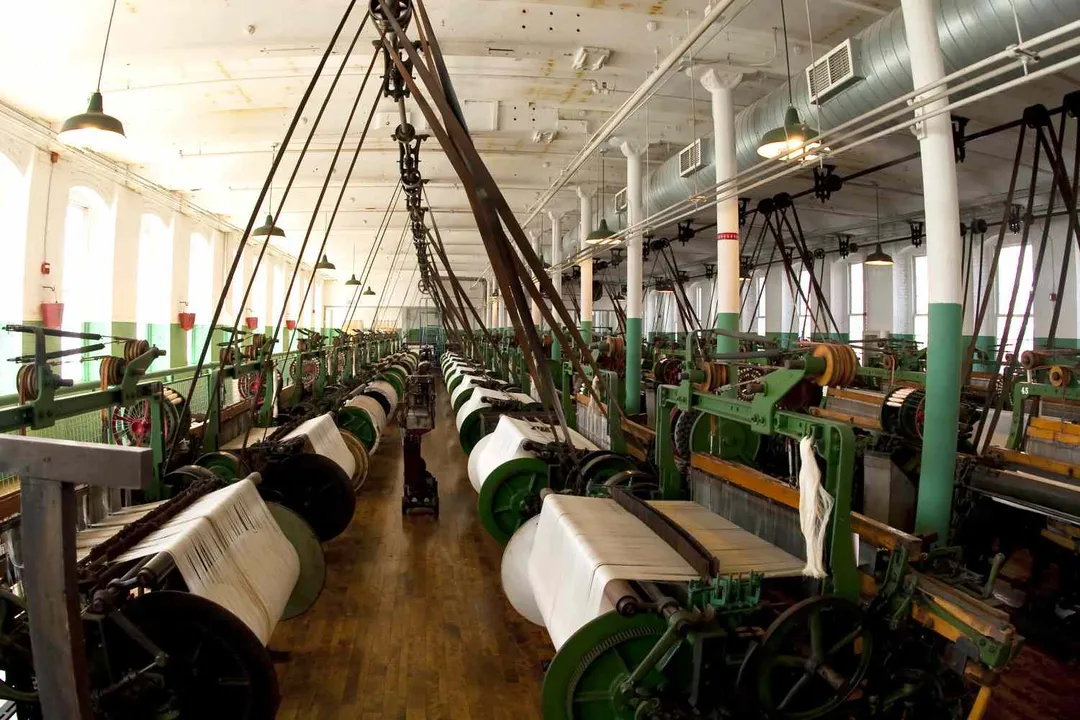
The history of textiles is deeply intertwined with human progress, stretching back to the earliest needs for shelter and covering, long before any machinery existed. Ancient societies in regions like Southern Turkey were producing woolen textiles as far back as 6000 B.C., while in India, Pakistan, and Eastern Africa, cotton was being grown and woven around 5000 B.C. Even earlier, around 2700 B.C., China was mastering the weaving of silk from silkworm cocoons. This early production—relying on the distaff and a bowl to spin wool or cotton by hand, and the equally ancient loom for weaving—was the domain of cottage industries, where entire families participated in slow, time-consuming labor within the home. [5] The breakthrough that moved this fundamental human activity out of the home and into the modern age was not one single event, but a cascading series of mechanical innovations beginning in the mid-18th century, primarily centered in Great Britain. [4][5] These textile advancements were so significant that they are credited with kicking off the entire Industrial Revolution, fundamentally changing employment, output value, and capital investment. [4]
# Early Leaps
The initial bottleneck in textile production was speed, particularly in weaving. Before widespread mechanization, a weaver could only work as fast as they could pass the shuttle by hand, limiting the width and speed of cloth creation. John Kay’s invention of the Flying Shuttle in 1733 directly addressed this. [4] By mounting the shuttle on wheels and operating it with cords, a single weaver could produce much wider fabrics and weave significantly faster than before. While this invention drastically improved weaving output, it immediately created a new problem: spinners could not produce yarn quickly enough to keep up with the weaving speed, creating a significant imbalance in the supply chain. [5]
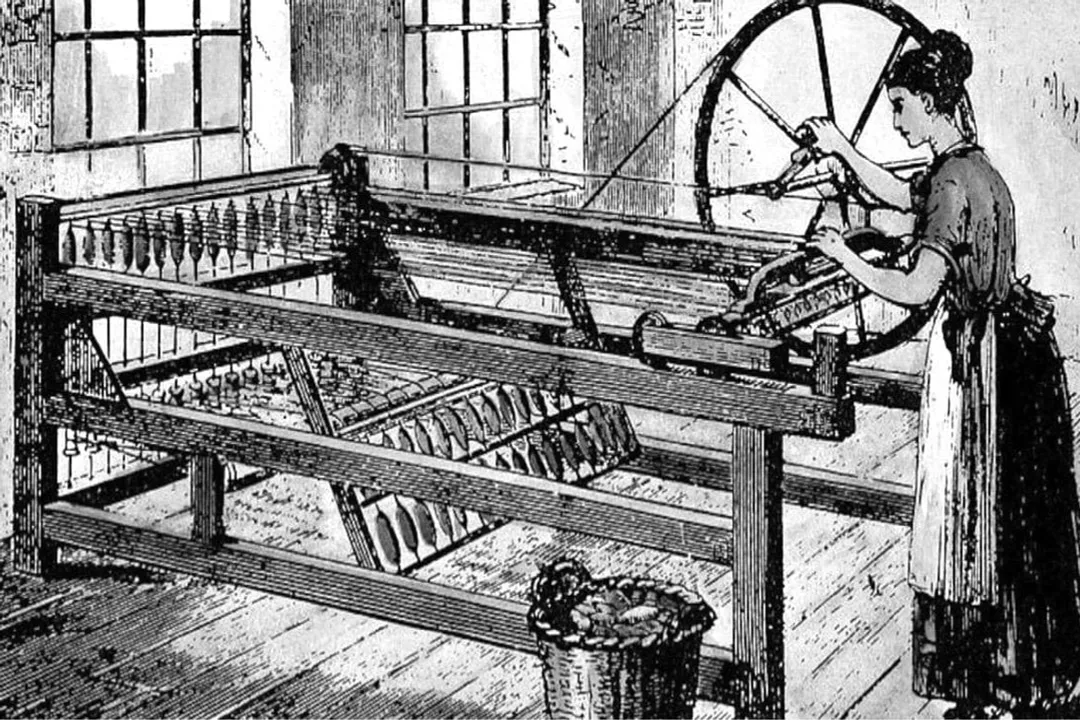
The pressure created by faster weaving demanded a radical shift in spinning technology. One of the earliest machines to improve upon the traditional spinning wheel was the Spinning Jenny, invented by James Hargreaves around 1764 and patented in 1770. [4] This machine was revolutionary because it allowed one person, or spinster, to operate multiple spindles simultaneously—early models handled eight—instead of just one. [5] The name is sometimes popularly traced back to Hargreaves’ daughter, Jenny, though other accounts suggest the term "jenny" was simply an old reference to an engine. [5] While effective, the yarn produced by the early Jenny was often weaker than hand-spun thread, making it unsuitable for use as warp threads in weaving; it was better suited for weft. [5] Despite this limitation, the Jenny was relatively simple and affordable, allowing some home spinners to increase production before the larger, factory-based systems took over.
# Powering Production

The next critical development involved strengthening the yarn and introducing powered operation. Richard Arkwright, often credited with nurturing inventors and financing initiatives, developed the Water Frame, patented in 1769. [4] This machine was based on earlier concepts, partly inspired by a machine built for Thomas High by clockmaker John Kay. The Water Frame used a series of multi-speed rollers to draw out the fiber, which was then twisted by the spindle. Crucially, it produced a much harder, medium-count thread that was strong enough to be used as warp, allowing for the production of 100% cotton cloth in Britain for the first time. The size of the Water Frame necessitated power beyond what a single human could provide; initially, horse power was tested, but settling on water power gave the invention its name. In 1771, Arkwright installed the first factory-sized unit powered by a water wheel in Cromford, Derbyshire, effectively establishing the cotton mill system where production was centralized. [4]
This shift to water power was the first step toward full mechanization, concentrating labor and reducing raw material transport costs. [5] The efficiency gains were enormous; if a worker spinning cotton by hand took over 50,000 hours to produce 100 pounds of cotton, by the 1790s, the new machinery could achieve that output in approximately 300 hours.
The Water Frame’s strong warp thread now required a better weft thread to maintain balance, and the existing Jenny’s weft thread needed improvement for warp quality. [5] The solution came from Samuel Crompton, who, between 1775 and 1779, created the Spinning Mule. [4] This hybrid ingeniously combined the best features of the Jenny (multiple spindles) and the Water Frame (roller drawing system). The resulting thread was finer than what hand spinning could produce and strong enough for warp, finally enabling Britain to produce high-quality, all-cotton calico cloth cost-effectively. Early mules were small enough for home use, but later versions evolved into massive machines with carriages carrying over a thousand spindles, requiring them to be housed in large factories. The self-acting mule, patented by Richard Roberts in 1830, automated the winding stroke, which previously required manual effort, further cutting production time for 100 pounds of cotton down to just 135 hours per worker.
# Weaving Automation
With spinning technology rapidly advancing and creating a surplus of strong yarn, the focus shifted back to the loom. Edmund Cartwright developed the Power Loom, which he patented in 1785. [4] While his initial vertical design had flaws, like frequent thread breakage, it represented the necessary automated counterpart to the new spinning machines. Subsequent improvements by inventors like Samuel Horrocks (1813) and Richard Roberts (1822) refined the mechanism, leading to the production of the Roberts Loom with a cast-iron frame in 1830. The ultimate goal was a fully automatic loom, which arrived later with the Northrop Loom in 1894, featuring automatic weft replenishment, which took over from the earlier Lancashire Loom.
The mechanization of the entire process—spinning and weaving—became truly industrial when coupled with new power sources. While the early mills relied on water wheels, James Watt’s continuous modifications to the steam engine, notably the design with an external condenser in 1774, made reliable, location-independent power available. By 1810, some mills like Quarry Bank were integrating steam engines to supplement or replace water power, and by 1836, mills were installing engines of 160 horsepower, far exceeding the early water wheel capabilities. The introduction of wrought iron for line-shafting, replacing heavier wooden shafts, further increased mill efficiency by reducing absorbed power.
It is important to note a pattern here that underscores the competitive nature of this era: innovation often followed a distinct sequence of imbalance and correction. The Flying Shuttle sped up weaving, leading to a spinning bottleneck. The Jenny and Water Frame broke the spinning bottleneck, leading to a renewed weaving bottleneck, solved by the Power Loom. This suggests that technological progress in the industry was less about isolated genius and more about an iterative feedback loop driven by production constraints. An operator looking at a factory floor today might see specialized robots, but the underlying principle—one machine’s increased output forcing the next station to improve—remains the same. [4]
# Geographic Shifts and Raw Materials
The technological explosion in Great Britain was heavily reliant on a specific raw material: cotton. The demand for cotton spurred inventions both abroad and at home. In the United States, the vast supply of short-staple cotton was unusable due to the labor-intensive process of separating the fiber from the sticky seeds. [4] Eli Whitney’s invention of the Cotton Gin in 1793 automated this separation, increasing a person's daily processing capacity by over 50 times. [4] This invention made upland cotton incredibly profitable and solidified the agricultural basis of slavery in the American South, feeding the booming mills in both the U.S. and Britain.
While Britain fiercely protected its machinery designs—even prohibiting skilled engineers from emigrating—Samuel Slater, an apprentice who worked with Arkwright's partner, successfully smuggled the knowledge to America in 1789, leading to the first water-powered spinning mill in Rhode Island by 1790-92. This transfer catalyzed the American textile industry, which later saw a major shift south after the Civil War due to cheaper labor costs and proximity to the cotton source.
| Invention | Inventor | Year (Approx.) | Primary Function | Impact on Process |
|---|---|---|---|---|
| Flying Shuttle | John Kay | 1733 | Weaving | Increased weaving speed and fabric width [4] |
| Spinning Jenny | James Hargreaves | 1764 | Spinning | Increased spindles from one to multiple (e.g., eight) [4][5] |
| Water Frame | Richard Arkwright | 1769 | Spinning | Produced strong warp thread; required water power [4] |
| Spinning Mule | Samuel Crompton | 1779 | Spinning | Combined Jenny and Water Frame for finer, strong thread [4] |
| Power Loom | Edmund Cartwright | 1785 | Weaving | Mechanized weaving to match spinning output [4] |
| Cotton Gin | Eli Whitney | 1793 | Fiber Preparation | Massively sped up seed removal from cotton fiber [4] |
| Jacquard Loom | Joseph-Marie Jacquard | 1804 | Weaving | Automated complex pattern creation via punched cards [4] |
# Pattern Making and Beyond
Another landmark machine focused not on sheer speed but on complexity was the Jacquard Loom, invented by Joseph-Marie Jacquard in 1804. [4] This invention mechanized the creation of intricate textile designs, particularly in silk weaving. It utilized a system of punched cards, where the pattern was encoded by which cards were included or excluded, automatically controlling the lifting of warp threads. [4] This concept of using encoded instructions to control a machine is a direct ancestor of modern computing logic. Viewing the Jacquard Loom in context with the self-acting mule reveals a clear trend: the elimination of skilled manual actions from the machine’s operation, moving toward machine autonomy.
The advancements did not cease with steam power and mechanical weaving. The latter half of the 19th century brought chemical innovation, exemplified by William Perkin's invention of the first synthetic dye in 1856. [4] This discovery moved textile finishing beyond natural colorants, opening up a vast new spectrum of reproducible color. [4]
The 20th century shifted the focus away from mechanical power systems toward material science. New fibers were developed to enhance durability, flexibility, and specific properties. Rayon, an early "artificial" silk made from purified cellulose, appeared commercially in the U.S. around 1910. This was followed by significant synthetic breakthroughs from DuPont, including Nylon in 1938 (which replaced silk in parachutes and hosiery during WWII), Acrylic fiber in 1950, Polyester in 1952 (often blended with cotton for wash-and-wear fabrics), and Spandex in 1959 for its lightweight flexibility. Glass fibers were spun into fabric in 1936, and metallic fibers appeared in 1946, showing a diversification into high-performance and novelty materials.
Considering the impact of these materials, it’s interesting to observe that while the 19th century was characterized by process inventions (how to spin/weave faster), the 20th century was defined by material inventions (what to spin/weave with). This bifurcation suggests that once the factory system and power infrastructure were established, the next frontier became manipulating the very composition of the fiber itself to achieve desired performance characteristics, a trend that continues today with smart textiles and sustainable cellulose derivatives like Lyocell. The legacy of these 18th and 19th-century inventors is that they created the means of mass production, but the 20th-century chemists provided the medium for modern variety. The industry, which began as a means of necessity, evolved through mechanical genius into a complex chemical and engineering discipline.
Related Questions
#Citations
A Timeline of Textile Machinery Inventions - ThoughtCo
The Spinning Jenny: A Woolen Revolution - Faribault Mill
A Timeline of Textile History
Technological Developments in Textiles | History of Western ...
The Industrial Revolution's Textile Industry Overview - Paradise Fibers