What is the oldest type of engine?

The quest to harness concentrated, rapid power—what we now call the internal combustion engine—did not begin with spark plugs and refined gasoline. Instead, it started with explosions contained, a raw burst of energy that civilized engineers struggled to tame into predictable motion. Before the sleek, highly efficient machines that power most of our world today, there existed a fundamental, less refined precursor: the atmospheric engine. This was the earliest successful type of internal combustion engine, a design whose very operation reveals a crucial moment in engineering history when energy conversion was brute force rather than precise calibration. [4]
# Early Power

The very first seeds of this technology predate modern mechanics entirely. Concepts involving rapid expansion of gases to create movement stretch back nearly two millennia, though these were mostly theoretical or rudimentary. For instance, by the year 100 AD, the simple fire piston was a known device concentrated in Austronesian regions—a perfect example of using rapid compression to generate enough heat to ignite tinder. [4] In the late 17th century, inventors like Christiaan Huygens prototyped engines using the controlled explosion of gunpowder to push a piston, mimicking a technique used in warfare, though these were far from practical power sources. [4] By the 1790s, inventors such as John Barber were patenting the principles of gas turbines, and Robert Street patented an internal-combustion engine that utilized liquid fuel—petroleum—ignited by an external flame. [4] Even the first known American internal combustion engine, designed by John Stevens in 1798, was an early foray into this emerging field. [4]
# Lenoir's Motor
The true breakthrough that established the internal combustion engine as a commercial type came from Belgium-born, French-trained engineer Jean Joseph Etienne Lenoir. In 1860, Lenoir produced his gas-fired, atmospheric engine. [4] This design is frequently credited as the first functional internal combustion engine, and critically, it was the first to see commercial success. [4]
The Lenoir engine worked on a principle similar to the dominant external combustion technology of the time: the steam engine. It was a double-acting engine laid out horizontally. [4] However, instead of steam, it used illuminating gas as fuel. The gas, mixed with air, was drawn into the cylinder during the intake stroke, and then it was ignited by an electric spark—making it an early example of spark ignition. [4] Crucially, unlike later designs, the Lenoir engine did not compress the fuel-air mixture before ignition. [4] It relied on the expansion of the combusted gases (hence "atmospheric") to push the piston, and the subsequent vacuum created to help pull it back, somewhat like a vacuum pump. [4]
This design was simple enough that by 1860, several units were reportedly built and used commercially in Paris, and by 1867, about 280 units had been constructed. [4] It found applications powering small machinery in settings like printing presses. [4]
While it achieved commercial viability, the Lenoir engine was inherently inefficient. Its reliance on atmospheric pressure rather than pre-compression meant it wasted a significant amount of potential energy. If we view engine evolution through the lens of thermodynamic efficiency, the Lenoir engine represents a necessary but mechanically primitive stage—a direct translation of external combustion concepts onto an internal explosion without fully grasping the potential of high-pressure thermodynamics. [4]

# Atmospheric Advance
The engine type didn't stay static for long. Contemporaries quickly sought improvements, recognizing the inherent drawbacks of atmospheric operation. Italian engineer Eugenio Barsanti, working with Felice Matteucci, had patented a design around 1854 that also relied on vacuum action; the explosion occurred, and the resulting vacuum pulled the piston down. [4]
A significant step toward refining this type came from German engineers Nicolaus Otto and Eugen Langen. In 1864, they produced their own commercially successful atmospheric gas engine, which became known as the Otto-Langen engine. [4] This machine, which won a gold medal at the 1867 Paris Exhibition, was a massive improvement over Lenoir's design. [4] It achieved fuel consumption rates less than half that of the Lenoir and Hugon engines, the latter being an improved commercial version of Lenoir's original concept. [4] The Otto-Langen engine worked by allowing a flame to ignite the fuel/air mixture that was already in the cylinder, then using the rapid expansion to lift a piston, which would then fall back under its own weight (or a counterbalance) to perform work. [3][4]
# Compression Shift
The true revolution that defined what most people consider an engine type today—the modern reciprocating engine—was the introduction of compression. In 1861, French engineer Alphonse Beau de Rochas described the principles of the four-stroke engine, though his initial patent application was later invalidated. [4]
It was Nicolaus Otto who, in 1876, patented the first truly successful compressed charge, four-stroke cycle engine—the Otto Silent Engine. [4] This design required the piston to complete four strokes (intake, compression, power, exhaust) for every one power stroke. [4] The critical difference from the Lenoir type was the deliberate compression of the air/fuel mixture before ignition. [4] This increase in pressure dramatically raised the engine's thermal efficiency and power output relative to its size. This single innovation essentially rendered the atmospheric engine design obsolete for mobile or high-power applications, cementing the compression-ignition and compression-spark-ignition cycles as the dominant engine types for the next century. [4] Later, Karl Benz patented a reliable two-stroke gas engine in 1879, and Rudolf Diesel followed in 1892 by developing the compression-ignition engine, which uses the heat of extreme compression to ignite the fuel, thus eliminating the need for a separate ignition system like a spark plug. [4]
The atmospheric engine, therefore, stands as the oldest type of internal combustion engine to achieve commercial use, born from the necessity to harness gas expansion, but ultimately unable to compete once controlled compression became feasible. [4]
# Modern Lineage
While the Lenoir and Otto-Langen designs faded from prominence, the idea of a fundamentally sound, long-lived engine architecture continues in modern manufacturing, even if the specific combustion cycle has evolved. Looking at the oldest engines still in production today reveals a commitment to refining proven platforms, which is a different kind of longevity than the historical "oldest type". [7]
For heavy-duty applications, the Cummins B-Series diesel inline-six is often cited as a king of durability, having started production around 1984. [5][7] While the original 1919 6hp Hvid stationary oil engine restored by Cummins Heritage Center predates the B-Series, it represents the earliest engine Clessie Cummins brought to market. [5] The B-Series, still powering Dodge Ram trucks and other commercial vehicles, is renowned for its robustness, with some units exceeding a million miles of service. [5][7]
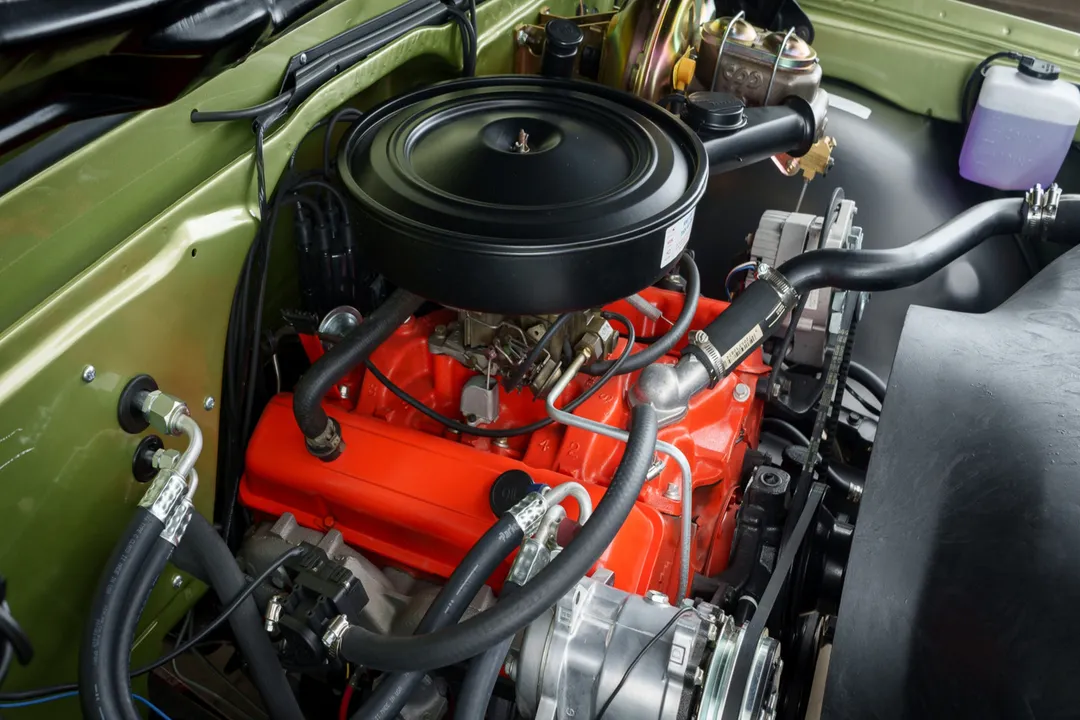
In the passenger car world, the lineage of the Chevrolet Small-Block V8 (SBC) is often invoked. Introduced in 1955, this engine is still available as a crate motor directly from GM, although the modern LT series engines used in new cars are significantly different derivatives rather than direct carryovers. [7] Other long-lived designs include the Bentley/Rolls-Royce 6.75-liter V8, which originated in 1959, and the Ford Modular V8, which started in 1991 and continues in updated forms, such as the Coyote V8 found in the modern Mustang GT. [7] In the world of motorcycles, the Enfield Bullet 350cc engine is noted for continuous production with minimal design changes since its 1949 introduction in India.
These modern examples demonstrate that while the type of combustion has standardized (mostly compression-ignition diesel or four-stroke spark-ignition gasoline), the underlying mechanical blueprint can survive for decades through continuous, iterative improvement—a crucial difference from the early atmospheric engines that were rapidly displaced by a superior cycle. [4][7]
# Design Endurance
The historical context of these early engines provides important perspective. The atmospheric engine's failure to dominate was not due to lack of ingenuity, but rather the constraints of the time. The first commercial engines, like Lenoir's, were relatively low-power devices running at low speeds, partly because the metallurgy and machining techniques of the 1860s could not reliably handle the high pressures generated by pre-compression without immediate failure. [4] Otto’s success in 1876 stemmed from his ability to build a machine that could withstand the necessary pressures, allowing the four-stroke cycle to finally realize its thermodynamic potential.
It is interesting to compare the physical output of the oldest functional type with today's minimal remnants. The 1860 Lenoir engine produced very little power relative to its size, requiring significant scale for small tasks. [4] In contrast, a modern, long-running engine like the Cummins B-Series can now produce nearly 500 horsepower and approach 1,000 lb-ft of torque in its latest configurations, all while maintaining a basic inline-six architecture that has been refined over nearly a century of diesel application, though the fundamental diesel cycle itself is newer than the Lenoir design. [5]
The comparison between the atmospheric engine type and the surviving model lineage highlights an evolutionary divergence. The atmospheric engine type was replaced wholesale by the compression cycle because the latter offered a fundamentally better way to extract work from fuel. By contrast, the longevity of the Cummins or SBC lies in their architecture being so flexible that they could successfully incorporate fundamental changes—like switching from carburetion to direct injection, or changing valve actuation—while keeping the core block geometry and overall design philosophy intact across successive generations. [7] In essence, the atmospheric engine reached an evolutionary dead end, while the four-stroke gasoline and compression-ignition diesel types were adaptable enough to survive into the current era by adopting incremental, performance-enhancing technologies. The earliest engine type failed because it couldn't handle more pressure; the modern survivors succeed because they are built to handle precisely controlled pressure, iteration after iteration. [4][7]
#Videos
World's oldest known Cummins engine is still running strong
TOP 10 OLDEST Running Engines - YouTube
Running Model of Very First Otto Langen. 1876 internal combustion ...
Related Questions
#Citations
History of the internal combustion engine - Wikipedia
World's oldest known Cummins engine is still running strong
What is the oldest engine in production today? Now With New Stuff!
This Is The Oldest Engine Still Being Produced Today - Jalopnik
10 Of The Oldest Engines Still In Production Today - SlashGear