Which engine did Rudolf Diesel improve?
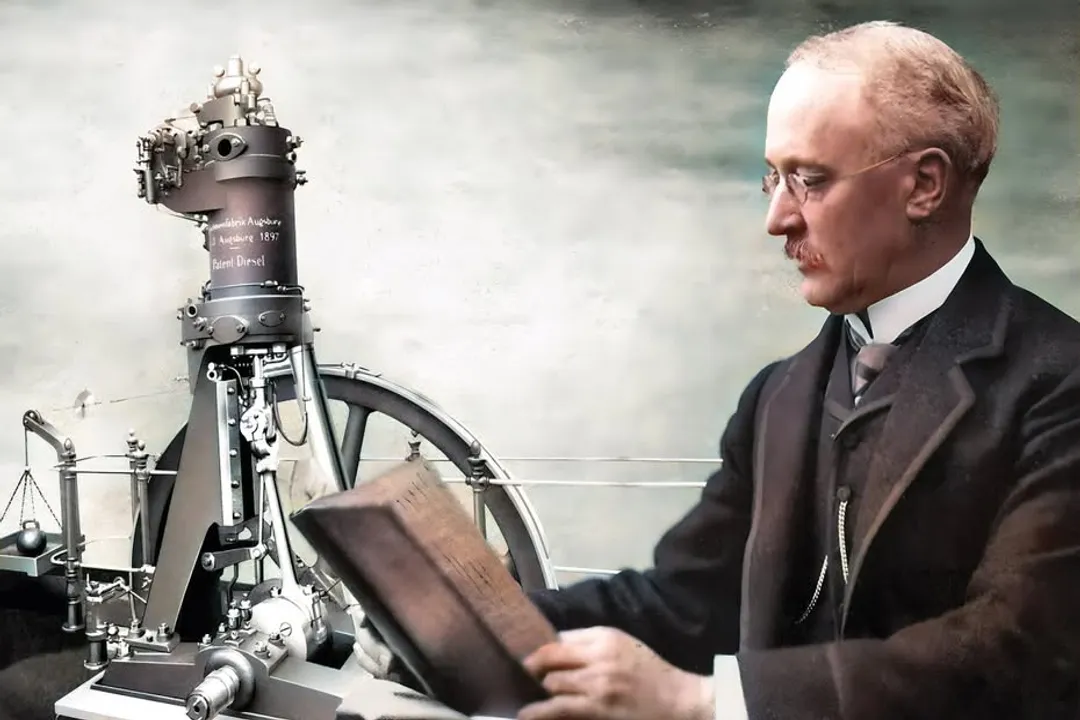
The internal combustion engine that bears the name of its inventor, Rudolf Diesel, was not a creation from a void, but rather a significant, fundamental improvement upon existing heat engine technology. [5][6] Diesel’s genius lay in realizing a different path to combustion than the one pioneered by Nikolaus Otto. He sought to build an engine that operated with far greater thermal efficiency than the contemporary steam engines or early spark-ignition gasoline engines of his era. [1][5]
The driving force behind Diesel’s work was a deep dissatisfaction with the poor efficiency rates of existing machinery. By the late 19th century, steam engines, which dominated industrial power, were wasting the vast majority of the energy contained within their fuel as waste heat. [1] Diesel envisioned a heat engine that could achieve theoretical efficiencies approaching 75%, a figure drastically higher than the roughly 10% thermal efficiency typical of contemporary engines. [5] His ambition was immense: to design a prime mover that was not only more efficient but could also run on a wider variety of fuels, including solid fuels like coal dust. [1][5]
# Thermal Limits

Diesel’s early career involved work with refrigeration and later as an assistant to Carl von Linde, where he gained profound insight into thermodynamics. [1] This background informed his pursuit of higher efficiency. He understood that the primary limitation of the common internal combustion engines—those using a spark to initiate combustion (the Otto cycle)—was related to the compression ratio they could safely handle before premature ignition occurred. [4] To achieve higher efficiency in any heat engine, one generally needs a higher expansion ratio, which in internal combustion is achieved through higher compression. [5]
If one simply compresses air in an Otto engine too much, the fuel-air mixture ignites prematurely, leading to knocking and engine destruction. Diesel found an elegant solution to this limitation by separating the compression event from the ignition event. Instead of compressing a mixture of fuel and air, Diesel proposed compressing only the air to an extremely high pressure. [4][6]
This necessary high compression ratio—significantly greater than those used in spark-ignition engines—caused the temperature of the air inside the cylinder to soar, reaching temperatures high enough (over 500 degrees Celsius) to spontaneously ignite any fuel introduced at the peak of the compression stroke. [4][5][6] This conceptual shift away from relying on an external spark marked his breakthrough. [5]
# Ignition Concept

The core innovation Rudolf Diesel patented was the compression-ignition process. [4] He received a German patent for his concept on February 23, 1892. [8] The engine operated through four main stages, though the critical distinction was the fuel introduction:
- Intake: Air is drawn into the cylinder.
- Compression: The air is compressed to a very high degree, raising its temperature dramatically. [4][6]
- Power: Just before the piston reaches the top dead center, fuel is sprayed under high pressure into the superheated air. The fuel immediately ignites due to the heat of compression, pushing the piston down. [4][6]
- Exhaust: Spent gases are expelled.
It is worth noting the difference in the timing of fuel introduction compared to spark-ignition engines. In a spark-ignition engine, the fuel and air are usually mixed before being compressed. In Diesel’s design, the fuel is added during the compression or just after the compression stroke is complete. [4] This distinction allowed for much higher compression ratios, which directly translates to greater thermodynamic efficiency. [5]
The patent he secured in the United States in 1893 described the engine's operation based on this principle of using compressed, hot air for ignition. [5] While many contemporary engines relied on gasoline or refined petroleum products, Diesel originally intended for his engine to run efficiently on readily available, less refined fuels, including vegetable oils and coal dust. [1][7]
# Early Successes
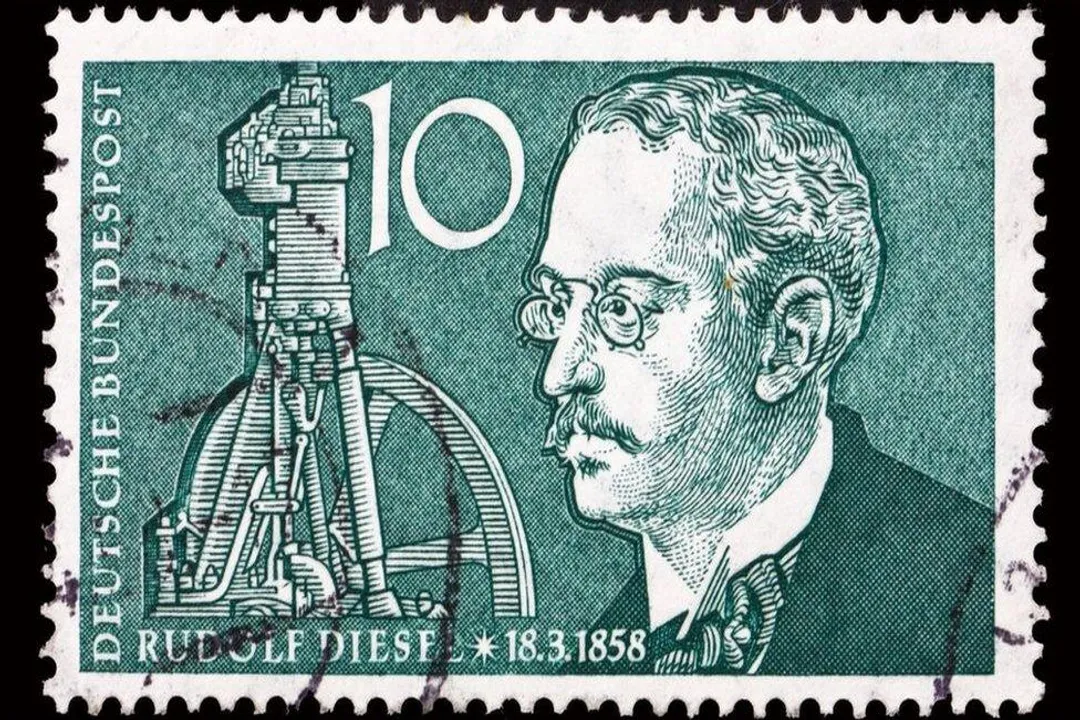
The path from patent to a functioning machine was fraught with technical hurdles and financial risk. [1] Diesel collaborated with manufacturers, notably the firm of MAN (Maschinenfabrik Augsburg-Nürnberg). [5] The first fully operational, self-sustaining engine was completed in Augsburg, Germany, in 1893. [5][7]
Interestingly, this very first engine did not immediately use petroleum diesel fuel. To prove the principle and secure further investment, the engine was successfully run using lard oil. [1][7] This demonstration, using a relatively inexpensive and non-petroleum-based fuel, was crucial for proving the adaptability of his design, even though his long-term focus remained on the potential of pulverized coal. [1]
The engine built in 1893, while successfully demonstrating the compression-ignition cycle, was still a massive, heavy prototype. It achieved an impressive thermal efficiency of around 26.7% in its early demonstrations, far exceeding the efficiency of contemporary steam engines, although still short of his theoretical goal of 75%. [5] The complexity and initial size meant that widespread commercial adoption took time, as the machining tolerances required for the high-pressure compression were severe. [4]
When considering the practical application, the choice of lard oil was a significant early deviation from the fuel type that eventually gave the engine its name. While the engine is now universally known as the "Diesel engine," the fuel that became standard later was refined petroleum distillate, often referred to as diesel fuel. [1] Diesel's initial goal of running the engine on coal dust proved far more challenging to execute mechanically than using liquid fuels, leading to the pragmatic pivot toward liquid injection systems in the final commercial designs. [1][7]
# Cycle Difference
The essential difference between the engine Rudolf Diesel developed and the gasoline engines prevalent at the time—often referred to as the Otto cycle—boils down to the method of ignition and the timing of fuel introduction. [4][6] Understanding this structural separation of duties is key to appreciating the improvement he brought to the field of reciprocating engines.
| Feature | Diesel Engine (Compression Ignition) | Otto Engine (Spark Ignition) |
|---|---|---|
| Ignition Source | Heat generated by high air compression | External spark plug |
| Fuel Introduction | Injected near the end of the compression stroke | Mixed with air before or during intake/compression |
| Typical Compression Ratio | High (often 14:1 up to 25:1) | Moderate (often 8:1 up to 12:1) |
| Primary Efficiency Driver | High compression ratio leading to high expansion | Controlled flame propagation |
The higher compression ratios allowed by the Diesel cycle inherently permit a greater conversion of thermal energy into mechanical work, which is why diesel engines generally exhibit higher fuel economy than their gasoline counterparts under similar operating conditions. [5] This characteristic is especially noticeable in applications requiring sustained, high-torque operation, such as marine propulsion or heavy trucking. [2]

# Lasting Power
Rudolf Diesel’s invention secured his place in history, earning him induction into the National Inventors Hall of Fame in 1977. [5] The technology he perfected became indispensable for powering industry, transportation, and agriculture throughout the 20th century and remains vital today. [2] Modern diesel engines are essential for heavy-duty trucks, trains, ships, and off-road equipment. [2] While regulatory pressures have prompted significant engineering advancements to clean up emissions, the fundamental principle of compression ignition remains unchanged from Diesel's original concept. [4]
Despite his technological success, Diesel’s personal life ended abruptly and mysteriously. In 1913, while traveling to London to promote his engine design and secure new financing, he disappeared from the deck of the steamer Dresden while crossing the English Channel. [1][6] His body was later recovered, but the circumstances surrounding his death remain officially unknown, leading to various theories. [1][6]
His invention, however, proved remarkably resilient. By separating the high compression required for efficiency from the method of ignition, Diesel successfully created a powerful, fuel-versatile heat engine that answered the pressing industrial need for greater power output relative to fuel consumed. [1][5] The improvements he introduced represented a major evolution in mechanical engineering, marking a clear advance over the limitations that constrained earlier internal combustion designs. [4]
Related Questions
#Citations
Rudolf Diesel - Wikipedia
History of diesel engines | Cummins Inc.
Rudolf Diesel - Lemelson-MIT Program
Early History of the Diesel Engine - DieselNet
NIHF Inductee Rudolf Diesel and the Internal Combustion Engine
How Rudolf Diesel's engine changed the world - BBC News
When Was the First Diesel Engine Made? A Look Back in Time
on February 23rd, 1892, Rudolf Diesel received a German patent for ...
Rudolf Diesel - an overview | ScienceDirect Topics