Was the bicycle invented in France?
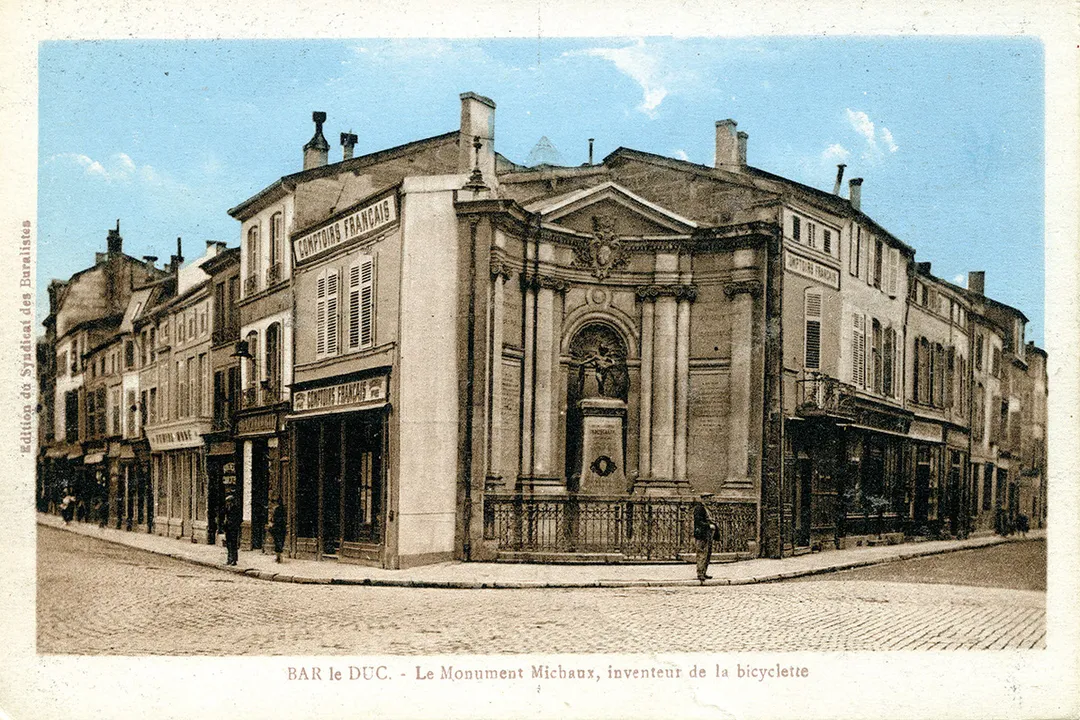
The story of the bicycle is often claimed by several nations, and France certainly holds a prominent, if complicated, position in that narrative. When people ask if the bicycle was invented in France, the immediate answer depends entirely on what one defines as a bicycle. If the definition requires two wheels, human propulsion, and steerability, the answer is certainly no, as the first verifiable, steerable precursor came from Germany. However, if the definition hinges on the addition of the defining feature of modern cycling—the pedals—then France has a very strong case for hosting the key innovation that turned a novelty into a practical machine. [3][7][9]
# Early Claims
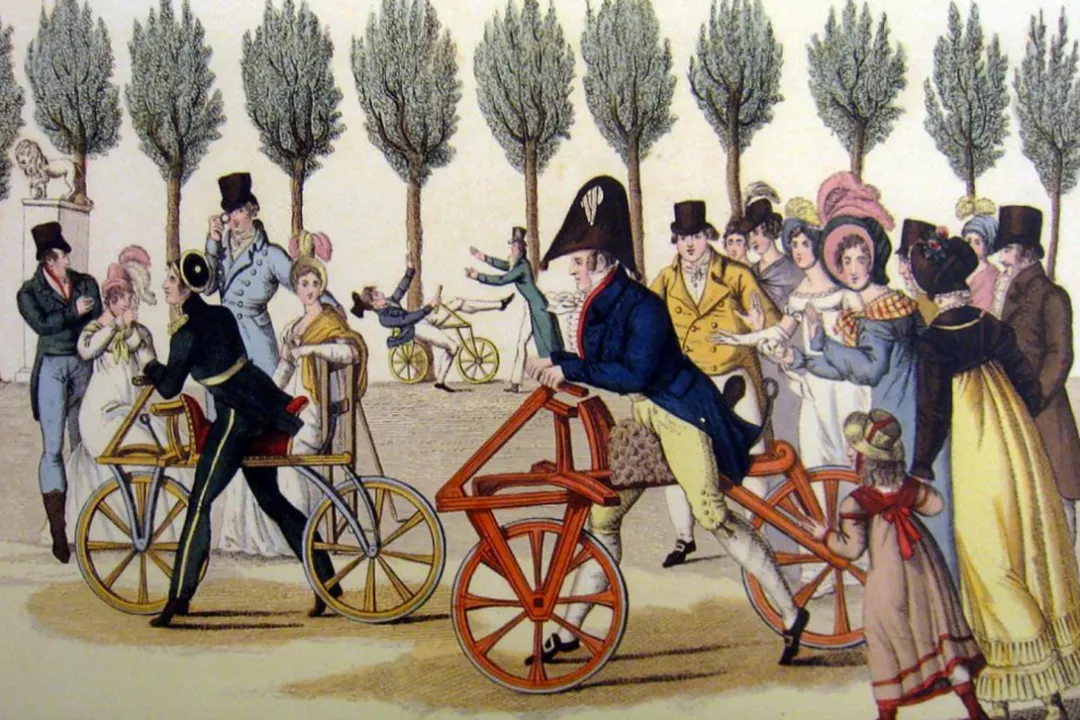
One of the earliest, most romanticized contenders for the title of "first bicycle" is the célérifère, often dated to around 1791 and attributed to a Frenchman, the Comte de Sivrac. [1][2] This machine was supposedly a simple wooden frame connecting two fixed wheels, propelled by the rider pushing their feet along the ground, much like a modern balance bike. [2][4] While this story is frequently repeated and seems to place the origin firmly in France, historical scrutiny suggests it might be more national mythology than verifiable fact. [8] The attribution to Sivrac is highly disputed, and some historical accounts even dismiss the célérifère entirely as a fabrication dating from later periods, possibly created to claim the honor of invention for the French. [1][8][9] The célérifère, even if it existed as described, lacked a crucial element that distinguishes a true precursor from a mere two-wheeled contraption: steering. It was essentially a scooter, and its primary function may have been as an early form of exercise equipment or children's toy. [2][4]
# Steerable Runner
The first machine to introduce genuine mechanical advancement—the ability to steer—came from elsewhere, demonstrating that the initial spark for personal two-wheeled transport was not purely French. This development is credited to the German Baron Karl von Drais in 1817. [1][9] His invention, known as the Laufmaschine (running machine) or Draisine, improved upon the concept by incorporating a steerable front wheel. [4][7] This addition fundamentally changed the nature of the device; it was no longer just a seated hobby horse but a machine that required balance and directable movement. [7] The Draisine was propelled solely by the rider pushing off the ground, essentially gliding between steps. [6][9] While it lacked pedals, the Draisine is recognized as the first truly verifiable, steerable, two-wheeled vehicle powered by a human. [7] The existence and design of this German machine provide important context, showing that the concept of a pedal-less "running machine" was established on the continent before the next great leap occurred.
It is fascinating to compare the mechanical simplicity of the rumored célérifère with the established engineering of the Draisine. The célérifère, as popularly imagined, was a fixed axle design, demanding constant foot-to-ground contact, which might make long-distance travel exhausting and inefficient. [2] In contrast, Drais’s steerable linkage, though primitive by modern standards, allowed for longer glides and a more focused requirement on balance over brute force propulsion. [4] This distinction highlights that early development wasn't a single leap but a series of necessary, incremental engineering corrections: first, two wheels in line; second, the ability to steer that alignment. [7]
# French Pedal Innovation
The true moment that separated the bicycle from its ancestors—the moment it became something recognizable as our modern machine—occurred in the 1860s, and this is where France reclaims the center stage of the story. [3][6] Several sources credit the French inventors Pierre Michaux and Pierre Lallement with the breakthrough of attaching cranks and pedals directly to the front wheel hub. [3][6][7][9] Lallement, a Frenchman working in the United States later, is often credited with the initial concept, but Michaux and his company were instrumental in commercially developing and popularizing the resulting machine, the vélocipède. [3][7]
This new design—the vélocipède—is considered by many historians to be the first machine that fully merits the title "bicycle" because it allowed for continuous propulsion without the rider's feet touching the ground. [6][8] Since the power was applied via the pedals, the design could then evolve toward larger wheels (like the Penny-Farthing) to achieve greater speed, something that was fundamentally limited on the ground-pushing Draisine. [1] Because of this addition of direct mechanical drive, the French contribution in the 1860s was transformative, setting the machine on the path to modern cycling. [3][9]
# Naming and Materials
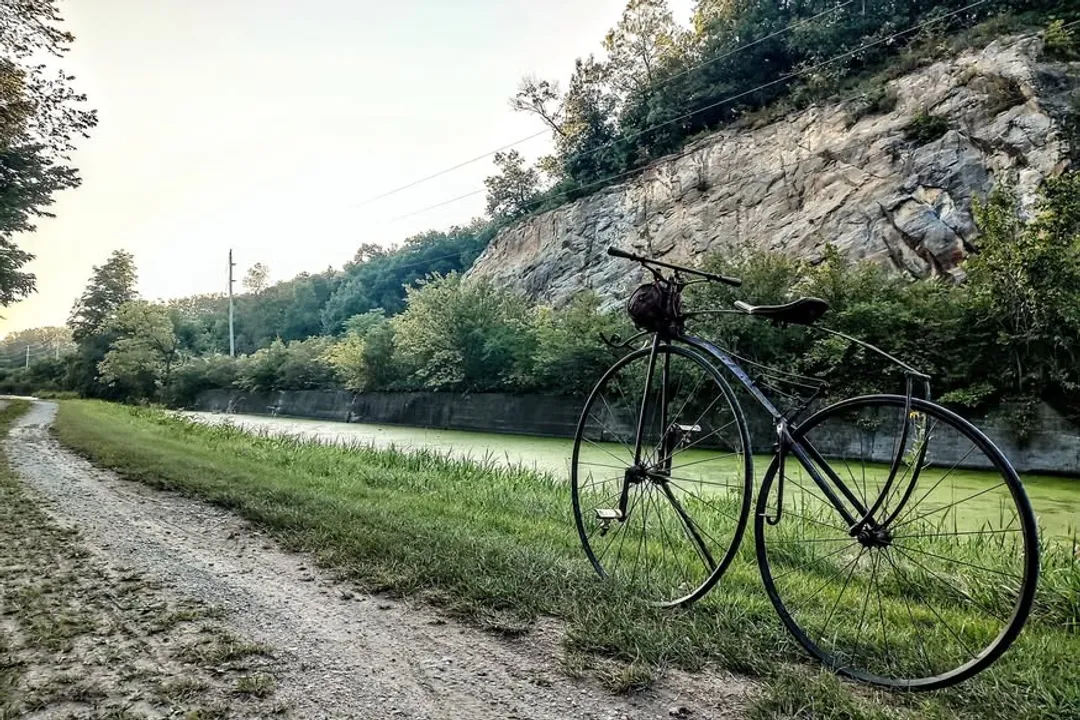
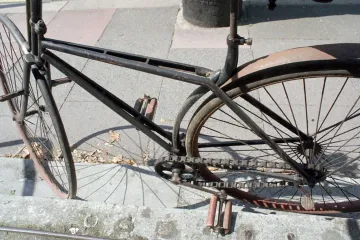
The popular name for these early pedal-driven machines in France was the vélocipède. [4][7] Unfortunately, the ride quality was notoriously poor on the cobbled streets of the era. The rigid wooden frames and iron-tired wheels earned the vélocipède the enduring nickname of the "boneshaker". [7] This name underscores the very real mechanical discomfort inherent in early cycling technology, a consequence of the materials available at the time. [7] While the French had solved the propulsion problem, the suspension problem remained unsolved, creating a new set of challenges for subsequent inventors across Europe. [1]
# The Evolution Continues
While the 1860s vélocipède was arguably the first true bicycle, it was far from the final product. The inherent danger and instability of having the cranks attached directly to the steering axle led to designs that favored a massive front wheel for speed—the high-wheel bicycle, commonly known as the Penny-Farthing. [1] This design carried the rider high above the driving wheel, which presented significant fall risks. [1]
The story eventually moves away from France and towards Great Britain for the next major paradigm shift. In 1885, John Kemp Starley introduced the "Rover Safety Bicycle". [1] This design utilized a chain drive to power the rear wheel, allowing both wheels to be nearly equal in size and placing the rider between them. [1] This configuration drastically lowered the center of gravity, making the bicycle safer, more stable, and accessible to a much wider population, cementing the design principles we still use today. [1]
# National Narratives
The debate over invention, particularly when examining the célérifère versus the Draisine versus the vélocipède, provides a curious case study in how national pride shapes historical memory. It appears that the desire to claim the bicycle as a national invention is strong in several countries. [8] The célérifère story, which places the invention in France decades before Drais, serves as a powerful, albeit likely inaccurate, cultural touchstone intended to assert French primacy in transport innovation. [8][9] This tendency to attribute foundational inventions to one's own countrymen, even with shaky evidence, is common across historical narratives.
When we weigh the evidence, we see a pattern: The German Baron Drais provided the steerable frame; [7] the French inventors provided the pedal drive; [3] and the British inventor Starley provided the safe chain-drive configuration. [1] If one prioritizes the first demonstration of steering, the credit leans toward Germany. If one prioritizes the first machine that could be continuously driven without feet on the ground, the credit firmly points to France in the 1860s. The lack of steering on the célérifère relegates it to the status of an interesting but ultimately superseded concept, perhaps best viewed as an early conceptual sketch rather than an engineered ancestor. [4]
To put this in perspective, consider the functional difference: Imagine trying to teach a novice rider on both. On a Draisine, the rider must perfectly coordinate their pushing rhythm with their balancing reflexes, requiring continuous physical contact with the ground. On a vélocipède, the rider can achieve a moment of true coasting after starting, allowing them to focus purely on steering and balance while the pedals maintain momentum. [6] This shift in required rider input is the essential difference between a simple propulsion aid and a true vehicle. The French inventors mastered that critical mechanical link.

# Key Milestones Summary
To clarify the international contribution to the modern bicycle, it is helpful to organize the primary mechanical additions chronologically and geographically:
| Feature Added | Date (Approx.) | Inventor/Origin | Significance |
|---|---|---|---|
| Two in-line Wheels (Non-Steerable) | c. 1791 (Disputed) | Comte de Sivrac (France?) | Conceptual predecessor (Célérifère) [1][2] |
| Steerable Front Wheel | 1817 | Karl von Drais (Germany) | First true, steerable two-wheeler (Draisine) [7][9] |
| Pedals Attached to Front Axle | 1860s | Michaux/Lallement (France) | First continuously driven machine (Vélocipède) [3][6] |
| Chain Drive to Rear Wheel | 1885 | John Kemp Starley (Britain) | Modern safety, equal wheels (Safety Bicycle) [1] |
This table clearly shows that no single nation invented the bicycle entirely; rather, it was a relay race of innovation spanning nearly a century across three different countries. [1][3][7] The bicycle, as we understand it today, is a composite of these essential advancements.
# Practical Understanding of Invention
For a contemporary rider preparing for a long-distance tour, understanding the historical progression reveals something about design philosophy. The early focus on propulsion—whether by foot or by pedal—often overshadowed safety and comfort. The French vélocipède was a breakthrough in power transfer, but the next challenge, ergonomics and stability, was solved by the British design focusing on wheel size and drivetrain. When we see a modern bicycle, we are seeing a direct descendent of Starley’s safety bicycle, but its ability to move continuously is a direct legacy of the Parisian workshops of the 1860s. The sheer difficulty of early riding—the jarring impact of the boneshaker—might have stifled adoption if not for the fact that the French invention provided a clear performance advantage over the ground-pushed Draisienne, incentivizing riders to endure the discomfort for the sake of speed and continuous motion. [7] This illustrates that invention isn't just about creating a solution, but creating a solution better than the existing standard, even if the final refinement is years away.
In summary, while France did not invent the very first two-wheeled concept, nor did it invent the final, safe iteration, the invention of the pedal-driven vélocipède in the 1860s represents the most significant step in turning the concept of personal two-wheeled transport into a bicycle in the functional sense. [3][8] The question of invention is thus answered with nuance: The idea is debated, the steerable machine is German, but the pedaled bicycle is fundamentally a French achievement. [1][7]
Related Questions
#Citations
History of the bicycle - Wikipedia
Inventing the Bicycle, Part 1: The Horseless Carriage and Celerifere ...
Tour de truth: bicycles with pedals were invented in France
The history of the bicycle - BnF / CNAC
Pierre Lallement Day: Invention of the Velocipede (Bicycle) on ...
History of Bicycle Invention From Pedal to E-Bike - Velotric
The Development of the Velocipede | Smithsonian Institution
A Monumental Travesty - Adventure Cycling Association
Who invented the Bicycle? - Pierre Michaux or Pierre Lallement?