Why is the submerged MBR configuration often favored for its spatial efficiency in treatment plants?
Answer
It removes the need for a separate large settling tank by integrating separation into the reactor
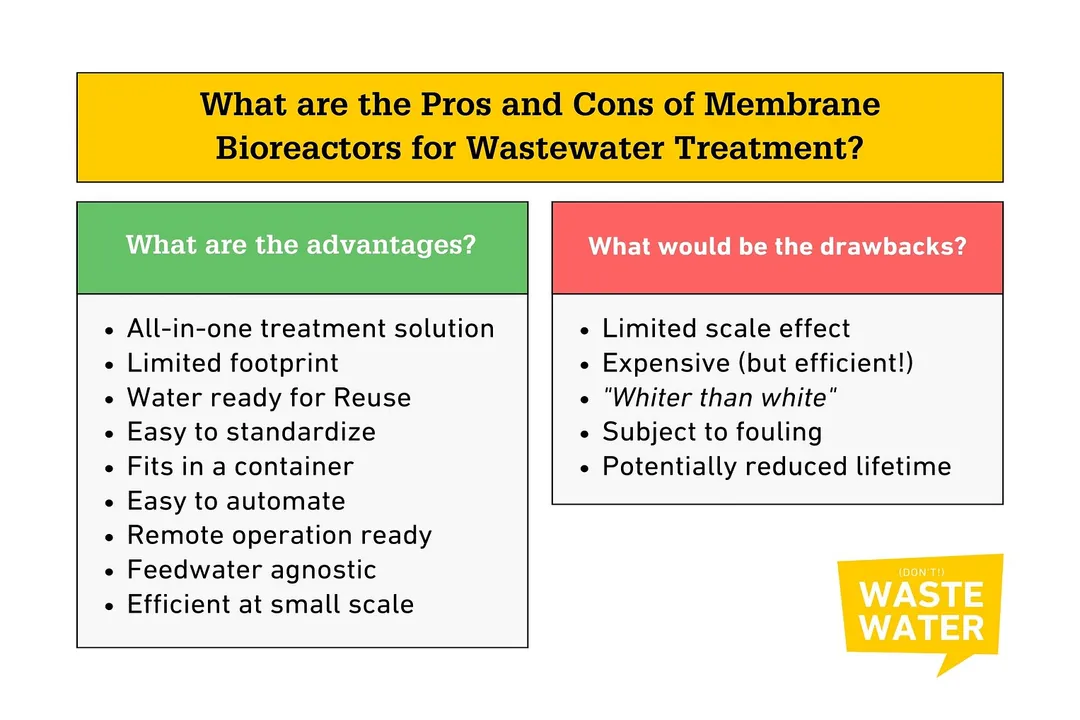
Submerged MBR systems provide significant footprint savings compared to conventional wastewater treatment plants because they combine the biological treatment and physical separation stages within a single vessel. By replacing the traditional large secondary settling tank with membrane filtration inside the aeration tank, engineers can design more compact treatment facilities that still produce high-quality effluent, making the technology highly advantageous in space-constrained locations.
Related Questions
Who filed the initial patents in 1969 suggesting the integration of membrane technology with biological processes for water treatment?What specific component did Dr. E. R. Hall and D. T. Thomas incorporate into their 1974 water treatment process patent?Which scientist is recognized for developing the submerged MBR configuration by placing membrane modules inside the aeration tank?What mechanical action in submerged MBR systems helps keep the membrane surface clean and prevents fouling?What significant advantage does an Anaerobic Membrane Bioreactor offer compared to traditional aerobic systems?How does the operational mechanism of an external MBR system differ from a submerged MBR design?Which specific advancement was essential for the commercial success and maturation of MBR systems?In 1989, which individual filed a patent for a submerged MBR system, contributing to the refinement of the technology?What did P. J. A. Gorzala and others describe in their 1992 system?Why is the submerged MBR configuration often favored for its spatial efficiency in treatment plants?