Who invented membrane filtration?
The concept of separating components in a liquid mixture by passing it through a barrier is ancient, yet the invention of membrane filtration as we understand it today—a precise, pressure-driven science—is less a single moment and more a confluence of discoveries spanning centuries. Long before modern polymers and high-pressure pumps, humanity sought cleaner water through simple physical barriers. The Ancient Egyptians, for example, relied on woven papyrus baskets or porous clay pots dating back to around 2,000 BCE to filter their water. Similarly, ancient Hindu cultures employed layered media like rocks, sand, and gravel for separation. Even the physician Hippocrates is credited with inventing a cloth sleeve filter for impurities in boiled water about 2,500 years ago.
# Nollet's Discovery
The scientific foundation for modern membrane separation was laid much later, concerning the phenomenon known as osmosis. In 1748, the French clergyman and physicist Jean-Antoine Nollet first successfully demonstrated this process in a laboratory setting. Nollet used a pig's bladder as his semi-permeable membrane to show that solvent molecules could selectively move from a liquid with a lower solute concentration into one with a higher solute concentration. This movement, driven by natural osmotic pressure, continued until a dynamic equilibrium was established across the membrane. While experimentation continued sporadically, the study of osmosis remained largely academic for the next two centuries, a fascinating curiosity rather than a tool for large-scale engineering. Around the same time in the early 17th century, Sir Francis Bacon experimented with passing seawater through multiple layers of sand in an early attempt at desalination, linking this early separation work to the burgeoning Industrial Revolution.
# Colloid Chemistry
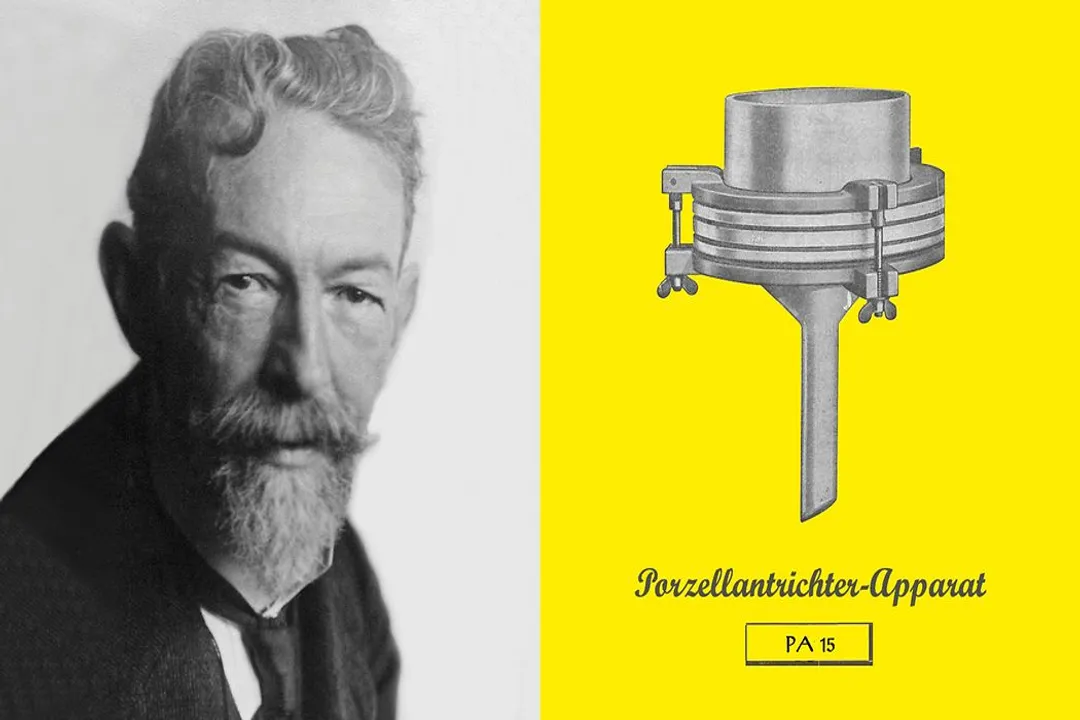
The true dawn of membrane filtration as a technology with defined separation capabilities arrived through the specialized field of colloid chemistry. The Austrian scientist Richard Zsigmondy focused his research on these minute particles or droplets, often on the micro- and nanometer scale, dispersed within another medium. His work led to the invention of the ultramicroscope in collaboration with Henry Siedentopf in 1903, allowing him to visually detect these previously invisible colloid particles.
The critical step in membrane technology, however, came when Zsigmondy turned his attention to separating these tiny entities. Starting around 1918, while at Göttingen University, Zsigmondy, alongside his colleague Wilhelm Bachmann, developed a method to manufacture synthetic membrane and ultrafine filters where the pore sizes were explicitly defined and reproducible. This was a significant departure from previous reliance on natural, inconsistent materials like wool or cotton. Zsigmondy’s ability to control this porosity earned him the 1925 Nobel Prize in Chemistry for demonstrating the heterogeneous nature of colloid solutions. Shortly after, in 1927, the pharmaceutical company Sartorius AG collaborated with Zsigmondy to establish Membranfiltergesellschaft (MFG), dedicated to the commercial production of these new membrane filters. These early filters, sometimes utilizing Cellulose Nitrate, paved the way for sterile filtration in food and medicine manufacturing, initially sold as flat discs.
# Pressure Reversed
While Zsigmondy’s work provided tools for separating microscopic particles, the breakthrough for large-scale water purification—the separation of dissolved salts—required reversing the natural osmotic process. This idea gained traction in the late 1940s driven by the US government's goal, spurred by the Kennedy administration, to find ways to desalinate seawater.
The key challenge was creating a synthetic membrane capable of rejecting dissolved solids while allowing water molecules to pass through under applied force. In 1959, Sidney Loeb at UCLA, working alongside Srinivasa Sourirajan from the National Research Council of Canada, achieved this by engineering the first functional synthetic RO membrane using a cellulose acetate polymer. They successfully pressure-forced water with high solute concentration through this engineered film, observing that only fresh water molecules passed through while NaCl (salt) and TDS were rejected. This technology worked in reverse of natural osmosis, hence the name reverse osmosis (RO).
# Synthetic Leap
The viability of RO was immediately hampered by flux (flow rate) issues until further chemical innovation refined the membrane structure. A significant advancement came from John Cadotte of the FilmTec Corporation, who discovered that superior membranes with particularly high flux and low salt passage could be manufactured through a process called interfacial polymerization involving m-phenylenediamine and trimesoyl chloride. This specific chemical process became the foundation for almost all commercial RO membranes used today.
The first large-scale application of this refined technology occurred in 1977 when Cape Coral, Florida, became the first U.S. municipality to adopt RO on a commercial scale, initially treating 3 million gallons of water per day. This success demonstrated that the dream of large-scale, affordable seawater desalination was finally becoming a reality.
# Mechanism Divergence
It is important to distinguish the mechanics of RO from what is often considered traditional membrane filtration, such as microfiltration. In standard filtration, the primary mechanism is straining, or size exclusion, where the pores are 0.01 micrometers or larger, theoretically allowing for perfect efficiency based on size alone, regardless of pressure or concentration.
RO, conversely, operates in a category known as hyperfiltration, removing particles larger than approximately 0.2 nm. The mechanism here relies less on simple sieving and more on solvent diffusion across a membrane that may be technically nonporous or use nanofiltration structures. The separation in RO is determined by differences in the solubility or diffusivity of the solute and solvent within the membrane material, making the process critically dependent on applied pressure and solute concentration. This subtle but crucial difference—switching from physical straining (Zsigmondy's domain) to diffusion across a selective barrier (Loeb/Sourirajan's domain)—marks a major evolution in separation science. Furthermore, early membrane materials like cellulose acetate were sensitive to chlorine, necessitating pre-treatment steps to protect the membrane, whereas newer thin-film composite membranes break down from chlorine exposure, requiring carbon pre-filters.
# Modern Challenges
The historical trajectory shows a continuous quest for finer separation and greater efficiency. Today, RO is indispensable across numerous sectors, from boiler feedwater preparation in industry to food concentration and large-scale desalination. However, the efficiency trade-offs continue to drive research. For instance, RO systems used for household drinking water purification often generate substantial waste; these units can discharge between 3 to 25 liters of wastewater for every single liter of treated water produced, which has led to regulatory scrutiny in water-scarce areas like Delhi. Addressing this waste and improving energy use remains a focus.
Contemporary research aims to overcome the limitations of current thin-film composite polyamide membranes. Scientists at institutions like UCLA are developing techniques such as Thin-Film Liftoff (T-FLO) to fabricate membranes using advanced materials like carbon materials or metal-organic frameworks which promise better performance but were previously difficult to scale. The T-FLO method involves casting the active filtration layer first on a stable substrate (like glass or metal) before adding the supportive layer, allowing the active layer to be treated with harsh chemicals or heat without damage—a clear improvement over casting the active layer onto a pre-existing support. Successful application of these next-generation materials could potentially increase membrane permeability by 30–40% by ensuring flow uniformity, opening the door to filtration processes currently impossible in industrial settings, such as efficient capture of gases like . This ongoing innovation confirms that the question of "who invented" membrane filtration is answered not by a single name, but by a succession of inventors who solved the problems of their time, moving from woven reeds to precisely engineered polymer films driven by pressure.
Related Questions
#Citations
The History of Industrial Filtration
Richard Zsigmondy and the Origins of Sartorius Filtration Technology
[PDF] A History of Sterile Filtration - ResearchGate
Reverse osmosis - Wikipedia
History of Reverse Osmosis | When Was RO Discovered
History of Reverse Osmosis Filtration - APEC Water
Aug 20, 2019 | Technique could make better membranes for next ...