What specific waves do modern Earthquake Early Warning systems detect to issue alerts?
Answer
Primary waves (P-waves)
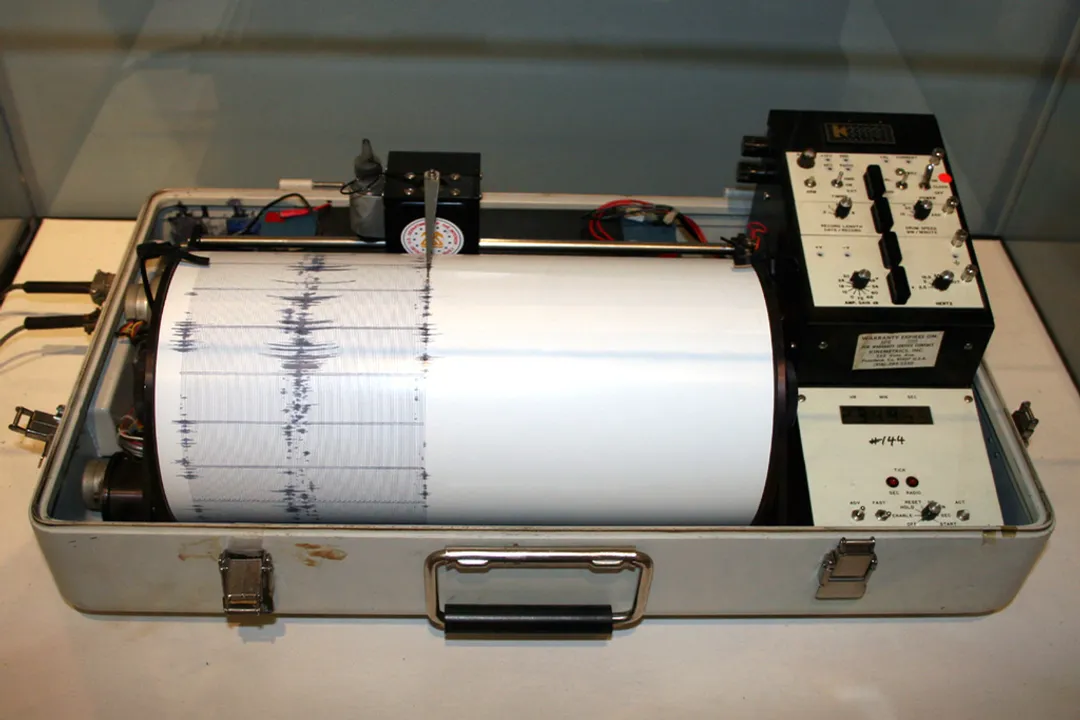
Earthquake Early Warning systems operate by analyzing the physics of seismic wave propagation. Earthquakes release two main types of waves: P-waves (primary waves) and S-waves (secondary waves). P-waves travel much faster than S-waves, which are the more destructive ones. By detecting the arrival of the faster P-waves at a sensor network, the system can calculate when the damaging S-waves will arrive at a specific location, providing a brief window for protective action.
Related Questions
Who is credited with inventing the worlds first seismoscope in ancient China?What animals adorned the bronze seismoscope created by Zhang Heng?How did Zhang Heng's seismoscope indicate the direction of an earthquake?What was the primary limitation of Zhang Heng's seismoscope compared to modern seismographs?What specific waves do modern Earthquake Early Warning systems detect to issue alerts?Why do modern Earthquake Early Warning systems use specific magnitude thresholds?What is the recommended immediate action upon receiving an Earthquake Early Warning alert?Around what year was Zhang Heng's seismoscope introduced?How does the primary purpose of Zhang Heng's seismoscope differ from modern EEW systems?What makes S-waves (secondary waves) distinct from P-waves in the context of earthquake detection?