Who invented earthquake alarms?
The concept of knowing an earthquake is happening, or is about to happen, stretches back deep into human history, long before sensitive electronic sensors existed. While today we rely on complex networks and algorithms for alerts, the very first instrument designed to announce seismic activity belongs to the ingenuity of ancient China, nearly two millennia ago. This early warning mechanism wasn't an electronic alarm in the modern sense, but rather a marvel of mechanical engineering credited to the polymath Zhang Heng.
# The Inventor
The honor of inventing the world's first seismoscope—a device to detect and indicate the direction of an earthquake—is widely attributed to Zhang Heng, a Han Dynasty scholar, mathematician, inventor, and astronomer. Born in AD 78 and passing away in AD 139, his creation is believed to have been introduced around AD 132. This places his invention almost 2,000 years before many modern advancements in seismology took hold.
What makes Zhang Heng's contribution so remarkable is that it achieved a function that modern systems strive for: indicating where the seismic event originated, not just that shaking occurred. While sources might debate whether this device truly recorded the tremor data in a lasting, graphical sense—a capability that evolved much later—it certainly acted as an effective, early alarm. The device was reportedly used to detect an earthquake occurring hundreds of miles away near the city of Longxi.
# Dragon Mechanism
The description of Zhang Heng’s seismoscope reads more like an elaborate piece of art than scientific equipment, capturing the imagination in a way that purely functional modern devices rarely do. The device was essentially a large, bronze vessel, shaped like a wine urn. It was an indicator designed not just for scholars, but to be seen and understood by the general populace.
The outer surface of this bronze vessel was adorned with eight dragon heads facing the cardinal and intercardinal directions—North, South, East, West, Northeast, Northwest, Southeast, and Southwest. Positioned directly beneath each dragon's mouth was a corresponding bronze toad, squatting with its mouth open.
When an earthquake occurred, the mechanism inside the vessel would trip a lever. This lever action caused one of the eight dragons to drop a small bronze ball from its mouth. The timing of the drop signaled the event, and crucially, the direction the ball fell pointed toward the epicenter or the direction of the strongest shaking. When the ball dropped into the waiting mouth of the toad below, it supposedly created a loud sound—the alarm—alerting the inhabitants of the capital city that a distant tremor had taken place.
Imagine the scene: a massive, ornate bronze urn sitting in a courtyard. Suddenly, a dragon's mouth opens, releasing a ball that clatters into a toad’s open jaws, announcing a geological event happening far away. This mechanical sequence is a profound demonstration of early expertise in interpreting physical phenomena and translating it into a functional warning system.

# Detection Versus Recording
It is important to draw a distinction between what Zhang Heng's device did and what later instruments were developed to do. Zhang Heng’s seismoscope was an indicator—a device that signaled the occurrence and inferred the direction of an earthquake. Its success was its ability to sound an audible alarm and visually indicate directionality.
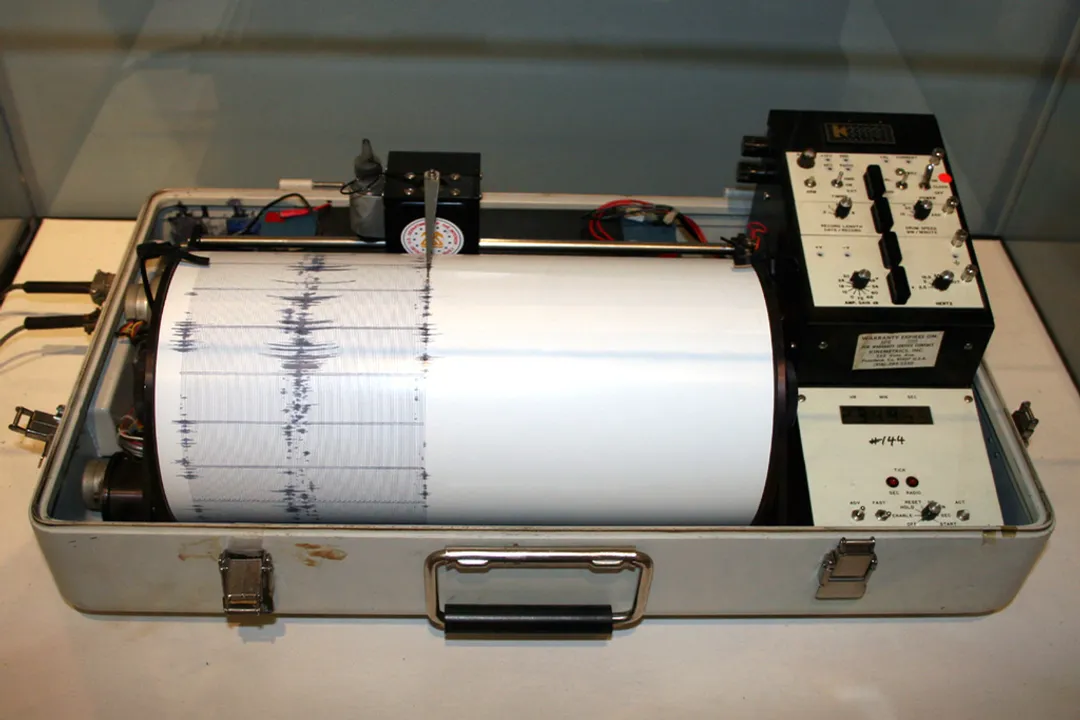
In contrast, the evolution of seismology required instruments that could record the motion of the earth in a quantifiable way. While Zhang Heng's device was mechanical and auditory, later innovations focused on creating a permanent trace of the shaking. For example, instruments like the Wiechert seismograph, developed much later in history, used a pen resting on a rotating drum of paper to create a seismogram—a visual record of the wave amplitudes and arrival times. This recording capability is what truly advanced seismology, allowing scientists to study the nature of seismic waves, but Zhang Heng provided the alarm component first.
A useful way to frame this historical progression is by considering response capability. Zhang Heng’s alarm provided immediate, directional knowledge, perhaps allowing officials hundreds of miles away to mobilize aid or prepare for delayed effects, assuming the shaking was strong enough to trip the mechanism. Modern recording instruments, conversely, provide data crucial for scientific study and hazard mapping long after the event. The ancient device prioritized immediacy of notification over data fidelity.
# Modern Alerts
Fast forward nearly two millennia, and the fundamental goal remains: giving people warning. However, modern technology has moved from mechanical levers to networked digital sensors, resulting in Earthquake Early Warning (EEW) systems.
These modern systems are fundamentally different from Zhang Heng’s detector because they rely on the physics of seismic waves themselves. Earthquakes generate two primary wave types: the faster, less damaging P-waves (primary waves) and the slower, more destructive S-waves (secondary waves). EEW systems work by detecting the arrival of the P-wave at a sensor station near the epicenter. Because the S-waves and surface waves travel slower, the system calculates the impending S-wave arrival time and sends an alert ahead of them.
This provides a crucial, if often brief, window for action—sometimes seconds or up to a minute or two, depending on the distance from the epicenter. This is a direct comparison to the ancient system: Zhang Heng’s device responded after the ground shook at his location, confirming a distant event, whereas modern EEW systems predict the arrival of the major shaking based on P-wave detection.
When considering the utility of modern alerts, it’s interesting to reflect on the threshold Zhang Heng set. His device was triggered by a significant event requiring mechanical displacement. A modern system, however, is programmed with specific magnitude thresholds. For instance, a local alert system might only issue a warning if the detected P-wave suggests the ground motion at your location will exceed a certain level of acceleration, say . This programming is a necessary filter to prevent alert fatigue. If we were to try and mimic Zhang Heng’s system in the modern era without this digital filtering, we might be overwhelmed by the sheer number of tiny, harmless tremors that our sensitive modern seismometers detect daily, turning a warning system into background noise.
# Actionable Preparedness
While the history of detection is fascinating, for those living in seismically active zones today, the evolution of the alarm system points toward practical preparedness. Modern EEW alerts, even those providing only a few seconds of warning, are designed to prompt immediate action based on established protocols.
If you live in an area with an operational EEW system, understanding the local response protocol is more important than knowing the precise physics behind the P-wave detection. In many places, the immediate, automated response to an alert is to Drop, Cover, and Hold On. The time gained, even if short, is meant for securing yourself under sturdy furniture or against an interior wall, not for running outside or attempting complex maneuvers.
This highlights a crucial difference in public safety strategy stemming from the technology. Zhang Heng’s system was primarily an informational bulletin for officials about a past, distant event. Modern EEW systems are active safety prompts designed to interrupt current activity for immediate, protective action.
# Legacy of Early Warning
The creation of the seismoscope by Zhang Heng represents a crucial moment where humanity transitioned from merely surviving natural disasters to actively attempting to anticipate them. Though subsequent technological advancements—from mechanical tracing to digital sensing—have completely changed how we measure and warn about earthquakes, the core concept remains unchanged: mitigating tragedy through timely knowledge. The dragon and the toad may have been retired from official duty, but their legacy lives on in every modern seismic network that strives to provide a few precious moments of warning before the earth begins to roar..
Related Questions
#Citations
Ancient Seismometer - Chinese Historical & Cultural Project
The first earthquake detector was invented in China almost 2000 ...
Seismometer - Wikipedia
Ancient Chinese Seismometer Used Dragons and Toads
Ancient Chinese Earthquake Detector - Tsem Rinpoche
Glad You Asked: What is an Earthquake Early Warning System, and ...
What was the first instrument that actually recorded an earthquake?
Zhang Heng and the Incredible Earthquake Detector
Ancient Chinese Earthquake Detector Invented 2000 Years Ago ...