Why were the Montgolfier brothers important?

The names Joseph-Michel and Jacques-Étienne Montgolfier are eternally linked to the moment humanity first defied gravity by ascending into the sky using a lighter-than-air craft. These two brothers, papermakers by trade from Annonay, France, are recognized as the inventors of the hot air balloon, an achievement that fundamentally shifted human perception of what was possible above the earth. Their breakthrough in the late 18th century did more than just create a novel spectacle; it effectively launched the age of aviation, paving the way for all subsequent aerial exploration.
# Brothers' Background
Joseph-Michel and Jacques-Étienne Montgolfier were part of a large family involved in the paper manufacturing business in Annonay, France. Joseph, the elder, was described as the more thoughtful and imaginative of the two, often preoccupied with scientific endeavors, whereas Étienne, the younger, was more pragmatic and involved in managing the family’s paper mills. Their father, Pierre, had developed a new process for making fine, translucent paper, which provided the brothers with both a steady income and access to materials and an environment conducive to experimentation. This industrial background is telling; unlike many contemporary natural philosophers who worked purely in theory, the Montgolfiers approached their problem with the practical, iterative mindset of craftsmen.
# Heated Air Principle
The central mystery that captivated thinkers of the era was how to make objects float in the air. Some early researchers, like Professor Charles in Paris, were focused on using hydrogen gas, which was known to be lighter than air. However, the Montgolfiers arrived at their solution through simple observation related to their existing business.
The story goes that Joseph observed smoke rising from a fire used to dry paper in the paper mill. He noted that the smoke seemed to lift light scraps of paper with it. This observation led him to hypothesize that a specific component in the smoke—perhaps an unknown gas—was responsible for the buoyancy. He initially called this mysterious lifting agent gas montgolfier. Over time, they realized the effect was not related to the smoke itself, but rather the hot air created by the fire. The heated air, being less dense than the surrounding cooler atmosphere, provided the necessary lift. This simple, empirical discovery—that heating a large volume of air was the key—was the first significant step toward atmospheric flight.

# Initial Demonstrations
The brothers progressed quickly from theory to testable models. Their initial experiments, likely conducted in 1782, involved creating small fabric bags that they would inflate over a fire to see them rise. These early tests confirmed their hypothesis about the lifting power of hot air.
The scale of their demonstrations soon grew, moving from small models to public displays that captured significant local attention. A key early public demonstration took place in Annonay on June 4, 1783. For this event, they constructed a massive envelope made of paper and cloth, measuring about 39 feet high. When set alight underneath, this unmanned balloon successfully ascended to an estimated height of 6,000 to 10,000 feet, traveling an unknown distance before landing. This successful flight proved the concept publicly and provided the credibility needed to seek royal attention in Paris.
It is worth noting the lingering confusion regarding the lifting agent even after these early trials. While the Montgolfiers correctly identified the role of hot air, contemporary scientific circles, heavily influenced by Antoine Lavoisier, were more interested in understanding true gases like hydrogen. The spectacle of fire and smoke surrounding the Montgolfier ascents contrasted sharply with the cleaner, more theoretical approach favored by established chemists.
# Animal Ascent
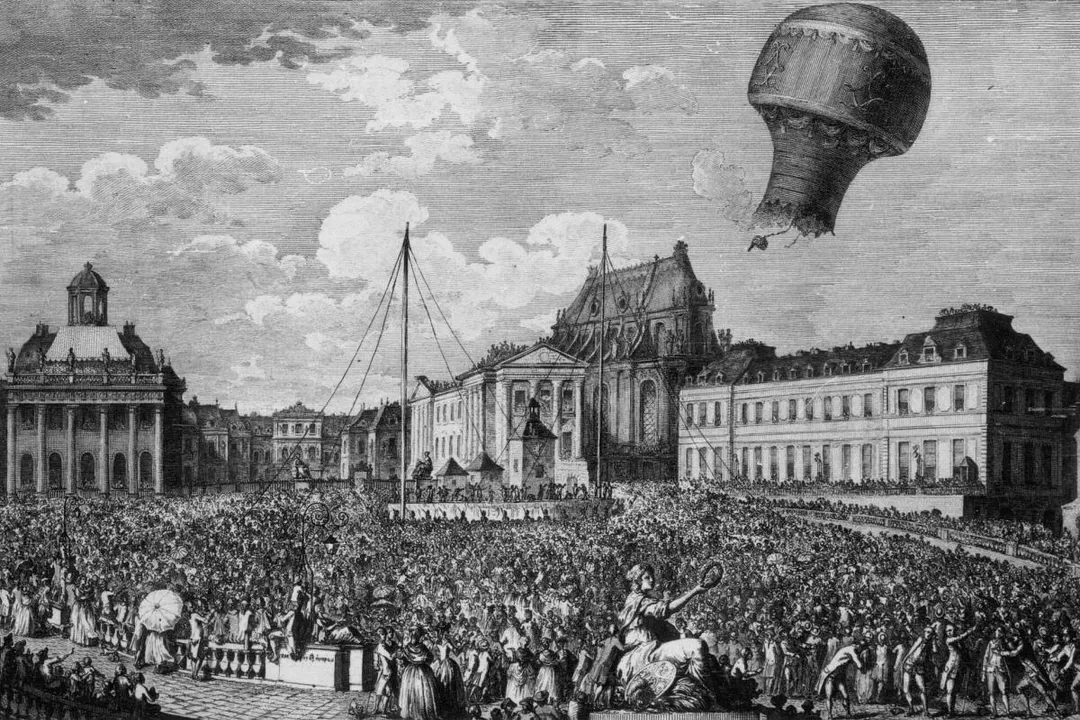
To gain more confidence and perhaps to appease skeptics who questioned the safety of sending a person aloft in an open-air fire contraption, the Montgolfiers planned a demonstration involving live cargo. This test was orchestrated in the presence of the King’s officials at the Palace of Versailles in September 1783.
On September 19, 1783, before King Louis XVI and Queen Marie Antoinette, the Montgolfiers launched their famous aeronautical passengers: a sheep, a duck, and a rooster. The balloon, which had a distinct appearance featuring painted suns and zodiac signs, carried its occupants to an altitude of about 1,400 feet, flying for approximately eight minutes. Upon landing safely, the animals were examined, and the sheep, in particular, was reported to be in good health, leading the observers to conclude that the atmosphere at altitude was breathable. This flight was a major step, showing the craft was stable enough to support life, even if the crew was not human.
# First Human Flight
Following the successful animal test, the next logical, and most perilous, step was to send a person up. The initial plan was for Étienne Montgolfier or the famous scientist Jean-François Pilâtre de Rozier to make the ascent, but the King issued an order that two condemned prisoners should be the first to fly, ensuring that if the balloon failed, no notable person would be lost. However, Pilâtre de Rozier successfully argued that he should go instead, ensuring the first flight would be made by a known volunteer.
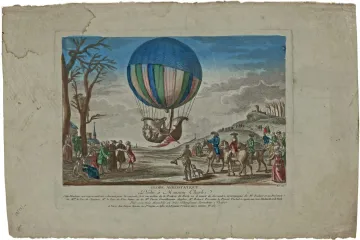
The maiden manned flight took place on November 21, 1783, launched from the Château de la Muette in the Bois de Boulogne, Paris. Pilâtre de Rozier was accompanied by François Laurent d'Arlandes. This flight lasted about 25 minutes, covering a distance of roughly 5.5 miles over Paris. The success of this voyage, witnessed by massive crowds, officially marked the dawn of human ballooning and secured the Montgolfiers' place in history.
If we examine the material constraints, the early balloons were essentially large bags of taffeta lined with paper. The total volume of the first manned balloon was approximately 22,000 cubic feet. An interesting logistical challenge they had to overcome was continuously feeding the fire beneath the open envelope while managing the descent—a necessity that dictated the design of early balloons, which often featured a circular opening at the bottom, rather than a fully sealed, gas-filled envelope. This empirical need for constant heat is a crucial distinction from later hydrogen or helium balloons. While hydrogen offered sustained lift without constant refueling, the Montgolfier method demanded active management of the heat source, turning the pilot into both navigator and fireman.
# Scientific Validation
While the Montgolfiers had achieved the feat through practical experimentation, the scientific community needed a more rigorous explanation, which often meant favoring the hydrogen-based approaches championed by scientists like Jacques Charles, who launched his first hydrogen balloon shortly after the Montgolfiers' success. Hydrogen balloons offered cleaner, sustained flight, whereas the Montgolfiers' reliance on fire made their craft spectacular but cumbersome for anything other than short trips.
However, the Montgolfiers' achievement was significant because it was demonstrable and repeatable by their own means. They provided the immediate proof of concept. The sheer scale of the spectacle served a purpose beyond mere entertainment; it forced the scientific elite to acknowledge that aerial navigation was physically achievable. The flights were closely observed, measured, and documented, providing essential data for the next generation of aeronauts, even those using different lifting agents. Their work inspired others, including Jacques Charles, who flew a hydrogen balloon in August 1783, though the Montgolfiers' manned flight in November preceded Charles’s later, more scientifically rigorous manned flight in December 1783.
# Lasting Importance
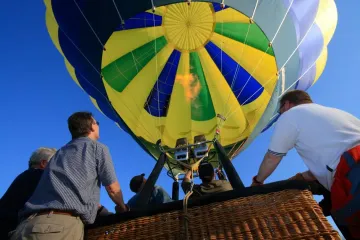
The importance of the Montgolfier brothers extends far beyond a single successful flight; they cracked the possibility of atmospheric flight. They established the basic architecture of the aircraft—an envelope to contain the lifting medium and a gondola or basket suspended below—which, in principle, remains unchanged in modern hot air balloons.
Their immediate impact was electrifying. The spectacle surrounding their flights in Paris created a sensation across Europe, demonstrating that science and engineering could achieve results once confined to mythology or fantasy. Furthermore, their initial use of fire-heated air as the lifting medium provided a simpler, more immediately accessible technology compared to the difficult and dangerous process of generating large quantities of pure hydrogen. This distinction highlights an often-overlooked aspect of their contribution: they provided the first viable path upward, accessible through relatively simple means available to skilled craftsmen, before the era of high-purity gas chemistry took over.
The legacy of Joseph-Michel and Jacques-Étienne is firmly rooted in the spirit of inquiry they embodied. They proved that innovation doesn't always require a doctorate in physics; sometimes, it requires careful observation of everyday phenomena, like smoke rising in a paper mill, followed by the persistence to scale that observation into a world-changing technology. Their work remains the foundational chapter in the history of human flight.
Related Questions
#Citations
Montgolfier brothers - Wikipedia
How the Montgolfier Brothers Helped Pioneer Aviation - History Hit
The first hot air balloon flight 19 September 1783 - Versailles
The History of Hot Air Balloons: When Were They Invented?
Joseph-Michel and Jacques-Étienne Montgolfier | Lemelson
Montgolfier Brothers | Smithsonian Institution
When Was The Hot Air Balloon Invented? Wild History
The Science and Spectacle of the First Balloon Flights, 1783
The History of Hot Air Ballooning and the challenge of the ...