What is the most important invention in the field of transport?
Determining a single "most important" invention in transport is a challenge because progress rarely happens in isolation; each advancement builds upon—or reacts to—what came before it. From simple rafts tied together on rivers to spacecraft reaching beyond Earth's orbit, the history of transportation technology is a story of ever-increasing efficiency and reach. Yet, if forced to choose the invention that most fundamentally altered human civilization by changing our concepts of distance, scale, and commerce, the argument must center on the harnessing of mechanical power for sustained, high-volume movement.
# Ancient Leaps
Before the industrial age reshaped the continents, the groundwork was laid by inventions that conquered basic physics. The earliest human transport relied entirely on muscle power—walking or using domesticated animals like horses, camels, or oxen. A fundamental shift occurred around 3500 BCE in the Mesopotamian region with the invention of the wheel. This simple yet profound concept dramatically reduced the energy needed to move heavy objects over land, eventually leading to ox carts and chariots. On water, early efforts involved rafts and dugout canoes, but the harnessing of wind energy through sails, noted around 3000 B.C.E. by Egyptians, provided the first non-human, non-current-dependent propulsion for travel. Later, advancements like the compass, invented in China around 1044, and improved shipbuilding techniques, which allowed European vessels to reliably cross oceans by the late 16th century, shrank the perceived size of the globe for explorers. These innovations made long-distance travel possible, but the pace remained tied to natural forces—wind, muscle, or water currents.
# Steam Power Age
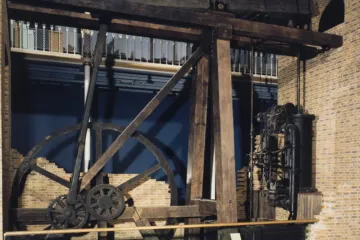
The true revolution—the one that decoupled movement from immediate, visible energy sources like wind or beasts of burden and tied it instead to scalable, stored energy—came with the mastery of steam. While the concept of a steam-powered model car dates back to the 1760s, the true foundation for modern mechanized transport was cemented by James Watt. Watt’s redesign of the steam engine in 1765 made it far more efficient and powerful than earlier models, allowing its application far beyond simply draining mines; it powered looms and mills, driving the Industrial Revolution.
The direct application of this power to transport manifested in the steam locomotive in the early 19th Century. Although earlier attempts at steam-powered road vehicles existed, the railway proved superior for mass movement. The opening of the Liverpool and Manchester Railway in 1830 is a critical inflection point. This line was the template for everything that followed: it was the first public transport system to operate without relying on animal traction for the main journey, featured twin tracks to allow simultaneous two-way travel, ran on a proper schedule, and included stations. This transition from sporadic horse-drawn carts to a scheduled, high-capacity mechanical network fundamentally changed how societies were organized. It allowed for the efficient movement of vast amounts of industrial materials—coal, ore, and manufactured goods—across nations, connecting urban centers in ways that transcended geography.
The steam engine’s impact was not just speed, but reliability and scale. Ships like the SS Great Western began regular transatlantic service via steam power in 1838. The system of synchronized time and track usage necessary for running a railway also demanded a new level of societal organization. In fact, the complexity introduced by the railways prompted Canadian engineer Sir Sandford Fleming to propose the division of the Earth into Time Zones in the late 1870s simply to manage schedules across vast distances. This railway infrastructure created the very framework of modern national economies, making the steam-powered train system arguably the most important catalyst for global connectivity and industrial capacity.
# Personal Mobility
While the train reorganized national commerce and industry, the next great wave of innovation targeted individual freedom: the automobile. Attributed to Karl Benz in the 1880s with his internal combustion engine vehicle, the car offered independence from fixed tracks and schedules. The invention itself was significant, but its democratization was the societal game-changer. This happened with Henry Ford’s refinement of the assembly line production method in 1913-1914 for the Model T. Ford’s innovation drastically reduced the time and cost to build a car, making personal vehicle ownership accessible to the masses.
The result was a societal restructuring known as the rise of the suburbs, as people could live further from their workplaces. Over a billion cars now exist worldwide, defining personal transportation in many cultures. Interestingly, the very popularity of the automobile created new transportation problems that required subsequent inventions to solve. For instance, the need to safely manage traffic flow in dense urban environments led to Garrett Morgan patenting the traffic signal, a critical safety addition for roads now choked with vehicles. Similarly, Percy Shaw's Cat's Eye Road Reflector was a direct reaction to the hazards of night driving on poorly marked roads, an issue inherent in a world reliant on personal cars. This dependency shows that the automobile’s importance lies not just in its engineering, but in the massive, complex infrastructure network it necessitated.
# Beyond The Horizon
Beyond ground travel, inventions opened up the vertical and global spheres. The Wright brothers achieved the first sustained, motor-driven flight in 1903. This paved the way for the jet engine, patented in 1932 by Frank Whittle, which ushered in the commercial jet age in the 1950s and made intercontinental travel a matter of hours rather than weeks. In the realm of logistics, the post-war era introduced another quiet but globally disruptive invention: standardized containerization. The entry into service of the Gateway City, the world's first purpose-built container ship in 1957, dramatically simplified the loading, unloading, and transfer of cargo between ships, rail, and truck, making modern global supply chains financially viable.
The late 20th and early 21st centuries have brought advancements focused on speed, automation, and environmental concerns. High-speed rail, like Japan’s Shinkansen starting in 1964, and magnetic levitation (Maglev) trains, which eliminate friction for incredible speeds, continue to push the limits of terrestrial travel. Simultaneously, the introduction of Global Positioning Systems (GPS) into everyday devices has made point-to-point navigation nearly effortless, a significant convenience innovation even if it doesn't move the vehicle itself.

# Final Assessment
If the criterion for "most important" is the creation of the fundamental mechanism for efficient movement, the Wheel stands alone as the prerequisite for all wheeled land transport. If the criterion is the enabling of personal, dispersed living and a massive societal overhaul, the Automobile driven by mass production is the answer.
However, the invention that most drastically and rapidly transformed economic scale, national integration, and the speed of the Industrial Revolution itself was the Steam Locomotive and the development of modern, scheduled railway systems it engendered. The railway network was the first technology to impose an artificial, mechanical structure onto the natural landscape that was both widespread and predictable, effectively creating the economic geography of the 19th and early 20th centuries. The ability to move thousands of tons of raw material to factories and finished goods to market on time, regardless of local weather or road conditions, was a quantum leap in human capability that arguably outweighs the subsequent revolutions in individual travel convenience. The integration of reliable, schedulable transport—the railway—was the engine of true mass industrial power.
Related Questions
#Citations
Top 10 Innovations in Transportation - GIMI
Timeline of transportation technology - Wikipedia
Transportation and Navigation Inventors and Inventions
Transport Inventions That Revolutionised Travel - GasanMamo
Logistics inventions that made history | KION GROUP AG
Transportation technologies | Research Starters - EBSCO