Who was the first robotic scientist?
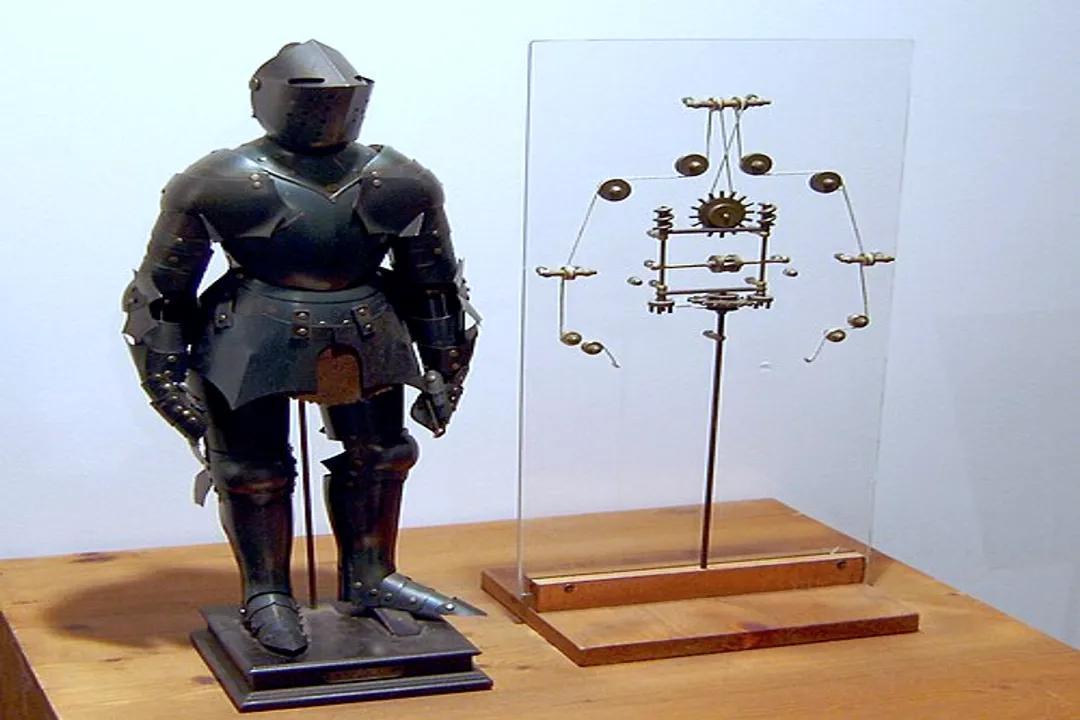
The search for the very first "robotic scientist" presents an immediate definitional challenge, as the journey from fictional concept to implemented automaton involves distinct figures across literature, engineering, and theoretical science. We cannot point to a single individual who simultaneously coined the term and built the first autonomous laboratory assistant. Instead, the title requires separating the origin of the idea from the origin of the machine, and then further distinguishing the inventor from the scientist who directs its use. [5]
# Coining Words
The word "robot" itself entered the global lexicon not through a laboratory, but through the theatre. [1] The term was introduced in 1920 by the Czech writer Karel Čapek in his science-fiction play, R.U.R., which stands for Rossum's Universal Robots. [1][5] Čapek did not invent the machine itself, but rather the concept of artificial, mass-produced workers. [5] The word he chose, robota, translates roughly from Czech as "forced labor," "drudgery," or "servitude," reflecting the initial bleak tone of his fictional creation. [1][5] While Čapek gave us the name, the actual engineering and scientific framework required for physical robots would take decades to materialize. [3]
# Ancient Ideas

Long before the 20th century, humans entertained the notion of creating artificial beings. Ancient myths and legends feature automatons and mechanical figures. [5] However, the modern concept of a robot—a complex, often programmable electro-mechanical machine—is tied directly to technological advances in electricity and information processing that were just beginning in the early 1900s. [3] Early theoretical work in cybernetics and automation laid the groundwork, but these were theoretical scientists and mathematicians, not typically the ones constructing the first hardware. [3]
# Industrial Fathers
When discussing the origin of practical robotics, the focus shifts decisively toward engineers and entrepreneurs who bridged the gap between concept and factory floor. In this arena, two names stand out as the founding fathers: George Devol and Joseph Engelberger. [7]
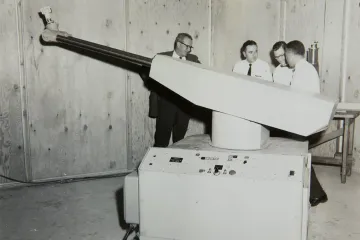
George Devol is credited with inventing the first digitally operated and programmable robot arm. [3][6] He filed a patent for this apparatus, which he called the Programmed Article Transfer device, and secured the patent in 1961. [3] Devol’s design provided the foundational method for controlling automated movements precisely. [6]
Joseph Engelberger, often cited as the Father of Robotics, took Devol’s invention and transformed it into a commercial reality. [4][7][8] Engelberger, with his vision for automation, co-founded the first robotics company, Unimation, with Devol. [7] Their creation, the Unimate, began work in 1961 at a General Motors die-casting plant in New Jersey, performing repetitive and hazardous tasks like stacking hot metal parts. [3][6] This installation is widely accepted as the dawn of the industrial robotics age. [3]
Engelberger’s contribution was perhaps more akin to a scientific evangelist and practical implementer; he possessed the foresight to understand the broad scientific and industrial implications of programmable manipulators, pushing them into new applications long after Devol had designed the core mechanics. [7]
# Distinguishing Roles
It is important to recognize the division of labor among these key figures. While Karel Čapek provided the defining linguistic artifact, his role remained literary. [1] Conversely, Devol was the inventor of the core hardware mechanism, the programmable controller that made the machine work reliably. [6] Engelberger, however, operated as the scientist-entrepreneur, driving the field forward by studying its potential applications and advocating for its acceptance in various sectors, even predicting future uses in medicine and space exploration. [7] This dynamic—where the visionary drives adoption while the engineer perfects the mechanism—is a recurring theme in technological progress. For instance, when considering the evolution of the robot arm specifically, it was Devol’s fundamental digital control concepts that enabled the later development of more complex, articulated arms used in modern settings. [6]
The transition from the Unimate’s simple pick-and-place operations to complex, adaptive systems involved countless other engineers and computer scientists, but Devol and Engelberger established the first successful industrial robot as a tangible entity. [3][7]
| Figure | Primary Contribution | Year/Context | Role Type |
|---|---|---|---|
| Karel Čapek | Coined the term "robot" in play R.U.R. | 1920 | Literary/Conceptual |
| George Devol | Invented the first digitally programmable robot arm (Unimate concept) | Patent filed circa 1954, granted 1961 | Engineering/Invention |
| Joseph Engelberger | Co-founded Unimation; promoted and commercialized industrial robotics | 1961 deployment | Scientific Application/Visionary |
# First Scientific Application
If the question is strictly "Who was the first robotic scientist?" meaning the first machine designed specifically to conduct scientific research autonomously, the answer shifts again, moving past the industrial pioneers of the early 1960s. [3] Early automated systems were designed to remove humans from dangerous or repetitive manufacturing tasks, not necessarily to generate new knowledge. [7]
The transition to scientific robotics required far more sophisticated sensing, feedback, and complex decision-making than early industrial arms possessed. [5] The first machines that could truly be called "robotic scientists" were likely sophisticated laboratory automation systems developed in the 1970s and 1980s. These systems often involved customized manipulators, sometimes based on repurposed industrial hardware, programmed to execute precise, multi-step laboratory protocols—such as sample handling, titration, or positioning in controlled environments—with minimal human intervention. [5] These early laboratory robots were the precursors to the sophisticated liquid-handling robots and automated screening systems we see in modern molecular biology labs today, where the robot itself performs the experiment and gathers data. [5]
These early lab automation experiments represent the birth of the scientific robot, distinct from the industrial robot. The focus moved from optimizing production throughput to ensuring experimental reproducibility and handling hazardous materials safely within a research context. [5] The scientists who designed these first custom laboratory rigs—often found within university engineering departments or specialized pharmaceutical research divisions—could arguably be the first to utilize a robot as a genuine research partner, rather than just a mechanical slave for lifting heavy objects. [5]
# Analyzing The Field's Beginnings
Looking back, the development path of robotics reveals a tension between theoretical modeling and physical realization. While Engelberger and Devol gave us the first functional hardware that looked like a robot and fit the cultural narrative, [7] the underlying theoretical science—how a machine perceives, reasons, and acts in an uncertain environment—was being developed concurrently by researchers at institutions like Stanford and elsewhere, often building on concepts like the early work of William Grey Walter and his simple autonomous beetles. [3]
The true scientific breakthrough wasn't just building a machine that could repeat a programmed motion, but building one that could adapt its motion based on sensory input, a concept that pushed the boundaries of early computer science and control theory. [3] The initial commercial success of the Unimate provided the financial impetus for further academic study, creating a feedback loop where industrial needs fueled scientific curiosity, and new scientific algorithms improved industrial performance. [7] Without the initial, relatively simple, programmable machine, the funding and interest necessary to develop the truly autonomous, intelligent systems that could act as "scientists" might never have materialized as quickly. [3]
Therefore, whether the "first robotic scientist" is the author who named the concept, the engineer who provided the first programmable hardware, or the researcher who first deployed a robot to execute a novel scientific procedure, the answer depends entirely on which facet of "robot" and "scientist" one prioritizes. The common thread is that each step required a convergence of literature, mechanical engineering, and nascent computer programming capabilities. [1][3]
Related Questions
#Citations
Robot - Wikipedia
Who Pioneered Robotics? - ThoughtCo
Robotics: A Brief History - Stanford Computer Science
History of Robots - Adelaide Robotics and Computer Science ...
History of Robots and Robotics | Origins of Robots - Robotnik
Inventor of the Robot Arm and Its Continued Development
From the Archives: The Evolution of Robotics - JHU Engineering ...
Brief history of robotics | Article Russian Robot - RusRobot
Who is the father of Human robot? - Quora