Who was the first American to design a steam-powered passenger locomotive?
The honor of designing and building the first steam-powered passenger locomotive in America belongs to Peter Cooper, a feat accomplished with his creation, the Tom Thumb, in 1830. This small, experimental engine was not just a novelty; it represented a crucial turning point, marking the beginning of domestically produced steam traction for passenger service on American rails, specifically for the Baltimore and Ohio (B&O) Railroad. Cooper's work was essential in proving that American ingenuity could successfully adapt and advance the technology that had previously been imported, largely from Great Britain.
# Early Rail Context
At the dawn of American railroading in the late 1820s, the concept of using self-propelled steam engines was met with considerable skepticism by the public and investors. Early American lines, such as the B&O, initially relied on horse power to haul passengers and freight. The few steam engines being tested or imported, like the John Bull, were essentially foreign designs being adapted, often with limited success on the often rudimentary American track infrastructure. There was a pressing need for a machine that was designed for American conditions—lighter, perhaps more adaptable, and certainly built on home soil to foster industrial independence.
Peter Cooper, already an established ironmaster and inventor, stepped into this engineering void. He was commissioned to build a working engine that could demonstrate the viability of steam over animal power on the B&O line. His creation, the Tom Thumb, was an attempt to achieve this goal within a tight timeframe and with limited prior American experience to draw upon for a complete locomotive design.
# The Design Effort
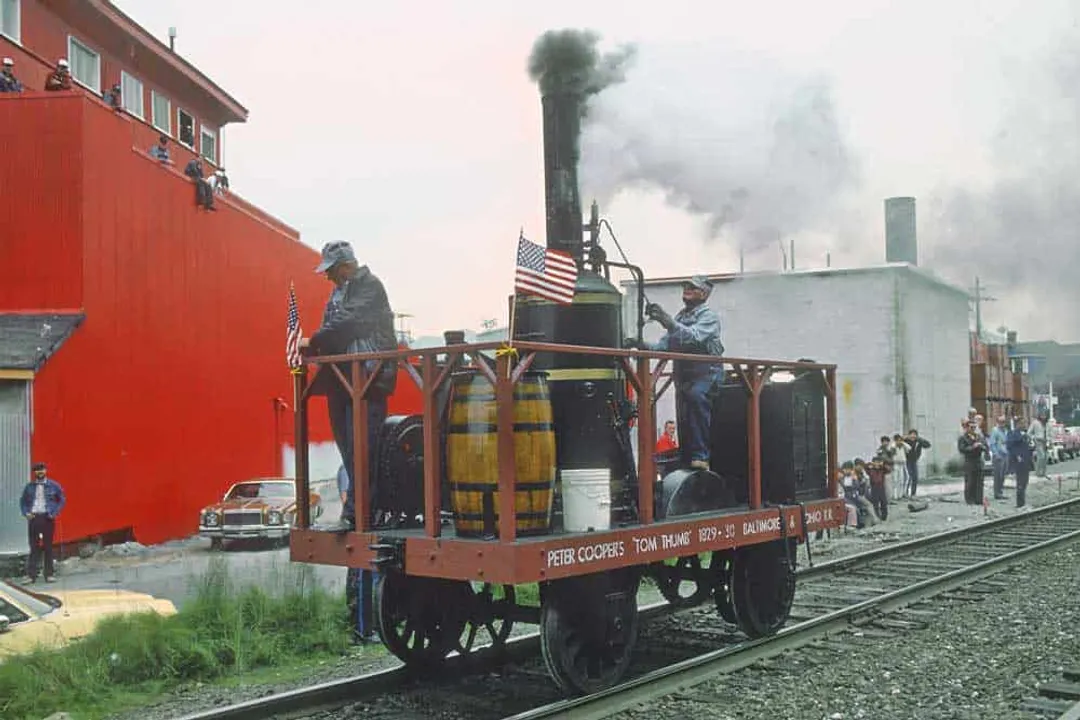
The Tom Thumb was a truly unique machine, reflecting the experimental nature of early American steam engineering. It was a very small, lightweight engine, which was a necessary compromise given the weight restrictions of the temporary tracks being laid down by the B&O. Unlike many later American designs that would feature horizontal boilers, the Tom Thumb incorporated a vertical fire-tube boiler. This was a significant design choice that positioned it distinctly apart from the standard locomotive architecture being developed simultaneously in Britain.
The engine featured four wheels, two of which were drivers, connected by rods to a crank mechanism. The power was transmitted from the steam cylinder to the driving wheels via a unique belt drive system connected to a pulley on the rear axle. This choice of a pulley-and-belt drive, rather than the more direct crank-and-rod linkage common on contemporary British engines, was one of the most discussed mechanical aspects of the Tom Thumb. Cooper was, in essence, testing multiple unproven concepts at once to see what would work under pressure. It was conceived as a demonstrator, not a long-term service engine, which explains its relatively brief life and its somewhat unconventional components.
Considering the early 1830s technological landscape, where metallurgy and precision manufacturing were still developing, Cooper's decision to rely on a vertical boiler speaks volumes about the rapid iteration required in American industry. While a horizontal fire-tube boiler, as seen in European counterparts, would become the standard for reliability, Cooper likely chose the vertical configuration because it was easier to construct quickly and perhaps less prone to catastrophic failure if the nascent boiler-making techniques proved insufficient for long horizontal shells. This period was less about adherence to established norms and more about immediate, functional proof-of-concept.

# First Passenger Haul
Once assembled at the B&O’s Mount Clare Shops, the Tom Thumb was ready to prove its worth. The historic first run, intended to carry passengers, took place in August 1830. The occasion was crucial: the B&O needed to show its investors and the public that steam traction was superior to the existing horse-drawn wagons.
The little locomotive successfully demonstrated its capability by hauling a small train of cars carrying spectators along the relatively short stretch of track available for testing. This initial success was a quiet but profound victory. For the first time, a locomotive designed and built in America was demonstrably pulling paying passengers, confirming the basic principles of steam power application on American soil. The engine showed it could maintain a respectable speed, proving the technology was sound enough to move forward with development, even if the immediate demonstration involved drama.
# The Famous Contest
The Tom Thumb is perhaps most remembered not for its success in hauling freight or passengers quietly, but for its legendary race against a horse. This contest became a highly publicized event designed to draw maximum attention to the new technology. The locomotive was pitted against a swift mare pulling a passenger carriage on the B&O line.
The race began well. The Tom Thumb, reportedly, quickly surged ahead of the horse, putting a significant distance between itself and its organic competitor. The small engine was proving its superior speed potential. However, the demonstration of American mechanical superiority was cut short by a component failure. Accounts differ slightly on the exact cause of the engine's eventual downfall, but the result was the same: the drive system failed. One prevalent story suggests that a piece of superheated metal, possibly a fragment of the piston rod, shot off and caused the critical leather belt connecting the engine to the axle to slip. Another account simply states that the pulley driving the axle slipped, losing traction. In any case, the horse quickly regained the lead and won the race to the destination.
While losing the race made for a sensational headline—the machine beaten by the horse—the event’s true significance lies in what preceded the failure. The Tom Thumb had run and pulled, and it had done so faster than the animal it was competing against, until the mechanical breakdown occurred. The failure itself was instructive, highlighting the immediate challenges in American locomotive construction: reliability, material stress, and drive train efficiency.

# Lasting Impact
Despite the anticlimactic finish to the race, the Tom Thumb achieved its primary objective: it convinced the B&O leadership that steam power was the future. Cooper's work demonstrated the potential for a domestic locomotive industry, even if the specific design proved too rudimentary for sustained commercial operation. The engine itself was short-lived; it was retired not long after its famous race, having served its purpose as a technological proof point.
The subsequent development of American locomotives, such as the DeWitt Clinton built a year later in 1831, quickly moved toward more robust, conventional designs, often utilizing horizontal boilers and direct rod drives that offered better power transfer and longevity. This illustrates a natural progression in engineering: the initial experimental model, like Tom Thumb, pioneers the concept, and subsequent models refine the known successful elements while discarding the weak links.
It is interesting to consider the market psychology at play. Had the Tom Thumb won the race flawlessly, investors might have expected every subsequent engine to be perfect and highly refined immediately. Because it failed publicly but proved the concept works, it may have subtly encouraged a more pragmatic, iterative approach to future designs—a tendency already present in American manufacturing—where proving fundamental feasibility precedes the pursuit of perfection. This early success, despite the mechanical hiccup, firmly established Peter Cooper as the father of American passenger steam locomotive design and paved the way for engineers like John B. Jervis who would refine the technology shortly thereafter. The legacy of the Tom Thumb isn't the victory in a race, but the undeniable, loud, and smoky demonstration that America would indeed be powered by its own steam engines.
#Videos
The First American Made Steam Locomotive - YouTube
Related Questions
#Citations
Tom Thumb (locomotive) - Wikipedia
Tom Thumb - The B&O Railroad Museum
Peter Cooper, the man who designed and built the first steam ...
The Evolution & History of Steam Locomotives
Tom Thumb, the First American-Built Steam Locomotive to Operate ...
The First American Made Steam Locomotive - YouTube
Tom Thumb, The Tiny Big Boy Relative | Steam Giants
04. Locomotives - Linda Hall Library