Who invented the pressure gauge?
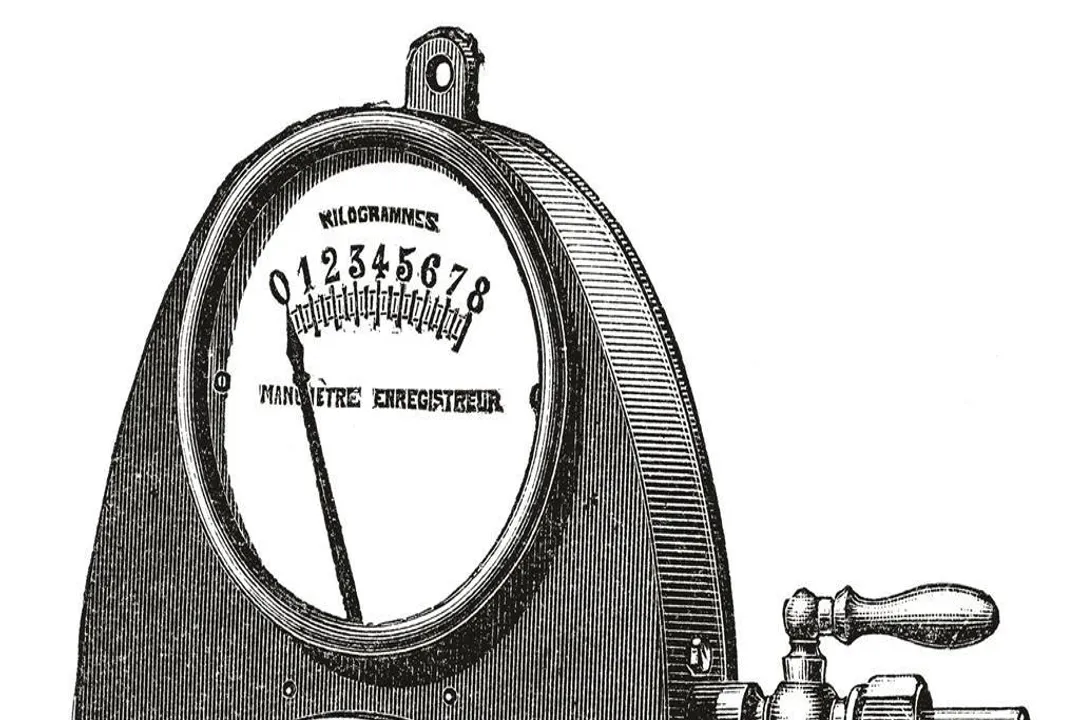
The creation of a device capable of accurately measuring the invisible force of pressure was a defining moment for the Industrial Revolution, shifting engineering from educated guesswork to reliable, reproducible science. While many earlier, often rudimentary, devices existed for gauging force, the true ancestor of the modern pressure gauge emerged from the workshop of a French engineer named Eugène Bourdon. [1][2] This invention was not simply an incremental improvement; it provided the necessary feedback loop to safely manage the high-pressure steam engines that were beginning to power factories and railways across the globe. [5]
# Inventor Named

The individual most widely credited with the invention of the recognizable pressure gauge that utilized a curved tube principle is Eugène Bourdon. [1][2] Bourdon, working in France, developed his breakthrough design around the year 1849. [2][4] His achievement lay in devising a mechanism that could translate the subtle, yet significant, internal pressure of a gas or liquid into a readable mechanical movement. [4] Prior to this, reliable, continuous pressure monitoring was a major safety concern, especially as boiler pressures increased to improve engine efficiency. [5] While there might have been earlier concepts or attempts to measure pressure using confined fluids, Bourdon patented a design that proved scalable and durable enough for widespread industrial adoption. [2]
# Tube Mechanics
The genius of Bourdon’s design is often described as beautiful in its simplicity. At the heart of the device lies the Bourdon tube, which is essentially a hollow, flattened metal tube bent into a C-shape. [2][4] When pressure is introduced into this hollow tube, the pressure acts on the inner walls. Because the tube's cross-section is flattened—making it slightly oval—the internal pressure attempts to force the tube into a more circular shape. [4]
This action causes the entire curved tube to try and straighten out, much like flattening a coiled garden hose causes it to resist the curve. This straightening motion, though small, is proportional to the internal pressure applied. [4] The end of the tube, which is sealed, is mechanically linked via a series of gears and levers to a pointer on a calibrated dial. [2][4] The movement of the pointer across the scale directly indicates the applied pressure.
When considering the industrial age, the sheer mechanical elegance of the Bourdon tube is striking. For instance, many early attempts at pressure measurement relied on balancing the unknown pressure against a known, often variable, weight (like a deadweight tester). Bourdon’s solution elegantly converted the linear force of pressure acting on the tube's cross-section into a rotational movement, a principle of mechanical advantage that is far more practical for a continuously operating machine than static equilibrium methods. [4][5]
# Patent Context
Bourdon filed for his patent in 1849. [2] The acceptance and subsequent use of his design marked a major step forward in process control and safety engineering. [5] The ability to see, rather than guess, the operating pressure meant that steam users could maintain optimal efficiency while critically avoiding the catastrophic failures associated with over-pressurization—a common danger in early steam technology. [5] Some sources indicate that while Bourdon is the recognized inventor of the curved tube principle, the refinement and commercialization of these gauges continued over the following decades, with later engineers perhaps developing more robust materials or more complex linkage systems. [2]
# Variations Emerge
While the C-shaped tube is the foundational element, the fundamental principle of converting internal pressure into mechanical deflection has been adapted over time. [7] After Bourdon established the benchmark, other mechanical gauges emerged, employing different methods to achieve the same goal. For example, some designs use a diaphragm or a bellows assembly instead of a single curved tube to sense pressure changes. [7] These alternative mechanical designs are often chosen based on the specific medium being measured (e.g., corrosive liquids versus dry gases) or the required pressure range. [7]
The crucial difference between these mechanical gauges—whether using a Bourdon tube, bellows, or diaphragm—and modern instruments lies in the output mechanism. Mechanical gauges provide a direct reading through physical linkage to a needle on a dial. [5]

# Gauge Evolution
The drive for greater accuracy, remote monitoring, and data logging eventually necessitated moving beyond purely mechanical readouts. [7] This led to the development of digital pressure gauges, which rely on electronic transducers that convert physical changes (like the deflection of a Bourdon tube or strain on a sensor) into an electrical signal. [7] These electrical signals are then processed and displayed numerically.
It's interesting to note that even as we discuss sophisticated digital sensors today, which often offer higher precision and easier integration with computer systems, the fundamental mechanical Bourdon gauge remains a staple in many less critical or harsher environments. This enduring presence suggests that its reliability, ruggedness, and inherent safety (as a failure often results in visible deformation rather than an electronic fault) offer tangible economic benefits that sheer electronic accuracy cannot always surpass in real-world industrial settings. [7] The basic physics demonstrated by Bourdon in the mid-19th century still provides a perfectly adequate solution for countless applications requiring dependable pressure indication. [4]
# Industrial Impact
The influence of Bourdon’s invention cannot be overstated when looking back at the era of steam power and early manufacturing. Before a reliable gauge, operators were forced to rely on empirical knowledge, watching the behavior of the machinery, or using relatively clumsy water columns for limited ranges. [5] The Bourdon gauge offered an immediate, quantitative reading that allowed engineers to standardize operations. This standardization was vital for safe scaling—if a process worked well at 50 psi in one factory, the gauge ensured the next factory could replicate that exact condition reliably. [5] Furthermore, the existence of these instruments allowed for the scientific study of fluid dynamics and thermodynamics under operational conditions, feeding back into better boiler and engine design throughout the latter half of the 19th century. [4] The historical documentation of early instruments, such as those found in museum collections, often showcases the transition from experimental apparatus to a standardized, mass-produced tool designed for daily use. [8]
Related Questions
#Citations
Eugène Bourdon - Wikipedia
Eugene Bourdon and the History of the Bourdon Gauge - WIKA blog
Pressure Gauges: History, How They Work, Calibration ...
Bourdon's pressure gauge | Opinion - Chemistry World
The Gauge and its History | Blanes Pressure Solutions | South Africa
Bourdon pressure gauge - Stressman Engineering AS
The Evolution of the Digital Pressure Gauge
Bourdon-Type Steam Gauge – ca 1860
History of the Bourdon Tube and Pressure Gauges | ITI UK