Who invented wearable blood pressure monitors?

The desire to track vital statistics outside of a clinical setting has driven medical technology forward for decades, and blood pressure monitoring is a prime example of this evolution. While the concept of a personal, always-on blood pressure monitor seems like a recent development, its roots trace back through significant advancements in measurement science, starting long before modern digital sensors existed. Understanding who deserves credit for the wearable device requires looking at the foundational inventors who made any non-invasive measurement possible, and then examining those who miniaturized and automated that process for daily use. [2][7]
# Initial Measurement

The very first steps toward modern non-invasive blood pressure measurement were taken around the turn of the 20th century. The critical breakthrough involved the development of the sphygmomanometer, the instrument that uses an inflatable cuff. [2] Before this, physicians relied on invasive methods, which were clearly unsuitable for routine or personal tracking. [7] The core technique that became the gold standard involved listening for the distinctive sounds, known as Korotkoff sounds, in the artery as cuff pressure was released. [2]
The development of the manual sphygmomanometer is often credited to Scipione Riva-Rocci, who introduced his device using an arm cuff around 1896. [2] This early apparatus was cumbersome, requiring a skilled observer to listen for the sounds using a stethoscope. [7] While this invention established the principle of occluding and slowly releasing pressure to determine systolic and diastolic readings, it was purely a clinical tool, far from being something worn daily. [5] It set the necessary baseline: if you can measure it reliably in a clinic, you can eventually try to miniaturize it for home use. [5][6]
# Automation Advance
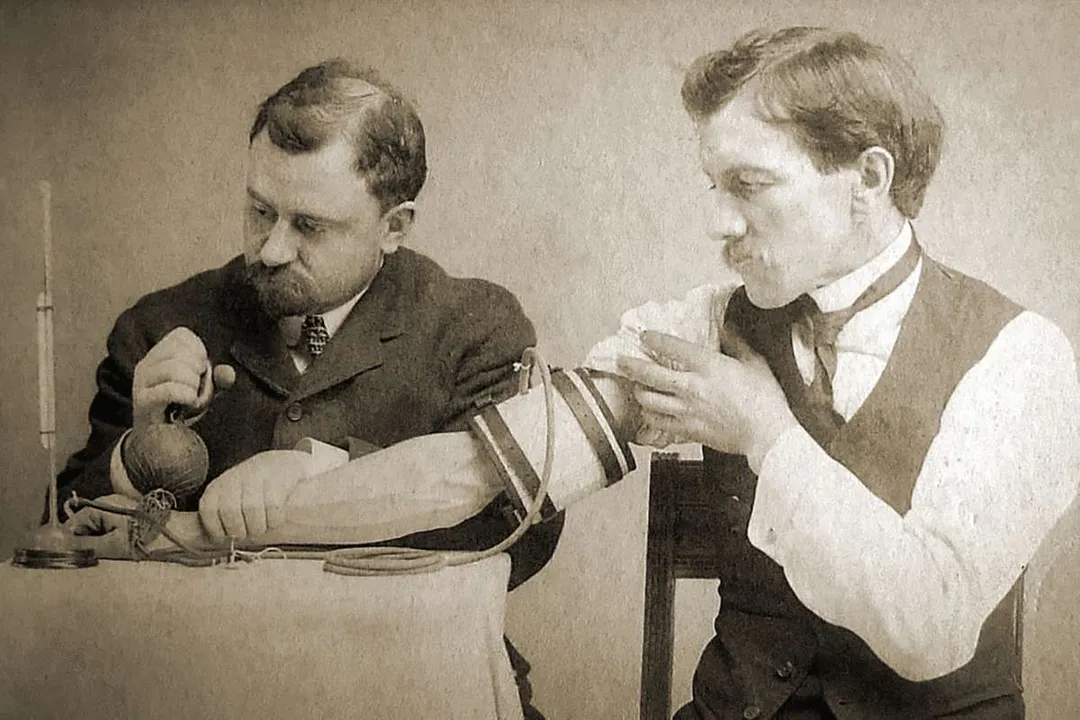
The transition from a manual, highly operator-dependent tool to a device usable by the general public marks the true beginning of the home blood pressure monitor—the direct ancestor of today's wearables. This step involved automating the detection of the pressure waves. Instead of listening for Korotkoff sounds, newer devices utilized the oscillometric method, which detects pressure oscillations in the artery wall as the cuff deflates. [2][5]
Companies began focusing heavily on making these devices practical for consumers in the latter half of the 20th century. For instance, Omron Healthcare has a long history in this space, marking over 50 years in the blood pressure monitor business. [9] Their focus was on accuracy and accessibility, leading to the development of automated upper-arm monitors that became staples in homes globally. [1][6] These were wearable in the sense that a user placed the cuff on their arm and operated the device themselves, but they still relied on the principle of the inflatable cuff. [7] The significant move here was replacing the need for a professional ear to interpret the sounds with an electronic sensor and microprocessor. [2]

# Wearable Breakthrough

The term "wearable blood pressure monitor" implies a device that is less intrusive than a traditional cuff, often remaining on the body for extended periods, perhaps even continuously, without the need for manual inflation and measurement cycles. [5] The invention that truly pushed into the modern definition of a non-cuff wearable monitor is credited to specific research focusing on entirely new measurement principles.
One notable development involved an innovator from Scotland who pioneered a wearable blood pressure monitor based on ultrasound technology. [8] This approach moves beyond the pressure-based mechanics of the cuff system entirely. Instead of measuring pressure waves against the artery wall via an external cuff, ultrasound-based methods can potentially monitor blood flow dynamics more directly or use different mechanical principles to derive pressure readings. [8] This represents a significant departure, addressing the common complaint that traditional monitors, even automated ones, are inconvenient for frequent checks. [5] While the Riva-Rocci invention allowed for home measurement, this ultrasound-based work signifies a major step toward the wearable concept—a device worn unobtrusively throughout the day. [8]
# Current Technology Types

Today, the market for devices labeled as "wearable" presents a bit of a spectrum, which can be confusing for the everyday user trying to determine authenticity and reliability. On one end, you have highly sophisticated, validated monitors that are simply smaller, often wrist-worn versions of the traditional oscillometric cuff device. [1][5] These are accurate because they still follow the well-tested principle of cuff-based measurement, even if the cuff is integrated into a watch-like form. [7]
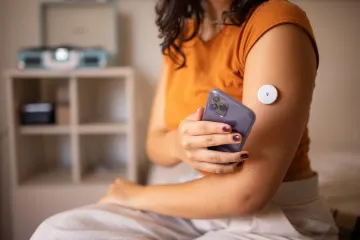
On the other end are the truly cuffless monitoring solutions, often integrated into smartwatches or advanced fitness trackers. [5] These devices use optical sensors (like photoplethysmography or PPG) or, as mentioned, ultrasound principles to estimate blood pressure based on pulse wave velocity or changes in vessel diameter. [5][8] The challenge with these newer, continuous monitoring methods is ensuring their readings maintain the necessary clinical accuracy over time compared to the established standard. [7] Continuous monitoring offers invaluable data, such as tracking nocturnal dips or spikes that a person might miss with twice-daily checks, but the calibration process is often more demanding. [5]
| Device Type | Core Principle | Wearability Level | Common Limitation |
|---|---|---|---|
| Manual Sphygmomanometer | Auscultation (Korotkoff Sounds) | Low (Clinical Use Only) | Requires trained operator |
| Automated Home Monitor | Oscillometric (Cuff-based) | Medium (Temporary Wear) | Requires sitting still for measurement |
| Advanced Wrist Monitor | Oscillometric (Miniature Cuff) | High (Worn/Stored Easily) | Potential for movement error during reading |
| Cuffless Sensor/Watch | PPG or Ultrasound | Very High (Continuous Wear) | Requires frequent validation against a cuff |
# Establishing Personal Baseline
When considering the shift from the cuffed inventions of the past to the sophisticated sensors of today, it's important to recognize that validation is key to trust. A device that uses the proven oscillometric method—even if it’s marketed as a wrist wearable—offers a higher degree of immediate trustworthiness than a brand-new cuffless technology, simply due to decades of clinical acceptance. [2][7]
To make the best use of any modern device, especially one tracking pressure continuously, the first step after purchase should be to establish a reliable personal baseline. This involves taking readings with your new wearable immediately after taking a reading with a clinically validated, upper-arm, cuff-based monitor multiple times over a few days. By comparing the two sets of data side-by-side, you can calculate the average offset your new device has—perhaps your cuffless watch consistently reads 4 mmHg high. Knowing this calibration factor allows you to trust the trend the wearable shows, even if the absolute number is slightly skewed, giving you practical, actionable data without waiting for a doctor’s appointment. [1] This process bridges the historical accuracy of the cuff with the convenience of modern technology.
# Monitoring Philosophy
The history shows a clear trend: medical equipment moves from the hospital setting into the home, and then finally onto the body for continuous tracking. [5][6] Early inventors like Riva-Rocci solved the problem of how to measure pressure non-invasively; later innovators, like those pushing ultrasound or automated electronics, solved the problem of how to measure it reliably without a doctor. [2][8] The contemporary goal, driven by companies and researchers alike, is to remove all friction—no cuffs, no scheduled measurements, just passive data collection. [5][7] For the reader, this means deciding which trade-off matters more: the proven accuracy of a device that still requires a manual step, or the convenience of near-constant monitoring from a technology that might need periodic re-calibration against a standard. [7] The ultimate inventor of the wearable monitor isn't one person but an accumulation of these incremental leaps, from the first manual stethoscope recording to the ultrasound pioneers changing how we perceive blood pressure data collection itself. [8]
Related Questions
#Citations
Story Behind the Rise of the World's First FDA-Approved Wearable ...
How Did Blood Pressure Monitoring Devices Evolve? A Timeline of ...
The History and Innovation of Home Blood Pressure Monitors
History and evolution of blood pressure measurement - PMC
Beyond the Cuff: The History & Future of Blood Pressure Monitoring
The History and Innovation of Home Blood Pressure Monitors
From Cuff To Cuffless: The Evolution Of Blood Pressure Monitoring
Wearable blood pressure monitor developed by Scottish ultrasound ...
OMRON Healthcare Celebrates 50 Years of Blood Pressure Monitor ...