Who invented the first gear cycle?
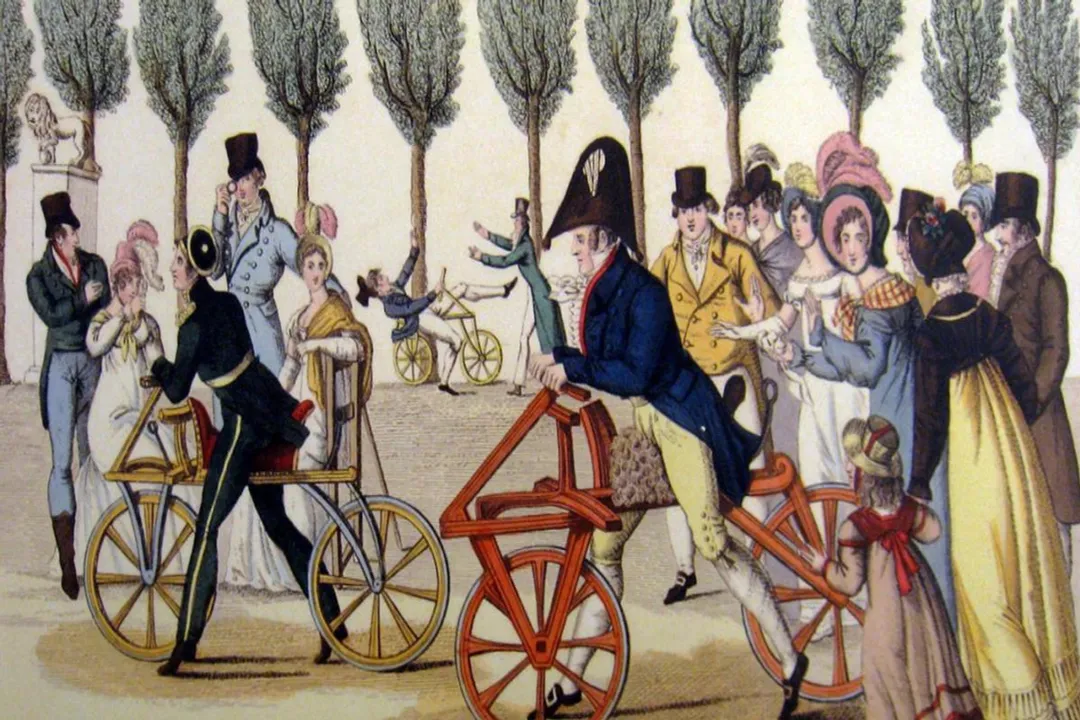
The identity of the person who engineered the very first bicycle equipped with gears is a question that doesn't have a single, simple answer. Instead, tracing the lineage of the geared cycle reveals a fascinating evolution where several critical innovations built upon one another, making the final product a collaborative achievement over decades. To truly understand who deserves the credit, we must look past the modern derailleur system and examine the foundational mechanical leaps that made variable speed transmission possible on two wheels.
# Foot Power
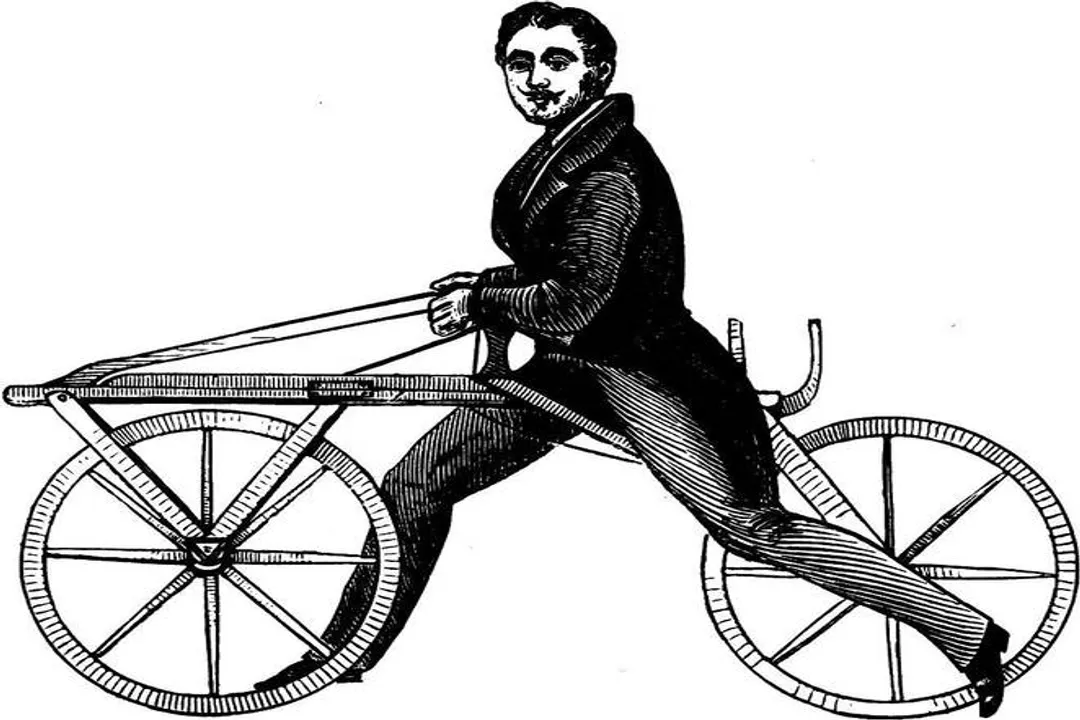
The story of personal, two-wheeled transport begins long before pedals or chains entered the picture. The earliest verifiable ancestor of the bicycle was the Draisienne, often called the hobby-horse or running machine, invented by Karl Drais in 1817. This contraption consisted of two in-line wooden wheels connected by a frame, steered by a handlebar, but it required the rider to propel it by pushing their feet along the ground. This machine established the basic concept of balancing on two wheels but offered absolutely no mechanical advantage or gearing mechanism, as it lacked both pedals and a drive system.
# Direct Drive Era
The next major step involved adding pedals, but rather than linking them to the rear wheel via a chain, these early designs attached the crank directly to the hub of the large front wheel. This machine, known as the Ordinary or the Penny-Farthing due to the disparity in wheel sizes, dominated cycling in the late 1870s. Because the ratio between the pedals and the wheel was fixed by the wheel’s diameter, riders had only one gear: direct drive. Speed was achieved only by making the front wheel larger, which introduced significant safety concerns, making the ride precarious, especially on rough roads or during emergency stops. This fixed-ratio design fundamentally prevented true gearing options, as the rider could not easily pedal fast enough to maintain speed or, conversely, pedal slowly enough to manage a steep climb without stalling or losing balance.
# Starley’s Claim
While the Penny-Farthing reigned supreme, some innovators sought solutions to the direct-drive limitation. One notable claim for inventing a gear cycle points toward James Starley in 1871. This claim suggests that Starley introduced a gear mechanism onto cycles around this time, fundamentally changing the machine's capability.
It is essential to place this 1871 date within the historical context. If Starley introduced gearing in 1871, it occurred before the widely accepted introduction of the chain-driven Safety Bicycle, which solved the height problem and provided the platform for modern gearing systems. This means Starley’s 1871 gear mechanism, if it existed in a successful form, was likely a complex, perhaps rudimentary, system integrated into the high-wheeled Ordinary design—a fixed reduction mechanism that was not the enduring chain-and-sprocket system we know today. The engineering challenge was overcoming the limitation of the direct drive on a high-wheeler; perhaps Starley implemented an early form of internal gearing or a friction drive, mechanisms which proved less reliable or scalable than what followed later.
This specific reference to Starley highlights the difference between inventing a geared machine and inventing the standard geared machine. Many mechanical concepts are realized in early, often impractical, forms before a superior enabling technology allows for mass adoption.
# Chain Drive Foundation
The real prerequisite for the universally accepted "first gear cycle"—meaning one that could effectively manage variable terrain through a chain drive—was the development of the safety bicycle in the 1880s. The safety bicycle featured two wheels of approximately equal size and, critically, a chain drive connecting the pedals to the rear wheel.
This chain-and-sprocket arrangement decoupled the pedaling speed from the wheel speed, allowing the wheel size to be reduced to a safer, manageable level while still achieving high road speeds through gear ratios. John Kemp Starley’s 1885 Rover safety bicycle is often cited as the design that codified this layout. Once the chain drive was established, the path was clear for true variable gearing systems, as the mechanical connection was proven robust enough to handle the necessary torque and tension.
The move from direct drive to the chain drive wasn't just an incremental upgrade; it was a fundamental engineering trade-off. The direct-drive Penny-Farthing prioritized pure speed on flat ground by maximizing the distance traveled per pedal revolution, but it created an inherently unstable machine that was nearly unusable for climbing hills or stopping quickly. The chain drive sacrificed the pure, large-wheel mechanical advantage for versatility, stability, and, crucially, the mechanical possibility of changing that mechanical advantage mid-ride.

# Derailleur Arrival
With the safety bicycle design established, the next step was implementing multiple ratios. While the chain drive made gearing possible, the first practical, reliable multi-speed shifting systems—the derailleur gears common today—took several more decades to mature.
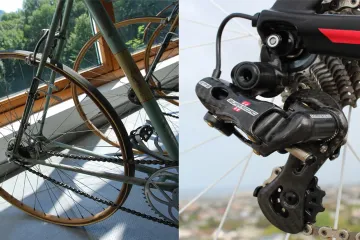
Although various concepts for variable speed existed earlier, it was not until the 1930s that derailleur systems began to appear consistently on racing bicycles, most notably in the Tour de France. Before this time, cyclists often had to rely on fixed-gear setups or perhaps a two-speed hub, which was complex and heavy. Early racing pioneers used manually operated mechanisms to shift the chain between two different-sized sprockets on the rear wheel, a crude but effective precursor to modern gear systems.
This distinction is important: the inventor of the first geared mechanism on a bicycle might be James Starley in 1871, as one source suggests, but the inventor of the chain-driven bicycle that made modern gearing viable was a later development in the 1880s, and the inventor of the modern derailleur system was established much later in the 1930s.
If we define the "first gear cycle" as the machine that introduced the concept of mechanical advantage change, then the answer likely rests with the early inventors of the 1870s, possibly James Starley. However, if the definition requires the fully integrated, reliable system that made gear-equipped cycling practical for general use—the chain-drive safety bicycle with the capacity for multiple speeds—then the credit must be shared among the late 19th-century engineers who perfected the chain drive, allowing for the refinement of derailleurs in the 20th century.
# Legacy of Innovation
The trajectory from the Draisienne to the modern geared bike clearly shows that the invention wasn't a single moment of genius but a series of necessary solutions to engineering problems. The Draisienne solved balance; the Penny-Farthing solved propulsion (via direct drive); the Safety Bicycle solved safety and provided the platform for gearing (via the chain drive); and finally, the racers of the 1930s solved variable speed control with the derailleur.
Consider the technical hurdle of designing a functioning derailleur for an 1870s high-wheeler. The rider sat directly above the massive front wheel, and any mechanical addition had to function reliably on a machine where stability was already compromised by height and direct drive. It is perhaps unsurprising that the real breakthrough in gearing followed the safer, lower-to-the-ground design that utilized the chain. This progression underscores a vital lesson in mechanical history: sometimes, the invention that enables the final goal is more significant than the first attempt at the goal itself. The chain drive, not the gear mechanism itself, proved to be the true turning point in making variable-speed cycling accessible and safe.
Related Questions
#Citations
History of the bicycle - Wikipedia
James Starley, in 1871 changed the world of cycles by inventing the ...
The History and Evolution of Bike Gears
200 years since the father of the bicycle Baron Karl von Drais ...
Director's Corner: The Bicycle: Invented 200 Years Ago & Still ...
Science of Cycling: History of Bicycle Frames - Exploratorium
History of the Bicycle: A timeline - Brown University
The drivetrain wars: A history of shifting - Velo
When did bicycles first get gears? - Quora