Who invented the first magnetic compass?

The discovery that certain stones possessed a mysterious, invisible force capable of influencing iron was known for millennia before it was harnessed for the world-altering purpose of navigation. For ancient mariners, direction finding was an art dictated by the day’s light, the phases of the moon, or the fixed patterns of the stars. Cloudy nights or thick fog could render even the most experienced sailor utterly lost, forcing reliance on guesswork, drift, or the scant knowledge of prevailing winds and currents. The invention that finally broke these geographical constraints did not spring forth in a single "eureka" moment from a known inventor but rather evolved over centuries, with its roots firmly planted in Han Dynasty China. The first magnetic compass was not initially a navigational tool at all, but rather an instrument of spiritual order and fortune-telling.
# Divination Spoon
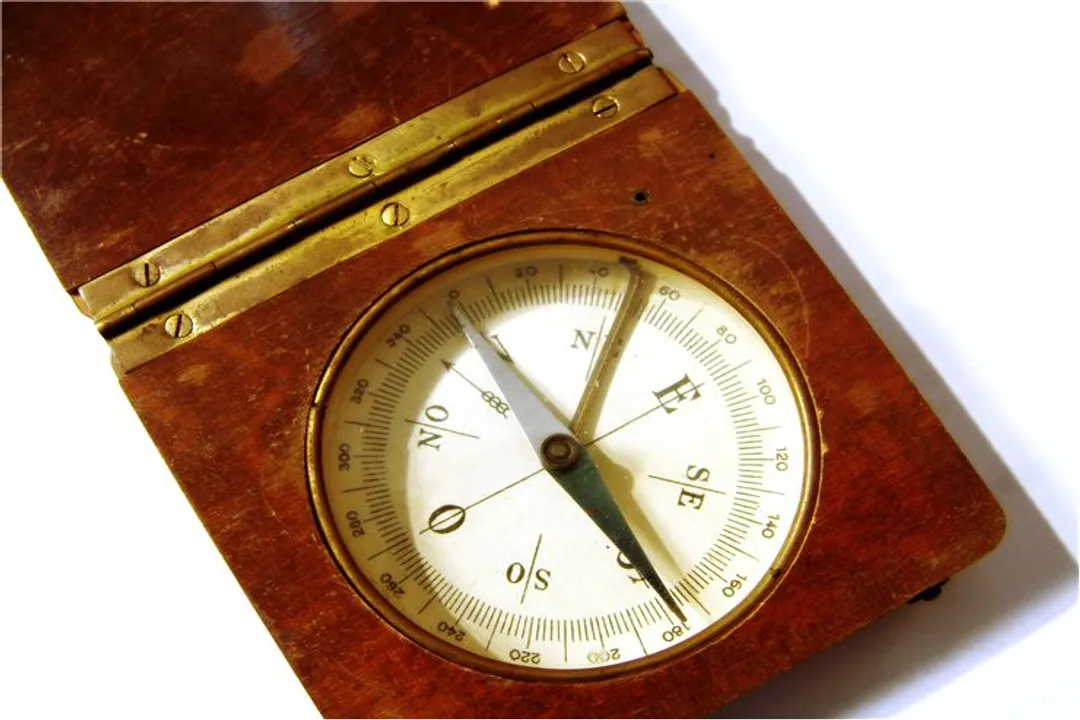
The earliest manifestations of what would become the magnetic compass were crafted from lodestone, a naturally magnetic form of the mineral magnetite. In China, dating back to as early as the 4th century BC, and certainly during the Han Dynasty (202 BC – 220 AD), these lodestone artifacts served purposes far removed from charting coastlines. This early device was known by names like the "South Pointing Fish" or the sīnán (South-governor).
The first recognizable form was often fashioned like a spoon or ladle, made entirely of lodestone. This spoon was set upon a smooth, flat plate, typically made of bronze, which represented the Earth. Due to the inherent properties of the lodestone, the handle of the spoon would consistently settle, pointing toward the south. This arrangement was central to practices like geomancy and Feng Shui, where aligning structures or finding auspicious locations for dwellings and burials was paramount to harmonizing one's environment. The markings on the bronze plate frequently included Chinese characters indicating the eight main directions, along with symbols linked to the I Ching, reflecting its philosophical and quasi-religious application. An early textual reference, composed between 70 and 80 AD in the text Lunheng, describes observing a "south-pointing spoon" come to rest pointing south after being thrown onto the ground, a phenomenon the author personally witnessed.
Another early design, also rooted in the Chinese cultural context, involved a magnetized needle housed within a wooden fish that floated in a bowl of water, again ensuring the South-pointing orientation. While these devices provided a direction, their primary function remained symbolic and spiritual for centuries, rather than being applied for practical wayfinding over long distances.
# The Shift to Navigation
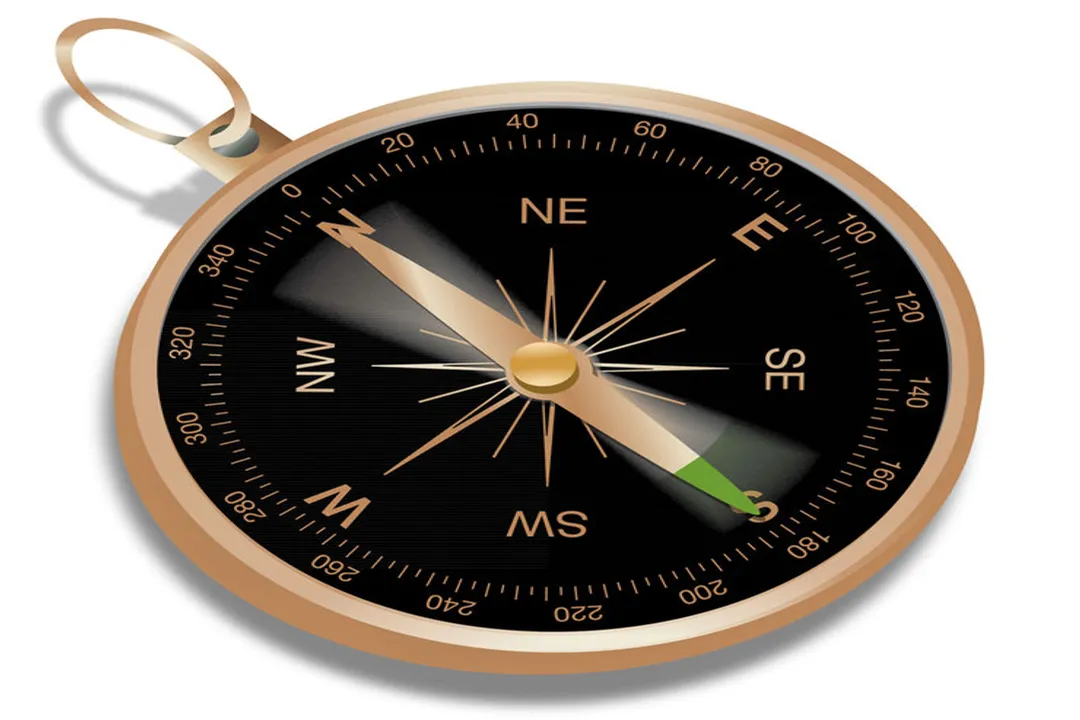
The understanding of magnetism as a physical law, rather than merely an occult property, required a significant intellectual leap. In China, this transition began in earnest during the Song Dynasty.
The earliest records suggesting a practical, non-geomantic application arrive with military usage for land navigation sometime before 1044 AD, as detailed in the Song military text Wujing Zongyao (Collection of the Most Important Military Techniques). This text described using the "south-pointing fish" floating in water to maintain orientation during dark nights or overcast days when celestial sighting was impossible. The magnetization method at this time was rudimentary, possibly involving heating the metal—a process known as thermoremanence—to impart a weak magnetic charge.
The undeniable breakthrough for maritime application appeared shortly thereafter. The first incontestable reference to the magnetic compass used for seafaring navigation is found in Zhu Yu’s Pingchow Table Talks, dated between 1111 and 1117 AD. Zhu Yu explicitly wrote that ship pilots, when the weather obscured the sun and stars, would consult the "south-pointing needle" to hold their course.
A crucial scientific description came in 1088 from the Song polymath Shen Kuo in his Dream Pool Essays. Shen Kuo detailed the process of creating a functional needle by rubbing a metal sliver with lodestone, then suspending the magnetized needle via a single strand of silk weighted with wax at its center. He was also among the first to observe and record magnetic declination—the fact that the needle did not point precisely to true north—a subtle but profound observation that marks a move toward empirical science.
It is noteworthy that while the Chinese utilized the compass for land navigation before 1044 and maritime navigation by 1117, the general consensus among historians is that the Chinese invention used for navigation predates the first European mention by at least 150 years.
# The Compass Finds New Shores
The knowledge of the magnetic compass slowly propagated outward from China, reaching the Islamic world and Medieval Europe. However, the narrative of who introduced it where, and whether it was independently developed, remains a topic of scholarly discussion.
In the Islamic world, the earliest reference appears in the Persian talebook Jawami ul-Hikayat in 1232, describing its use on the Red Sea or Persian Gulf. Arab navigators adopted the technology, reportedly using the fish-shaped magnetic leaf design common in early Chinese models. Beyond navigation, the concept was adapted for religious observance. By the late 13th century, the Yemeni Sultan and astronomer al-Malik al-Ashraf described using the compass as a Qibla indicator—a device to determine the direction of Mecca for daily prayers. This adaptation highlights how local needs shape technological evolution; the primary concern shifted from "which way is North for sailing?" to "which way is Mecca for praying?".
Europe received the device slightly later. The first literary mention of a magnetic compass in Western Europe comes from the English theologian Alexander Neckam around 1190 in his work De naturis rerum. Neckam described sailors using a magnet to touch a needle, which would then be spun until it pointed north, specifically mentioning its use in the English Channel when the sun or stars were obscured. By 1269, Petrus Peregrinus of Maricourt detailed both a floating compass for astronomical observation and a dry compass for seafaring.
Interestingly, while some historians have suggested Arab traders introduced the concept to Europe via Indian Ocean trade routes, others argue for an independent European invention, meaning the phenomenon of magnetic alignment might have been independently rediscovered or refined in the West.
# Engineering Refinement: From Water to Gimbals
The early European and Islamic compasses largely mirrored the Chinese "wet" design—a magnetized element floating in water. This method was simple but unstable on rough seas. The next wave of innovation focused on stabilizing the pointer, leading to the development of the dry compass.
The pivotal refinement that modernized the instrument is often traditionally attributed to Flavio Gioja, an Italian pilot from Amalfi, around the turn of the 14th century (1295–1302). Gioja is credited with taking the floating needle and suspending it over a fixed compass card within a round box, creating the device that most closely resembles the recognizable compass today. This attachment of the card to the magnetic element meant the card rotated with the needle, allowing the navigator to read the course directly from a fixed reference point, rather than having to interpret the orientation of the entire floating apparatus. While this attribution is traditional, sources also reference portable compasses in boxes from 1318 and a dry suspension description from 1150-1250 in China, showing development was occurring concurrently across cultures.
The addition of gimbals—a mounting system of rings that kept the compass bowl level regardless of the ship's pitch and roll—was another critical European step, ensuring the card remained flat and readable. This improved stability allowed sailors to maintain voyages throughout the winter months, vastly increasing the sailing season and, consequently, Mediterranean trade.
We can pause here to consider the nature of invention itself. The history of the compass is a powerful example of technological evolution driven by conceptual necessity. The first step was observing nature (lodestone attracts iron); the second was applying that observation to a spiritual framework (geomancy); and the final, world-changing step was the abstract leap to applying a predictable physical property to direction itself, divorced from celestial markers. This required an institutional trust in the non-visible—that the Earth possessed an invisible field—which challenged older worldviews where such properties were often considered supernatural or occult until figures like William Gilbert later formalized the science in the 17th century. It was the cultural willingness to treat the magnet as a reliable physical tool, not just a magical talisman, that truly ushered in global navigation.

# The Modern Leap Dampening the Swing
For centuries, the dry-pivot compasses, even when gimbaled, suffered from the needle violently oscillating or even falling off its pivot during heavy weather. The solution arrived in the form of liquid damping.
While Sir Edmond Halley introduced a working model of a liquid-filled compass in 1690, it was a later refinement that made the design practical for widespread use. The goal of the liquid—often alcohol or refined kerosene in later designs—was to slow the needle’s swing, allowing it to settle on North more quickly and protecting the pivot from shock.
An Englishman, Francis Crow, patented a practical liquid mariner’s compass in 1813. However, it was the American physicist Edward Samuel Ritchie who patented a greatly improved liquid marine compass in 1862 that finally addressed the key drawbacks of leaks and pivot wear effectively. This made the liquid compass decisively superior to the dry-card type, rendering it obsolete by the close of the 19th century. The impact of this dampening cannot be overstated; while the needle on a dry compass might spin for a considerable time before settling, a liquid-damped needle stabilizes almost instantly, a massive time saver on a busy ship deck or in an early aircraft cockpit.
Considering the timeline of adoption offers another analytical view. While European adoption enabled them to expand trade routes through the Bay of Biscay and later launch the Age of Discovery by extending the sailing season, the initial Chinese maritime adoption in the 11th and 12th centuries supported vast internal trade and coastal routes long before, giving the Song and Yuan dynasties an earlier stability in long-distance commerce that is often underappreciated in Western-centric historical narratives. In fact, the detailed "needle records" from Zheng He's 15th-century voyages demonstrate a sophisticated, established system centuries later.
# Specialized Instruments and Final Forms
The compass continued its evolution into specialized tools. Surveyors developed the bearing compass to accurately measure horizontal angles for map-making, which was already common by the early 18th century. The invention of the prismatic compass (patented 1885) and the mirror compass (patented 1902) allowed users to sight distant landmarks while reading the bearing simultaneously, removing estimation from the process.
A fascinating contemporary development occurred in the realm of personal navigation when Gunnar Tillander in 1928 combined the magnetic compass with a protractor baseplate, leading to the orienteering compass—a design eventually commercialized by the Silva Company. This development shows that the fundamental challenge for the compass user—how to transfer the magnetic bearing information onto a flat map efficiently—was solved not by magnetism itself, but by integrating it with cartographic tools. The final major deviation came with the gyrocompass, which aligns with true north (the Earth's axis) rather than magnetic north, removing the need to calculate for magnetic declination, a significant improvement for modern military and long-range navigation.
In summary, identifying the single inventor of the first magnetic compass is impossible because the invention evolved across cultures and centuries. The credit for the concept belongs to the ancient Chinese thinkers of the Han Dynasty who observed lodestone's natural properties. The credit for practical land navigation belongs to the military engineers of the Song Dynasty. And the credit for the mariner's reliable, pivoted compass is traditionally shared between Islamic scholars, who adapted it for the Qibla, and Italian craftsmen like Flavio Gioja, who engineered its mechanical stability on the open ocean. It is a story less about one person and more about the collective human need to conquer the unknown by understanding the reliable forces beneath our feet.
Related Questions
#Citations
History of the compass - Wikipedia
Magnetic compass | Invention, History, & Facts | Britannica
The First Compass for Travelers and Road Warriors
Early Chinese Compass – 400 BC - Magnet Academy
History of Compass - Who Invented Compass?