Who invented the first garage door?

The proliferation of the automobile in the early twentieth century brought about an entirely new architectural necessity: a dedicated, secure place to store and service these newfangled machines. As cars moved from being novelties to everyday essentials, the structure we now call the garage began to replace the traditional carriage house. However, designing the entrance for these new structures presented an immediate problem. The existing solutions for large openings, often adapted from agricultural or carriage house needs, simply were not suited for frequent, easy access by a new class of vehicle owner.
# Early Closures

Before the specific invention that revolutionized the garage entrance, builders improvised with whatever large door systems were available. In many cases, the earliest garages relied on swinging barn doors or large, heavy wooden doors that opened outward, similar to what one might find on an outbuilding for wagons or livestock. This posed immediate practical difficulties. If a car was parked too close to the door, or if there was an obstruction outside, the door couldn't be opened fully, or at all. Imagine the inconvenience of having to move your automobile just to exit the structure, or having snow piled up against the outside forcing you to clear it before you could even leave for work.
Another common solution involved sliding doors, which ran along a track parallel to the exterior wall. While these eliminated the outward swing problem, they introduced a new spatial constraint: the doors required significant clear wall space on either side of the opening to slide completely open. This was a major issue, especially in the dense, growing suburbs where property lines were becoming tighter and driveways were often positioned right up against the structure. A car parked too close to the side wall could block the track, rendering the door useless. The demand was clear: a door that opened upward and disappeared out of the way was needed to maximize both internal and external real estate.
# The Upward Solution

The answer to this architectural and functional puzzle is credited to C.G. Johnson, an inventor whose work defined the modern concept of the garage door. In 1921, Johnson engineered what is widely recognized as the first upward-acting sectional garage door. This was a profound departure from the swinging or sliding predecessors.
Johnson’s genius lay in the mechanism that allowed the door to break into horizontal sections, which were then mounted on tracks to follow an arc up and then back along the ceiling of the garage interior. This design solved the major issues of prior systems: it required no external space for swinging, and it required minimal side space compared to a fully sliding system, as the door simply stacked neatly above the opening. This innovation made opening and closing the garage door much more convenient for the average car owner.
The immediate commercial success of this invention spurred Johnson to formalize his business endeavor. In the same year, 1921, C.G. Johnson founded the Overhead Door Corporation. The establishment of this company cemented the technology into the marketplace, ensuring that his design—the upward-acting door—became the standard for the burgeoning residential garage industry. The founding of this corporation marks the true beginning of the modern garage door industry as we know it.

# Manufacturing the Standard

The early days of the Overhead Door Corporation were focused on perfecting the design and scaling production to meet the overwhelming demand generated by American automotive culture. While the initial design was groundbreaking, early versions would have required a significant amount of manual effort to lift and lower those heavy wooden or metal sections. To visualize the initial installation process, one might picture the installers in the early 1920s carefully balancing the tension springs and ensuring the tracks were perfectly aligned, knowing that even a slight misalignment could make the heavy door nearly impossible for the homeowner to operate manually. The engineering skill involved in balancing those early counterweights and spring systems was formidable, representing genuine mechanical expertise applied to a mundane, yet essential, daily task.
It is interesting to consider the materials available at the time. While modern doors often use lightweight steel or composite materials, the earliest sectional doors likely incorporated more wood, which would have added considerable weight and complexity to the spring mechanism required for manual operation. The development of lighter, more durable materials over the decades that followed would certainly have improved the user experience, but the fundamental geometry of the upward-acting sectional design remained Johnson’s lasting contribution.
# Beyond the Door Itself
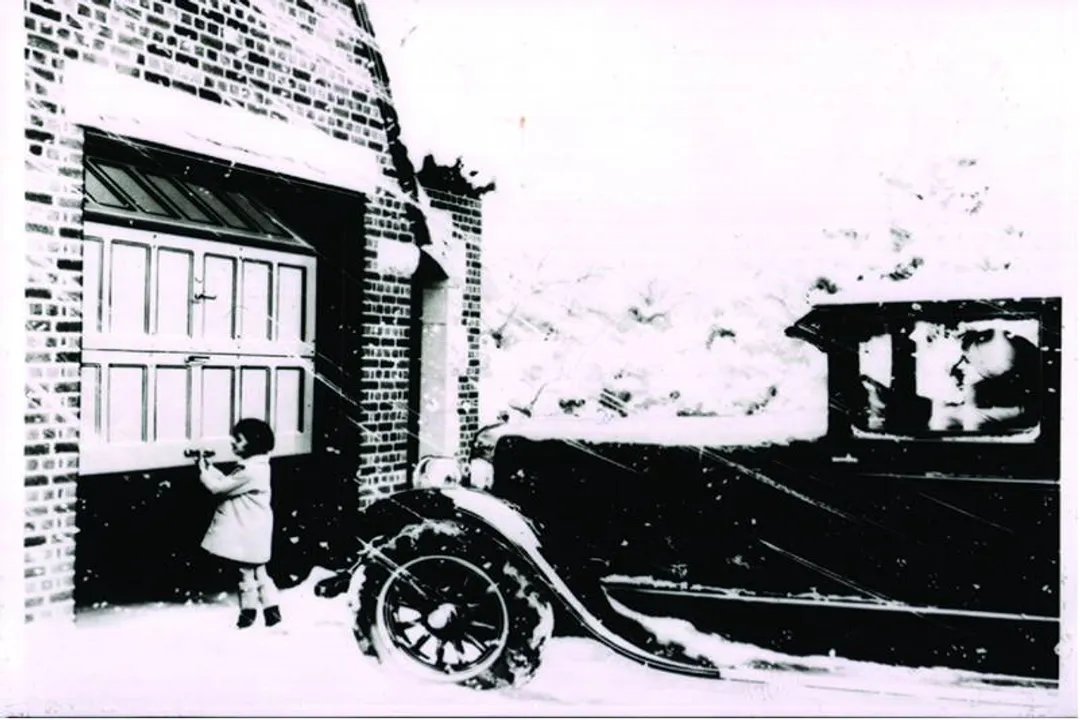
The invention of the door was only the first part of the automated convenience equation. For decades, the primary interaction with the overhead door remained a physical one—pulling a rope or latch from inside or manually lifting the door from the outside. The next logical evolution, which built directly upon the installed tracks and mechanisms of Johnson's design, was the addition of a mechanized opener.
The concept of a mechanical opener started gaining traction in the 1920s, soon after the door itself was standardized. The earliest mechanical operators were quite rudimentary, often employing electric motors and chains or belts to assist the lifting process. These early mechanisms were sometimes retrofitted onto existing manual doors, transforming them from a chore into a convenience accessible with the flip of a switch or a pull of a cord inside the house. By the 1930s, companies began developing more integrated systems, though widespread adoption of electric openers took much longer, often waiting until homeowners could afford the extra cost and electricians could ensure safe installation near gas-powered vehicles.
This timeline—door in 1921, and powered openers starting shortly thereafter—highlights a pattern in successful invention: a problem is solved with an effective mechanical principle first (the sectional door), and then convenience features (the opener) are layered on top as technology and economics permit. This layered approach is a common characteristic of innovations that successfully transition from novelty to necessity.

# Establishing an Industry
The impact of C.G. Johnson extended past the physical design of the door; his establishment of the Overhead Door Corporation laid the foundation for an entire industry focused on garage access and safety. The success of the original product led to the creation of a network of distributors and installers. This structure ensured that not only was the door manufactured, but it was also installed correctly—a crucial factor given the delicate spring tension required for proper function.
The formalization seen in the founding of the company also allowed for industry standards to develop over time. While Johnson was perfecting the sectional door, other innovators were also working on related access systems. The desire for formalized standards, better manufacturing practices, and consistent installation quality eventually led to the formation of organizations like the Door and Access Systems Manufacturers Association (DASMA). This growth from a single, brilliant solution in 1921 to a formalized manufacturing association demonstrates the profound shift in how society viewed the garage entrance—it was no longer just a big shutter, but a critical piece of building machinery requiring specialized knowledge.
When you observe a modern garage door today, it might seem mundane, but its very existence is a testament to solving a specific set of early twentieth-century problems: limited space, the need for reliable daily access, and the challenge of lifting a very large, heavy barrier.
# Evolution of Style and Material
While C.G. Johnson solved the mechanical problem of opening, the subsequent decades have seen continuous evolution in aesthetics and material science. In the 1920s and 1930s, garage doors needed to complement the architectural styles popular at the time, which often meant they were built to mimic traditional wood carriage doors, even if they were constructed using the new sectional technology. Homeowners wanted their new, modern garages to blend with their Craftsman or Tudor-style homes.
As technology advanced, the focus shifted from mimicking wood to exploiting the strengths of steel and aluminum. Steel doors offered superior durability, better insulation potential, and were easier to mass-produce with precision tracks. This transition is something a modern homeowner might overlook when replacing a door; choosing a modern stamped-steel door over a traditional wood-look composite is a choice directly informed by over a century of material improvements following Johnson's mechanical breakthrough. The ability to select a door with an R-value for insulation, or specific window placements for natural light, simply was not an option in 1921.
The shift from purely functional to highly customized is a key difference between the first invention and the present day. Johnson solved the access question; later generations solved the integration question, making the garage door an integral, often decorative, part of the home’s façade rather than just a utilitarian barrier.

# Operational Considerations Today
Understanding the origin of the sectional door helps illuminate current maintenance needs. Because the system relies on tracks, hinges, springs, and rollers to manage the weight of the door through its arc, even small issues can cause major failures. The spring system, which Johnson’s early designs relied upon heavily for manual operation, remains perhaps the most critical and dangerous component of the door system today.
For anyone living in a climate with significant seasonal temperature swings, it’s worth noting how this might have affected the original 1921 installation. Metal components expand and contract with temperature changes. An early steel or wood door assembly installed in a cool autumn might operate smoothly, but if that same door was used during a harsh, freezing winter, the hardware might bind or the tension in the lifting springs might need manual adjustment to compensate for the change in material properties—a maintenance task that modern manufacturers have tried to engineer around but never entirely eliminate from the equation. This foundational reliance on precisely balanced tension is a direct inheritance from the first upward-acting designs.
In summary, while many large doors existed before it, the person who invented the door that defines the modern garage experience—the upward-acting, sectional overhead door—was C.G. Johnson in 1921, leading directly to the founding of the Overhead Door Corporation. His innovation provided the essential spatial efficiency that the automobile age demanded, paving the way for all subsequent improvements, from electronic openers to advanced insulation.
Related Questions
#Citations
A Brief History of Garage Doors
The Invention of the First Garage Door
History & Evolution of Garage Doors in Jacksonville, FL
The Story of the Modern Garage Door - Overhead Door
Who Created the First Overhead Garage Door?
[PDF] DASMA - The Founders of the Garage Door Industry
The History of Overhead Door Corporation
History of Overhead Door
The History of Garage Door Openers
Did you know that the first overhead garage door was invented by G ...