When was the first metal spring invented?

The history of the humble spring—that seemingly simple component that stores and releases mechanical energy—is far more ancient and complex than most people imagine, stretching back thousands of years before metallurgy even allowed for dedicated metal coils. If we define the "spring" by its function, its lineage begins with the bow and arrow, a non-coiled elastic device used for hunting and defense dating back potentially 64,000 years or more. Long before specialized metal springs, the principle of elasticity was captured in flexible yew wood.
Even within early metalworking, the concept of using elastic materials for mechanical advantage predates the familiar coil. In the Bronze Age, more sophisticated devices appeared, evidenced by the spread of tweezers across many cultures. Ancient Egyptian chariots reportedly used simple spring or suspension systems to absorb shock. Furthermore, historical accounts note that Ctesibius of Alexandria developed a method for crafting springs using a bronze alloy, which achieved its required elasticity by being hammered after it was cast. These early examples show ingenuity in harnessing resilience, but they lack the specific form most people now associate with the term "metal spring."
# Coiled Appearance
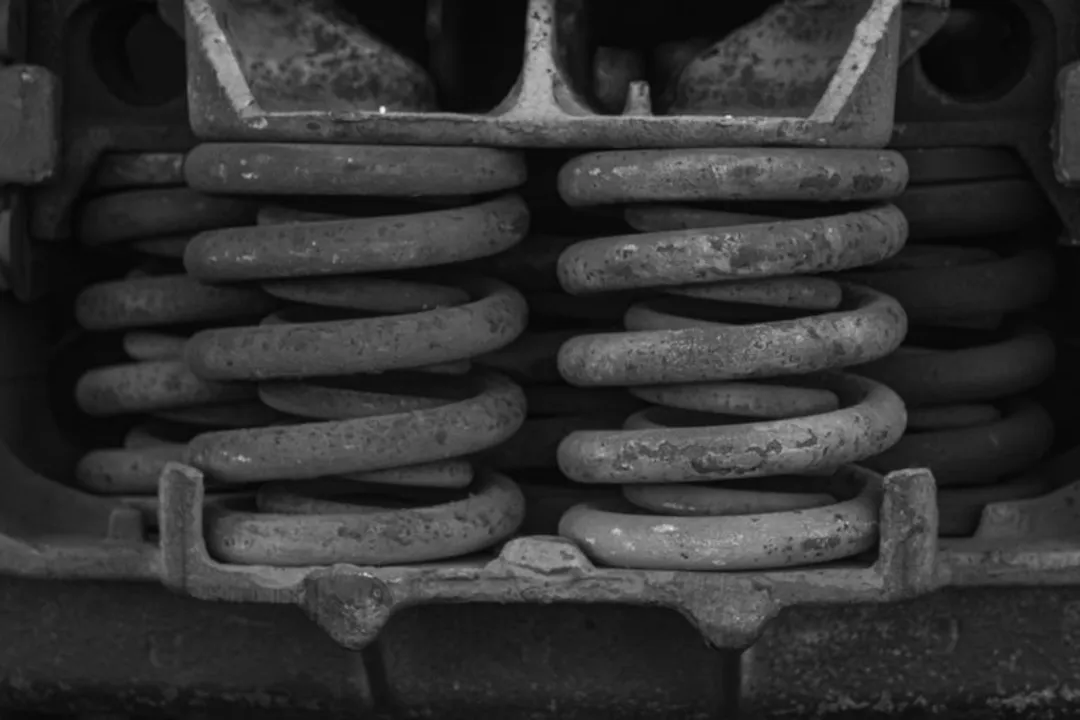
The shift toward the coiled form, which we now recognize as the quintessential spring, occurred much later in human history. Archaeologists have uncovered coiled, helical-shaped wire objects in Europe and the Balkans dating back as far as 4,000 BC. However, the first functional coiled springs specifically incorporated into complex machinery appeared in Europe during the late Middle Ages.
The 15th century marks a key period where coiled springs moved from abstract artifacts to tangible mechanical parts. They first appeared prominently in door locks. Crucially, this era also saw the development of the first spring-powered clocks in that same century. One specific piece of evidence points to the Glastonberry Clock around 1330 AD as the first clock construction to mention "metal springs". By the 16th century, these mechanisms had evolved further, appearing in the first large watches, miniaturizing timekeeping technology. While these early applications were transformative, they often relied on flat wire wound into spirals.
It is interesting to compare these early clock and lock springs to other contemporaneous elastic devices. In medieval times, torsion springs, often made from materials like bull's hair, were used in siege engines to launch projectiles. These demonstrated powerful torsion, but lacked the precision and compact nature that metal coil springs would later offer.
# Physics Defined
Before the definitive patent for the modern coil spring, the underlying physics needed to be formalized. This foundation allowed future inventors to design springs with predictable performance, moving the technology from mere craft to true engineering. In 1676, the British physicist Robert Hooke postulated his famous principle, now known as Hooke's Law. In essence, Hooke's Law describes that the force exerted by a spring is approximately proportional to its extension or compression, provided the material is not stretched beyond its elastic limit. Hooke himself expressed this relationship as ut tensio sic vis, meaning "as the tension, so the force". Understanding this linear relationship—that force relates directly to displacement—was absolutely vital. It provided the mathematical blueprint necessary to move springs from being components of clocks to being critical elements in industrial machinery.

# The Patented Coil
The specific invention that many point to as the genesis of the modern metal spring—the coil spring designed for mechanical loading—was patented by R. Tradwell (also cited as Tredwell) in 1763. This was British Patent No. 792. This patent described a novel method for manufacturing springs specifically for carriages.
This 1763 invention was not just a simple coil; Tradwell’s full patent detailed nine iterations of a helical suspension system intended for hanging coaches. The immediate advantage this coiled spring offered over the contemporary standard, the leaf spring used on carriages, was significant. While leaf springs required constant separation and lubrication to prevent squeaking and maintain functionality, the new coiled design, once properly engineered, offered a more compact and accurate alternative that required less persistent maintenance. This patent effectively launched a new era for spring technology, paving the way for improvements in everything from mattresses to industrial mechanisms.
# Industrial Revolution and Steel
While Tradwell secured the patent for the concept of the coil spring in 1763, the large-scale transition to durable, widely applicable springs required a change in material and manufacturing capability, driven by the Industrial Revolution. The initial metal springs were often made from softer materials or shaped by hand. The true leap forward came with the standardization of spring steel.
The first steel coil spring, as recognized for mass production applications, was patented in America in 1857. Its initial use was surprisingly domestic: for chair seats. This seemingly humble application signaled the massive manufacturing power being unlocked. Before this, manufacturing involved hand-winding springs on an arbor, a slow process that could not keep pace with the burgeoning demands of the automotive and farm equipment industries. The mid-1800s saw a rush of patents securing new spring-making equipment—including adjustable winders and large-diameter coilers—which allowed for the mass production of springs with greater speed and precision.
The material science aspect of the spring’s evolution is often overlooked when focusing only on the shape. The development of high-performance spring steels, and later alloys like stainless steel or titanium for specialized needs (like corrosion resistance), allowed springs to handle exponentially greater stresses and cyclical loading than earlier materials could manage. The ability to mass-produce consistent steel coils meant that springs could become the ubiquitous, reliable components we now expect in everything from machine tools to door hinges.
For example, the first innerspring mattress, patented by German inventor Heinrich Westphal in 1871, directly capitalized on these advancements in steel coil production, dramatically changing furniture comfort.
# Beyond the Coil
The evolution did not halt with the standard helical compression or extension spring. Once the foundational coil spring was established and mass-produced, specialized forms were developed to solve specific, often space-constrained, engineering problems.
One notable example of later innovation is the wave spring, which Smalley claims to have invented in the late 1960s. The initial application for this wave spring was in Bayonette Connectors, where it replaced stamped wavy washers. The crucial differentiator here was load tolerance: the wave spring, manufactured by edgewinding flat wire, could reliably hold tolerances as tight as ±10%, far superior to the stamped washer's ±30% variation. This tight tolerance control, stemming from the superior metallurgy (circular-grain structure) achieved through edgewinding versus stamping, proves that innovation in springs continues to focus on precision and material structure, not just basic shape. The wave spring’s success in connectors shows how material processing—how the metal is formed—is as important as the initial invention of the coil itself.
If we consider the entire history, we see a clear progression: first, the elastic concept (bow); second, the early metal manipulation (Ctesibius’s bronze); third, the early coiled form (15th Century locks); fourth, the scientific quantification (Hooke, 1670s); fifth, the patented, practical coil design for transport (Tradwell, 1763); and finally, the mass-producible, high-strength material (steel coil, 1857).
The sheer scope of modern spring application—from shock absorption in high-speed Shinkansen trains to the precise deployment mechanisms in the Apollo 11 landing gear—hinges on this long, incremental history. It is difficult to overstate the impact of the 1763 patent by R. Tradwell, which provided the necessary template for the industrial age to harness elasticity reliably. Had the science been delayed, the Industrial Revolution’s reliance on precision machinery requiring consistent energy storage might have stalled waiting for a proper elastic component. Today, well over 90% of mechanically produced goods require some form of spring, demonstrating that the simple concept first captured in wood and then refined in metal remains central to engineering.
Related Questions
#Citations
Understanding the History of Springs and How They've Evolved
Invention, History, and Timeline of the Wave Spring - Smalley
Spring (device) - Wikipedia
The History of Metal Springs Explained
A History of Springs - Simply Springs Ltd
History of Springs - Acxess Spring
Learn more about the history of steel springs
The History of Springs and Spring Manufacturing
7 Facts about Springs & Unusual places they've been used