Who invented off-grid power kits?
Pinpointing a single individual who invented the "off-grid power kit" is akin to trying to name the inventor of the modern car; it’s a culmination of technologies bundled into a convenient package rather than a singular eureka moment. The modern kit, defined as a collection of matched components—panels, charge controller, battery, and inverter—designed to operate independently of the utility grid, is an evolution. Its history traces back to the first successful harnessing of sunlight into usable electricity, making the true origin story rooted in the invention of the photovoltaic cell itself. [1][2]
# Cell Origins

The foundational block of any solar power system is the cell, and credit for the first practical silicon photovoltaic cell generally rests with scientists at Bell Telephone Laboratories. In 1954, Gerald Pearson, Calvin Fuller, and Daryl Chapin created the first cell capable of converting sunlight into enough electricity to power small devices. [1][4] While earlier work existed—for instance, Alexandre Edmond Becquerel observed the photovoltaic effect back in 1839 [2][4]—it was the Bell Labs creation that marked the beginning of solar power as a practical technology, albeit initially one that was very expensive, leading to early applications primarily in space exploration. [4] Before these cells, off-grid power relied on combustion engines or other stored energy methods; the solar cell introduced the possibility of generating power remotely and silently. [9]
# System Maturity
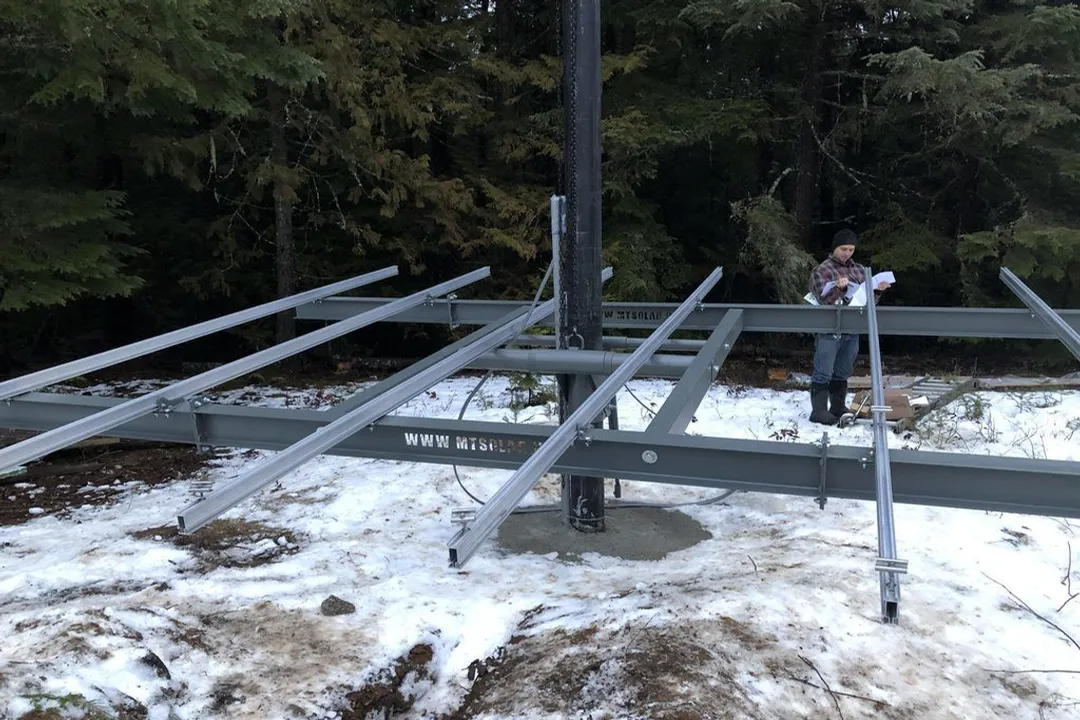
An off-grid power kit is more than just solar panels; it requires a complete ecosystem to function reliably day and night, through varying weather. The invention of the kit concept required the maturity and affordability of several other critical components that work in concert with the panels.
First, reliable energy storage was mandatory. While batteries have existed for centuries, the development of cost-effective, deep-cycle batteries—like lead-acid variations, and later lithium-ion chemistries—made storing daytime solar energy for nighttime use viable. [1] Without dependable storage, a solar setup is merely a daytime generator, not an off-grid solution.
Second, the charge controller became essential. This device manages the electricity flowing from the solar array to the battery bank, preventing overcharging, which severely degrades battery life. [1]
Third, the inverter bridges the gap between the low-voltage DC power stored in the batteries and the standard AC power used by most household appliances. [1] The efficiency and affordability of these inverters directly influenced the usability of early systems.
The shift from simply owning these items separately to purchasing them as a pre-bundled kit—a solution where components are guaranteed to be compatible—is where the modern "off-grid power kit" truly solidified its form. Companies today offer complete off-grid solar kits, suggesting they simplify the process for the end-user who needs a defined power output for a cabin, RV, or emergency backup. [3][5][6]

# Packaging the Idea

The transition from ordering separate components to acquiring a curated kit wasn't dictated by a single patent for the bundle itself, but rather by market demand for simplicity and guaranteed compatibility. Before kits, users—often DIY enthusiasts or those building remote homesteads—had to possess significant electrical expertise to correctly size the panels to the charge controller, the controller to the batteries, and the battery bank to the inverter/load. [9]
This complexity meant that many early attempts at setting up independent power failed due to mismatched equipment. The solution lay in aggregating vetted components. We see evidence of this packaging evolution in patent filings, such as the portable solar generator design, which specifically details an integrated system comprising panels, batteries, and control circuitry in a single deployable unit. [10] While this patent is relatively recent (filed around 2014), it represents the sophisticated evolution of the kit concept—making the whole system immediately usable upon delivery.
It is important to distinguish between inventing the prerequisite technology (the solar cell, the battery) and inventing the delivery mechanism (the standardized, compatible kit). The former required singular scientific breakthroughs across decades, [2][4] while the latter is a commercial and engineering innovation focused on consumer experience and ease of deployment. [3][6]
# Design Considerations
When examining the history, it becomes clear that the invention of the kit wasn't about what power is generated, but how it is delivered and managed. A fundamental principle guiding kit design, which any buyer must appreciate, is the necessity of correct sizing across the entire chain. For instance, a common failure point in DIY builds is under-sizing the charge controller relative to the panel wattage, leading to wasted energy or potential equipment damage if the controller cannot handle the maximum short-circuit current from the array. Conversely, buying an oversized controller is an unnecessary expense. The value proposition of a professional kit, invented perhaps by the first company to successfully market a truly plug-and-play solution, is the elimination of this complex sizing calculation for the buyer. [1][5]
For example, consider a small system powering essential lighting and charging devices in a remote location, like the system detailed in one user’s account of setting up their own off-grid power. [9] That user had to source panels, a charge controller, a battery bank, and an inverter, ensuring the capacity of the battery bank could cover the required days of autonomy (the ability to run without sun) while the panels generated enough power during sunny days to replenish that deficit. The modern kit maker simply bundles components proven to meet a specific wattage target (e.g., a 1kW kit) while automatically accounting for these necessary ratios. [3][6]
# Market Drivers
The increasing presence of companies specializing in these bundled systems, such as those found in the commercial sectors, underscores that the "invention" was driven by market needs. Whether for survival preparation, which sees specific needs for portable units, [9] or for powering residential additions away from the main utility line, the demand for immediate, functional power independence spurred the creation of these integrated packages. [8] Companies like those selling pre-packaged solar bundles are responding to a consumer base that values time and simplicity over the granular control of component selection. [3]
While the exact date or name associated with the first sale of a complete, pre-wired off-grid solar kit remains obscured in early business records or perhaps localized DIY evolution, the concept crystallized as solar cell technology became cheaper and battery technology became more accessible during the late 20th and early 21st centuries. [4] The kit is the commercial answer to the scientific question: How do we make independent power easy for everyone?
# Component Balancing
To further illustrate the engineering effort behind the kit that superseded the collection of parts, it's helpful to view the necessary synergy between the core parts. A typical kit aims for a balance that ensures longevity and performance. If one component were to be analyzed from an inventor’s perspective, the charge controller's role is arguably the most subtle yet crucial invention within the kit structure itself.
Consider the difference between older Pulse Width Modulation (PWM) controllers and modern Maximum Power Point Tracking (MPPT) controllers. An MPPT controller actively searches for the most efficient voltage/current combination from the panel under current conditions, often yielding 10% to 30% more harvestable energy than a simpler PWM unit. [1] A well-designed kit today almost certainly includes an MPPT controller to maximize the small footprint of the solar array, something a novice purchaser might overlook in favor of a cheaper PWM model, leading to a system that constantly underperforms its stated capacity.
Here is a simplified comparison of how key kit components interact:
| Component | Primary Function in a Kit | Invention Origin |
|---|---|---|
| Photovoltaic Cell | Energy Collection | 1950s (Bell Labs) [1][4] |
| Deep Cycle Battery | Energy Storage | Mid-19th Century (Evolutionary) |
| Charge Controller | System Protection/Regulation | Post-PV Cell Implementation [1] |
| Inverter | DC to AC Conversion | Early Electronics |
| The Kit Bundle | Guaranteed Compatibility/Ease of Use | Market Demand (21st Century) [3][6] |
This table highlights that the "kit" itself is a system design achievement rather than a component invention. The real innovation behind the kit is the aggregation and quality control applied to proven technologies. [9]

# Future Iterations
Today’s off-grid kits are becoming increasingly sophisticated, often incorporating Bluetooth monitoring and advanced battery management systems found in lithium battery packs. [8] These developments suggest that the concept of the kit continues to evolve, driven by miniaturization and smart technology integration. While the core function—powering a location without the utility grid—remains the same as the goal of early pioneers experimenting with the first solar cells, the delivery method now prioritizes remote diagnostics and automated performance tuning. Therefore, while we can trace the invention of the power back to the mid-1800s and the first practical photovoltaic conversion to the 1950s, the invention of the off-grid power kit is best described as a continuous, market-driven refinement of packaging and system integration, rather than a singular moment in history attributable to one inventor. [1][2][4]
#Videos
Lowest Price DIY Offgrid Solar System for 2025 - YouTube
Related Questions
#Citations
Who Invented Solar Panels? Uncover Solar Energy's Origins
Who Invented Solar Panels?
Complete Off-Grid Solar Kits - Signature Solar
Who invented solar panels? The history of solar energy - Solar Choice
Off Grid Solar Kits for Sale - Ozark Mountain Offgrid
Off-Grid Solar Kits | Complete Off-Grid Power Systems - SolarTown
Lowest Price DIY Offgrid Solar System for 2025 - YouTube
Off Grid Kit – Off grid living consultant and supplier of Solar, batteries ...
The Story of our Solar System! - Sustainable Preparedness
Self-contained off-grid solar panel/generator - Google Patents