What was the first car with suspension?
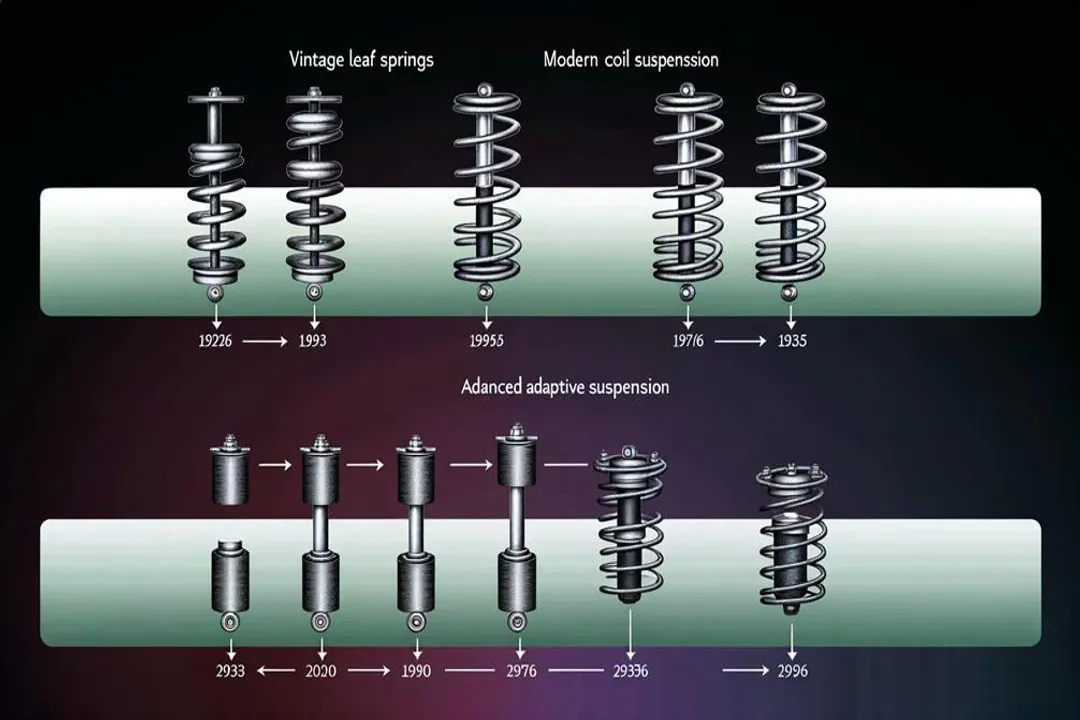
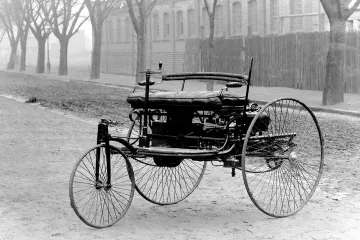
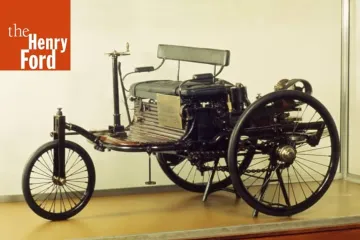
The initial appearance of a suspension system on a motorized vehicle is less a singular 'eureka' moment and more an immediate adoption of existing carriage technology. When the first automobiles sputtered onto rutted, unpaved roads, they required some method to keep the body from violently shaking apart, and the quickest solution was borrowing what already worked for horse-drawn buggies: springs. [9] Therefore, the first cars effectively had suspension the moment they left the workshop, provided they were built on chassis derived from or mimicking carriage design principles. [5][9]
# Primitive Isolation

The earliest functional automotive springing generally relied on leaf springs. [5][9] These were sets of curved strips of metal stacked on top of each other, forming an arc that allowed for vertical movement. They were attached directly between the solid axle and the vehicle frame. [1][9] This setup provided adequate load support and a basic buffer against minor surface irregularities. [1]
However, this early architecture had severe limitations that quickly became apparent as engineers gained experience. A horse-drawn carriage suspension was primarily designed to protect the delicate cargo—passengers or goods—from the jarring forces of the road. [9] An early automobile carried an added complication: the engine, transmission, and other heavy mechanical components needed protection too, an entirely new set of stresses that carriage builders never had to account for. [9] The heavy, unsprung mass meant that when one wheel hit a bump, the entire axle assembly swung up aggressively, often leading to poor wheel control over subsequent bumps, as the system lacked any mechanism to dampen the oscillation. [1]
# Adding Dampening

To improve ride quality and, more importantly, vehicle control, the next logical evolution was to introduce a device to control the back-and-forth movement created by the springs themselves. This led to the introduction of shock absorbers or dampers. [1] Early shock absorbers were crude, often relying on friction discs or simple viscous resistance to slow down the compression and rebound cycle of the leaf springs. [7]
While these additions certainly improved handling by controlling excessive spring movement, they were still attached to a solid axle system. [1][7] This meant that when the right wheel climbed over a stone, the left wheel was forced to follow its exact path, slightly lifting or dipping in response, which severely compromised grip and stability, particularly at the higher speeds automobiles could achieve compared to horse-drawn vehicles. [1]
# Independent Design
The true step change in suspension technology—the point where automotive design began to break decisively from its equine origins—was the move toward independent suspension. [2] This arrangement allows the wheel on one side of the vehicle to move vertically without directly affecting the position of the wheel on the opposite side. [1]
Pinpointing the absolute first production car with independent suspension is difficult, as development often happened concurrently in various experimental shops. [2] However, one notable early contender in front-wheel drive vehicles was the Tracta in the mid-1920s, which featured independent suspension on the front axle. [2] While groundbreaking, these early independent designs often utilized complex linkages and were not immediately adopted across the industry. [2]
For decades following these initial experiments, many manufacturers continued to rely on the proven, albeit less sophisticated, solid axle configuration for the rear wheels, often pairing it with coil springs or even evolving the leaf spring design, while experimenting with independent setups only on the front. [1][4] For instance, the 1934 Citroën Traction Avant is often cited for popularizing front-wheel drive and independent front suspension, making it a landmark vehicle in moving this technology into the mainstream, though not the absolute first example of the concept. [1] It wasn't until after World War II that truly mass-produced vehicles began adopting sophisticated independent suspension systems on all four corners. [4]
# Advanced Mechanics
Beyond the standard spring-and-damper setup, designers continuously sought ways to use different media for ride control, leading to specialized systems.
# Hydraulic Systems
The concept of using fluid dynamics for damping and even primary springing has been around for a long time, though it was never the standard for the first suspension. [6] Early attempts to implement hydraulic suspension involved using fluid-filled cylinders to manage wheel movement, aiming for a smoother ride than basic friction dampers could provide. [6] These systems were complex, often difficult to maintain, and required specialized components, which restricted their widespread use primarily to high-end or experimental vehicles for many decades. [6]
# Air Spring Concepts
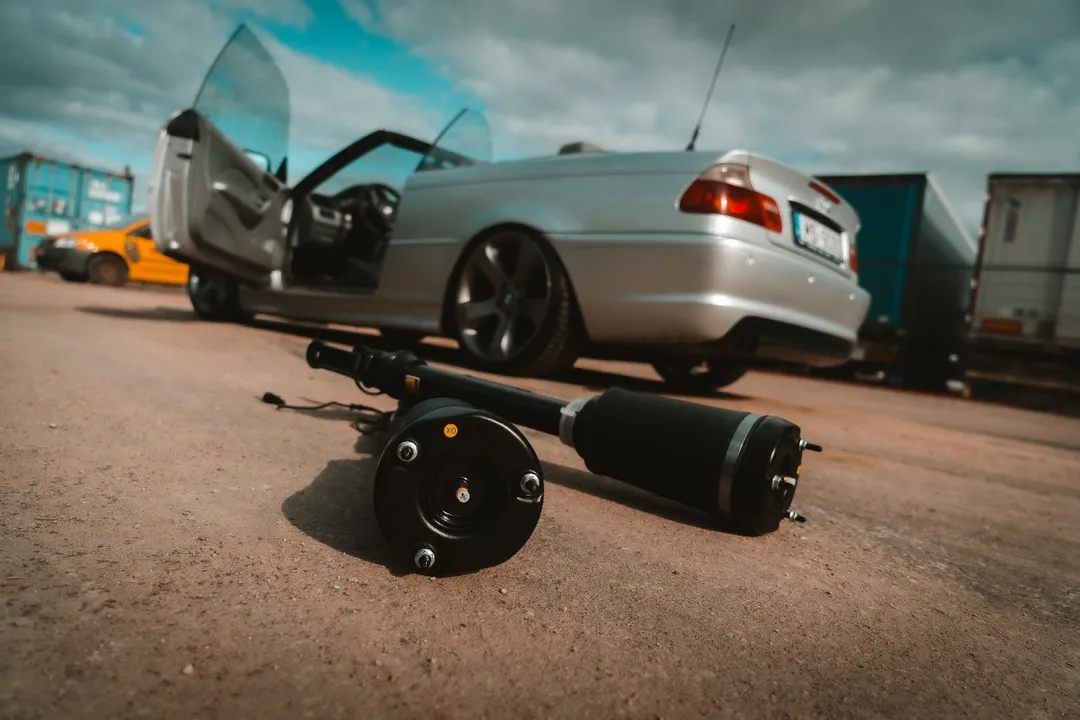
Another significant departure from mechanical steel springs is the air suspension system, which uses pressurized air bellows or bladders as the primary spring medium. [3] While modern air suspension is often associated with luxury or off-road performance vehicles, the idea is quite old. Concepts for using air for ride control were being toyed with as early as the 1930s, though achieving reliable, self-leveling, and durable operation proved elusive for many years. [3] It took a substantial amount of engineering refinement before air suspension moved from a novel concept to a practical component available to the general consumer. [3]
# Evolutionary Pace Analysis
The timeline reveals a fascinating pattern in automotive innovation. The initial jump from no suspension (a fixed axle directly to the frame) to some suspension (leaf springs) happened almost instantaneously in the late 19th century, born out of necessity derived from existing transport technology. [9] The subsequent leap from the primitive, coupled movement of a solid axle to the superior control of independent movement took several decades of trial and error throughout the early 20th century. [1][2] Once the fundamental challenge of allowing wheels to move independently while maintaining chassis stability was solved—a triumph of mechanical engineering in the 1920s and 30s—the rate of innovation seemed to accelerate. The transition from mechanical links to fluidic systems (hydraulics) and pneumatics (air) required entirely different scientific principles, yet these advanced systems were gradually integrated over the subsequent 50 to 70 years, often replacing the older independent setups rather than coexisting with the initial leaf-spring design. [3][6]
A good rule of thumb when assessing early automotive hardware is to judge the system based on its primary function. If the goal was merely keeping the body attached to the wheels over rough terrain, the first cars with leaf springs qualify. If the question implies a system designed specifically for superior road handling and comfort through controlled wheel articulation, then the answer lies in the development of independent suspension in the 1920s and 1930s, marking the true divergence from carriage engineering. [1][2]
| System Type | Primary Media | Defining Characteristic | Historical Context |
|---|---|---|---|
| Early System | Leaf Springs | Solid Axle Connection | Immediate adoption from carriage design [5] |
| Advanced Damping | Friction/Viscous Dampers | Controlled Oscillation | Added shortly after basic springing for stability [1][7] |
| Major Leap | Independent Suspension | Uncoupled Wheel Movement | Pioneered in the 1920s/30s for better grip [2] |
| Fluidic Control | Hydraulic Dampers | Use of incompressible fluid | Specialized, complex applications early on [6] |
| Modern Alternative | Air Bellows | Pressurized air chambers | Conceptually old, mass-market application later [3] |
This table illustrates that "the first car with suspension" is best answered by acknowledging the first technology used (leaf springs on motor vehicles) while recognizing that the first truly automotive suspension involved the invention of controlled damping and independent geometry. [1][5] The continued refinement, moving from basic mechanical springs to complex electronic controls, shows that suspension development is an ongoing process driven by the ever-increasing demands for speed, safety, and driver comfort. [4]
#Videos
World's first book on the history of car suspension - YouTube
Related Questions
#Citations
Car suspension - Wikipedia
What was the first car designed with Independent suspension? - Quora
Air Suspension: How Has it Developed over the Past 100 Years?
The Evolution of Car Suspension Systems - Gexhaust
The History of Automotive Springs - Katy Spring
History - first car to have hydraulic suspension - The Jalopy Journal
World's first book on the history of car suspension - YouTube
The Complete History of Automotive Suspension
How it works, Automobile suspension, Front suspension