What was the first bike with suspension?
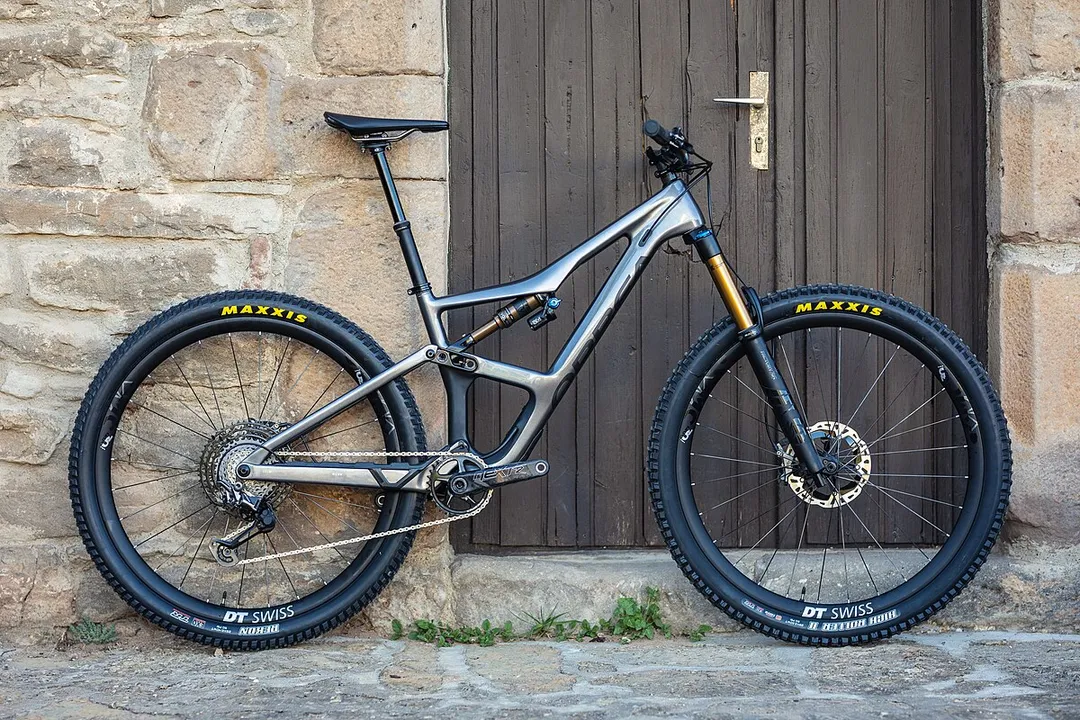
The origin of the first bicycle equipped with suspension is not a simple date or name; it’s a layered history that depends entirely on how one defines "bike" and "suspension." If we are talking about dampening road vibration on a standard bicycle, the concept dates back surprisingly far, predating modern mountain biking by nearly a century. However, if the focus narrows to the rugged, dual-suspension machines we recognize today, the timeline jumps forward to the late 1970s and early 1980s, marking a different kind of engineering revolution focused on control rather than mere comfort.[2][5]
# Antique Dampening
The earliest recorded example of a bicycle frame incorporating suspension features appears to come from around 1888. [5] This machine, often referred to as the "Cushion Wheel" bicycle, was created by Lewis Evans. [5] The engineering approach was foundational, aiming to smooth out the ride quality of the era's solid-tired, rigid-frame velocipedes. [5] Evans achieved this by constructing the frame not out of traditional welded tubes, but using strips of metal connected by bolts and, crucially, springs. [5]
This design prioritizes vertical compliance for rider comfort, a necessity when roads were often little more than rutted dirt paths. It’s fascinating to consider that the foundational idea—isolating the rider from the terrain—was present before many common bicycle components we take for granted today were even standardized. [5] While not designed for tackling steep, rocky descents, this 1888 invention sets the baseline for mechanical suspension on two wheels, proving that designers were looking for ways to mitigate impact forces immediately after the safety bicycle design took hold. [5] It serves as a powerful reminder that innovation in cycling often cycles back to improving the ride quality before speed or aggressive capability becomes the primary driver.[2]
# MTB Patent Emerges
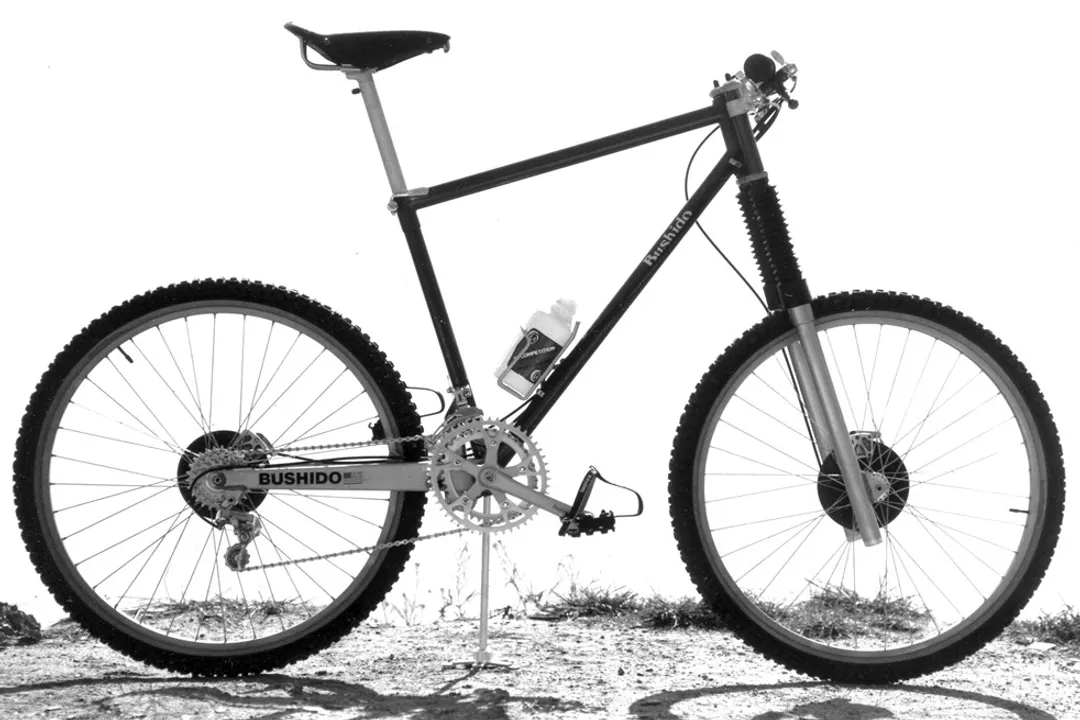
The story shifts dramatically when we look specifically at the mountain bike segment, where suspension became critical for managing rough, uneven trails rather than just poorly maintained city streets. The true genesis of the modern full-suspension mountain bike design is often credited to a patent filed in 1977 by Clyde Staley. [2][8][9] Staley’s design focused specifically on the rear wheel, engineering a linkage system to absorb impacts encountered while riding off-road. [8][9]
Staley’s concept was arguably the first articulation of the engineering problem that still defines mountain bike design: how to keep the rear wheel tracking the ground effectively for better traction and control while simultaneously absorbing shock. [2] Although his patent existed, it appears this design did not immediately translate into a widely available commercial product, leaving a gap between the theoretical breakthrough and market reality. [4] This early patent highlights a crucial stage in development: the articulation of the need for effective off-road damping, even if the industry wasn't quite ready to mass-produce the solution. [8]
# First Production Model
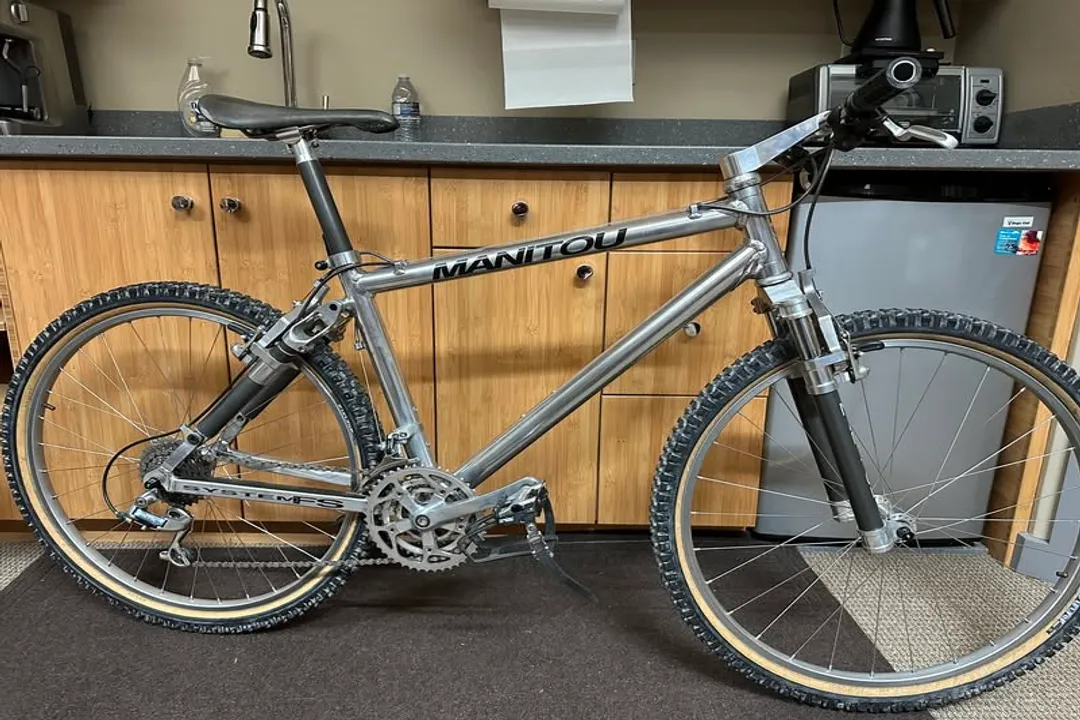
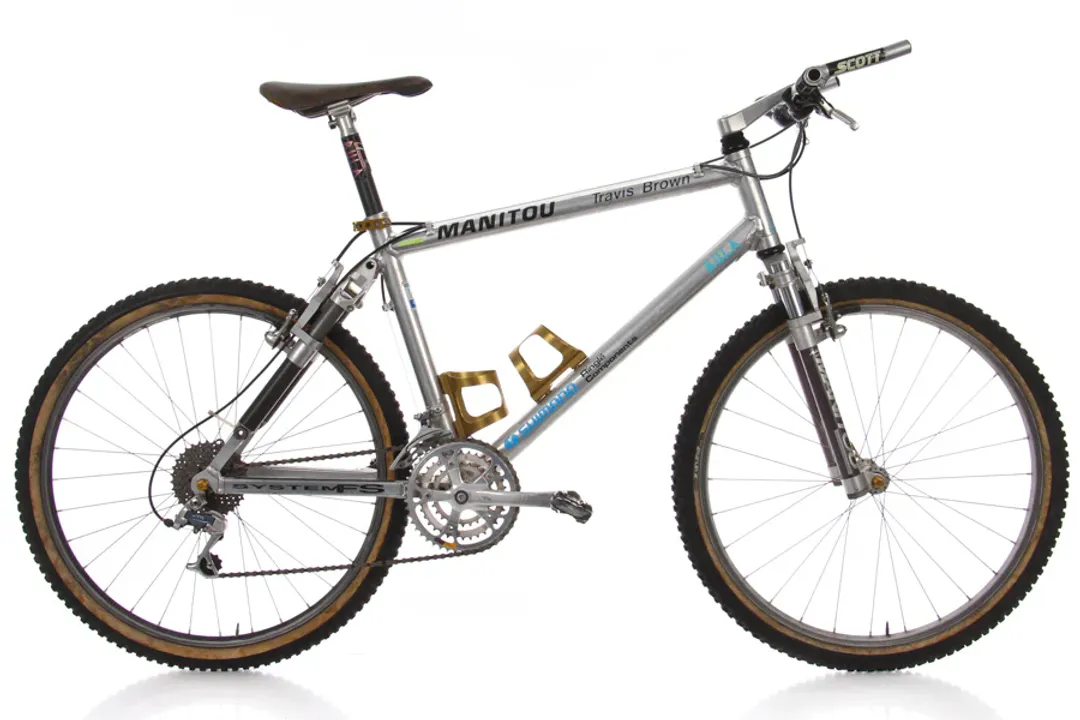
The conversation about the first production full-suspension mountain bike inevitably leads to Doug Bradbury and his Manitou 1. [4][9] Built starting around 1979 or 1980, the Manitou 1 is frequently cited as the first full-suspension mountain bike available for purchase, even if in very limited numbers. [3][4][9] It followed Staley’s conceptual groundwork but brought the idea into tangible, rideable form. [9]
The Manitou 1 featured a distinctive, linkage-actuated rear suspension system. [3] It wasn't merely a comfortable cruiser; it was designed with the competitive, demanding environment of early mountain biking in mind, representing a tangible step toward modern geometry and travel figures, even by today’s standards. [1][3] While the exact production numbers are likely small, its existence signifies the moment when some companies believed the market was ready to pay a premium for advanced frame technology that offered genuine off-road performance benefits over rigid frames. [1] A comparison between Staley’s patent and Bradbury’s production machine reveals a key difference: the patent defined the mechanism, while the Manitou 1 defined the marketable product. [2][4]
# Early Commercialization
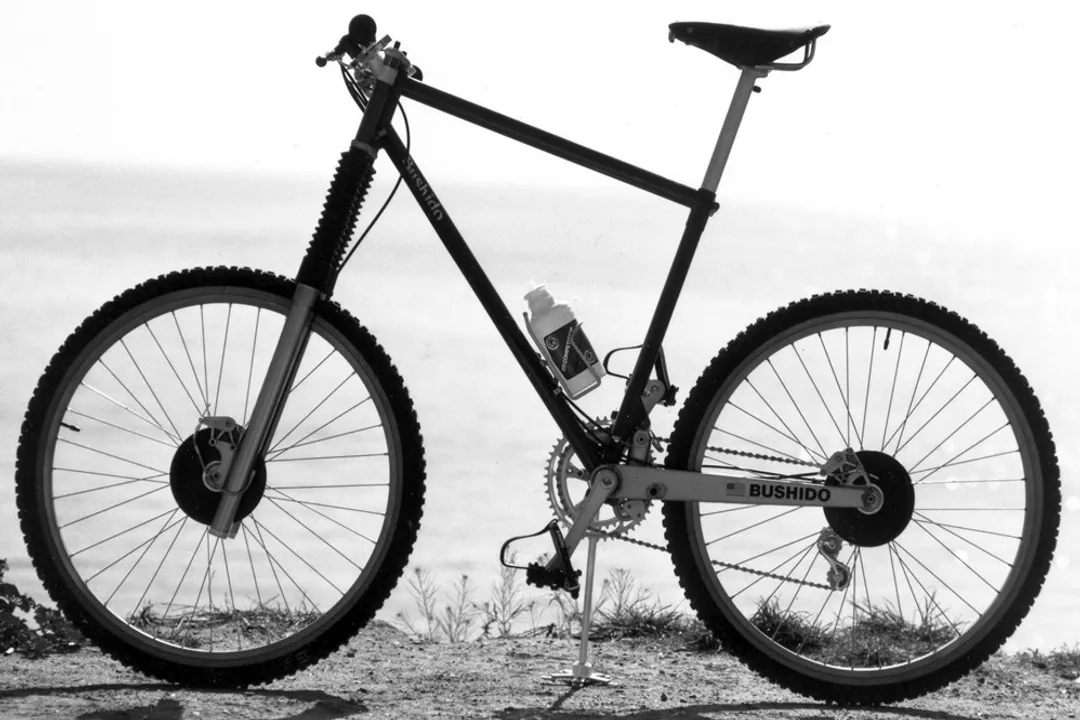
The initial attempts at full-suspension technology were often born from the specific needs of influential riders or small, highly specialized builders, leading to a scattered landscape of early prototypes and limited runs. These machines, while not mass-market successes initially, were vital proving grounds for suspension kinematics. [1]
The Greebie, for example, built by Jim Manton in 1982, stands out as another highly sought-after and historically significant early full-suspension bike. [1] It represented a continuing refinement of the concept in the early 1980s, even as many major manufacturers remained hesitant about the added complexity and cost. [1] Similarly, by 1983, even larger players like Raleigh were dipping their toes into the market with models like the Mustang. [1] These scattered releases suggest that the market was receiving these new concepts, but manufacturers were still experimenting with how to best deliver the technology—whether through linkage designs, pivot points, or coil/elastomer springs. [2]
It is interesting to note the engineering philosophy prevalent in these early production runs. While a 19th-century suspension bike aimed to isolate the rider from surface irregularities for comfort, these early 1980s MTBs were primarily concerned with tire contact. The goal was to maintain maximum rubber on the ground during high-speed impacts, thereby increasing braking ability and cornering grip on loose terrain. [5] This subtle shift in purpose—from comfort to performance control—marks the true turning point in the history of bicycle suspension technology. If you look at the initial market reception, many early full-suspension bikes were heavy and expensive, leading some riders to stick with the simpler, lighter rigid frames until the technology matured later in the decade. [10]
# The Technology Divide
When examining the 1888 Cushion Wheel next to the 1979 Manitou 1, one observes a complete divergence in engineering intent, which is an important analytical lens for understanding the history of suspension.
| Era | Primary Goal | Suspension Mechanism Example | Terrain Focus |
|---|---|---|---|
| c. 1888 | Rider Comfort | Frame strips connected by springs [5] | Paved/Unpaved Roads |
| c. 1979+ | Tire Control/Traction | Linkage-actuated rear suspension [3][4] | Technical Off-Road Trails |
The gap between these two points is significant. The earlier suspension systems were reactionary, designed to cushion a seated rider from a jarring impact. The later MTB systems were proactive, designed to manage the entire kinetic energy transfer between the wheel and the frame to maintain momentum and steering authority. [2] This realization—that a suspended wheel provides better performance uphill and downhill, not just on downhills—was a realization that took nearly 90 years to fully solidify in the design consciousness.[2][10]
Furthermore, the very first mountain bikes built by pioneers often featured modifications that hinted at suspension needs before the fully integrated designs arrived. For instance, some early custom builds experimented with linkage forks, such as a Specialized Stumpjumper modified around 1980 for rider Clif Sharp that featured a form of linkage up front. [6] These one-off creations, often driven by racers trying to gain a competitive edge, reveal that the need for travel was recognized almost as soon as dedicated off-road cycling gained traction, even if the patent office and manufacturers were a step behind. [2][6]
# Maturing the Mechanism
The initial skepticism surrounding early full-suspension bikes eventually gave way as designers refined the kinematics. By the mid-to-late 1980s, the industry began to move away from single-pivot or simple flex stays toward more sophisticated multi-link designs that better managed pedaling forces (pedal bob) while still offering meaningful travel. [10] The difference between the early, heavy, and sometimes poorly damped 1980s models and the eventual success of models in the 1990s lies in solving the control equation: how to offer significant travel without the bike sagging excessively under the rider's weight during pedaling efforts. [2]
It is worth noting that while the rear suspension saw early development with Staley and Bradbury, front suspension—the fork—took longer to achieve mainstream adoption and reliability. Many early full-suspension bikes utilized simple, heavy linkage or elastomer-based front ends that offered minimal, often inadequate, damping compared to the rear shock systems they were paired with. [4] For a rider in 1981 looking for a full-suspension experience, they were essentially buying into a system where the front end might still ride rigidly, which presents a unique riding challenge. This uneven development often meant that the front wheel slammed into obstacles while the rear managed to absorb smaller hits, creating a somewhat unbalanced feel that pioneers had to manage through sheer physical effort and skill. [6]
This historical progression confirms that the "first bike with suspension" depends on context. If you are a history buff interested in mechanical dampening, the answer is the 1888 Lewis Evans design. [5] If you are a mountain biker focused on the technology that enables modern trail riding, the answer is likely found in Clyde Staley’s 1977 patent or Doug Bradbury’s 1980 Manitou 1. [2][3][8] The journey from basic cushioning to high-performance control shows an evolution in the very definition of what a bicycle is supposed to do when taken off the pavement.[10]
#Videos
The First Mass Produced Full Suspension DH Bike - YouTube
Related Questions
#Citations
The First Full-Suspension Mountain Bikes: A Brief History of Full ...
Bicycle suspension - Wikipedia
the first full suspension mountain bike ever - Manitou #1, built by ...
What was the first production full suspension bike
The World's First Full-Suspension Bicycle, circa 1888
First bike with suspension : r/mountainbiking - Reddit
The First Mass Produced Full Suspension DH Bike - YouTube
First Full Suspension Mountain Bike – Charlie Kelly MTB Pioneer
Mountain Bike History Uncovered | Polygon Bikes US