What machine was used for cotton?
The long history of cotton use, stretching back millennia, is fundamentally a story of machines. Before any fabric could be created, the raw, harvested cotton—a protective boll full of fibers tightly wrapped around seeds—presented an immense obstacle. The machines developed to conquer this initial separation, and those that followed to draw those fibers into thread, ultimately dictated the speed, profitability, and scale of the entire textile world. Understanding the machinery is key to understanding the industry itself.
# Seed Separation
The absolute first mechanical challenge in cotton processing is ginning, the process of separating the usable fibers, or lint, from the seeds. For centuries, this was a painstaking, low-yield manual task that required hours of labor for just a small amount of clean fiber. The breakthrough that industrialized cotton depended entirely on machinery designed for this specific separation.
# Ancient Rollers
The earliest known mechanical approach utilized the roller gin. Evidence of a single-roller gin dates back to 5th-century India, depicted in Buddhist paintings. This concept evolved, with dual-roller gins appearing between the 12th and 14th centuries in India and China. The mechanism relies on gripping and stretching the fiber through rollers or blades. This older technology, often called the churka or charkha, was introduced to the American South in the mid-18th century. The roller gin proved effective, particularly for cleaning the superior long-staple cotton (like the Sea Island variety) grown in coastal regions, as it preserved the lint quality better by gently pulling the fibers away from the seeds.
# Whitney’s Engine
The true revolution for short-staple cotton—the variety common in upland regions—came with Eli Whitney’s cotton gin (short for cotton engine), patented in 1794. Whitney's design differed significantly from the gentle roller approach; it employed a series of slender wires or teeth mounted on a rotating cylinder. These teeth dragged the cotton fibers through narrow openings called ginning ribs. The seeds, being too large, could not pass through the ribs and were thus stripped away from the fiber. To prevent jamming, a second cylinder equipped with brushes wiped the clean lint off the saw teeth.
The efficiency contrast between the manual method and Whitney’s invention is staggering. While one laborer might take ten hours to clean a single pound by hand, a team using a cotton gin could produce around fifty pounds in one day. This dramatic increase in processing speed—sometimes cited as equivalent to 600 hours of hand labor in one hour of machine time—transformed cotton from a marginally profitable crop into a powerhouse commodity almost overnight.
It is worth noting a key differentiator: while Whitney’s saw gin was ideal for the sticky, short-staple upland cotton that Georgia planters desperately needed to monetize, it often damaged the longer, higher-quality fibers. For that finer fiber, roller gins, such as the later McCarthy’s gin (a smooth cylinder roller gin patented in 1840 using a reciprocating knife), remained more suitable.
A fascinating point of contrast lies in regional specialization driven by machinery. The roller gin’s gentleness preserves quality, making it suitable for premium, long-staple cotton, whereas the speed and aggressive action of the saw gin favored mass production of the more common short-staple variety. One can infer that the very choice of ginning technology historically shaped the market grade of the cotton being produced in any given area, as saw gins were common across the US South while roller gins were preferred elsewhere, such as in parts of Africa, though manufacturers like Lummus later adapted roller designs for modern use.
# System Ginning
The development did not stop with Whitney. Following the Civil War, efficiency demands in custom ginning operations—where farmers brought their seed cotton to a central facility for a fee—drove further innovation. The next major step was system ginning, pioneered by Robert S. Munger in 1879. Munger’s concept integrated all the machinery—feeders, gin stands, lint cleaners, and presses—into one continuous flow system. This process heavily relied on using air to move cotton between machines smoothly, making the operation faster, more cost-effective, and improving working conditions compared to the previous setup of separate, manually tended machines. Modern automated gins, capable of processing up to 15 tonnes per hour, are direct descendants of this integrated "Munger Revolution".
# Thread Creation
Once the fiber is clean, the next set of machines takes over: the cotton-spinning machinery. These devices transform the loosened, cleaned fiber mass into workable yarn or thread, a process that also saw massive evolution during the Industrial Revolution.
# Early Devices
Before the industrial era, all spinning relied on the spinning wheel, which originated in the Islamic world around 1030 and spread to Europe by the 13th century. This device allowed a spinner to draw out fiber and twist it using a single spindle, a slow, manual process.
The imbalance created when weaving became faster than hand-spinning spurred invention. In 1748, Lewis Paul developed the hand-driven carding machine to align fibers, followed by his Roller Spinning machine, which used differently sped rollers to draw the cotton to an even thickness. While Paul’s initial mills were not profitable, his principle was sound.
# Industrial Leapfrogging
The real acceleration came with machines that could handle multiple spindles:
- Spinning Jenny: Invented around 1764 by James Hargreaves, this was essentially a multi-spool adaptation of the spinning wheel, capable of spinning between six and 80 spindles simultaneously, providing a temporary relief to the weaving bottleneck. However, the yarn quality was often inferior.
- Water Frame: Patented by Richard Arkwright in the 1770s, this machine used water power and was much larger and heavier than the Jenny. Crucially, the Water Frame created a stronger yarn, though it could only spin in one direction and required a factory setting due to its reliance on a water wheel.
- Spinning Mule: Samuel Crompton’s 1779 invention combined the best features of the Jenny and the Water Frame. It used an intermittent process: extending the roving out while twisting it into yarn on the outward traverse, then reversing to wind the new yarn onto the spindle on the inward traverse. The Mule produced yarn quality comparable to the finest hand-spun Indian cotton and became the most common spinning machine for decades.
This historical progression demonstrates a clear cascading technological dependency in the textile sector. For instance, John Kay's 1733 Flying Shuttle sped up weaving immensely, creating a demand that initially overwhelmed spinners. The Jenny helped, but the Water Frame, powered by water, finally produced yarn strong enough to keep pace, shifting the operation from the home to the water-powered mill. When the Power Loom arrived, it sped up weaving again, which was subsequently matched by Richard Roberts’ automated Spinning Mule in 1831. The logic is clear: an advance in downstream processing must be followed by an advance in upstream preparation, or the system stalls.
# Modern Methods
The 20th and 21st centuries introduced high-productivity alternatives to the traditional Mule and Ring frames.
- Break or Open-End Spinning (Rotor Spinning): Developed in the mid-20th century, this method drastically increased output by feeding fiber slivers directly, eliminating the intermediate roving frame stage. While its yarns are often bulkier and slightly less strong than ring-spun varieties, its speed made it indispensable for medium and coarse yarns.
- Air-Jet Spinning: Commercialized in the 1980s, this technique uses high-velocity compressed air in a nozzle to create a vortex, twisting fibers around a parallel core. This results in yarns with low hairiness and very high production rates, ideal where smoothness is prioritized.
- DREF Friction Spinning: Developed in the 1970s, DREF spinning is optimized for extremely coarse yarns or technical textiles where the ability to incorporate core materials is beneficial.
# Mill Sequence
In a contemporary cotton mill, the raw cotton, often arriving in massive, compressed modules, moves through a strict, highly automated sequence of machinery designed to deliver consistent yarn.
# Opening and Cleaning
The first machine encountered is the Bale Opener, which breaks apart the tightly packed bales to ensure a uniform feed into the next section, the Blow Room. The blow room machinery employs various cleaners and beaters to aggressively remove initial impurities like trash, dust, and foreign matter. After this coarse cleaning, the cotton passes through a Cylinder Cleaner using rotating, spiked cylinders to further break up clumps, allowing finer soil and leaves to pass through screens and be removed.
# Alignment Refinement
After initial cleaning, the goal shifts to organizing the chaotic mass of fibers. This happens in the Carding Machine, which is critical for aligning the fibers into a parallel web known as a card sliver while removing any last vestiges of impurities. The next stage utilizes the Drawing Frame, which takes multiple card slivers, combines them, and draws them out. This drawing process ensures increased evenness and superior fiber alignment, essential qualities for any high-quality textile.
# Final Yarn Prep
The resulting slivers are then prepared for the final twist in two steps:
- Roving Frame: This machine takes the drawn slivers, further elongates them, and imparts a slight twist to create a roving—the long, thin strand ready for the final spinning.
- Spinning Frame: Here, the roving receives its final, substantial twist, adding the necessary strength and stability to become finished yarn. This process can yield anything from coarse to fine yarn counts based on the machine’s setting.
Following spinning, the yarn is collected by a Winding Machine, which packages it onto bobbins or cones, maintaining correct tension for transport or subsequent use. Some facilities also use Reeling Machines to wind yarn onto larger spools for dyeing or immediate fabric creation.
# Weaving Looms
Once the thread is spun and wound, it is ready to become cloth, a stage dominated by the Weaving Looms. Traditional weaving involved a series of warp yarns (running lengthwise) interlaced with the woof or filling yarn (running across). The Flying Shuttle, invented in 1733, automated the movement of the shuttle, dramatically increasing weaving speed and cloth width capabilities compared to hand-pushing.
Today, mills employ advanced systems like rapier looms or airjet looms to weave the prepared yarn into fabric structures. Post-weaving, the fabric must undergo a final battery of machines, including Fabric Inspection Machines to spot flaws, and Finishing Machines like stenter frames that apply dyeing, printing, or special coatings to achieve the final textile product.

# Combined Processes
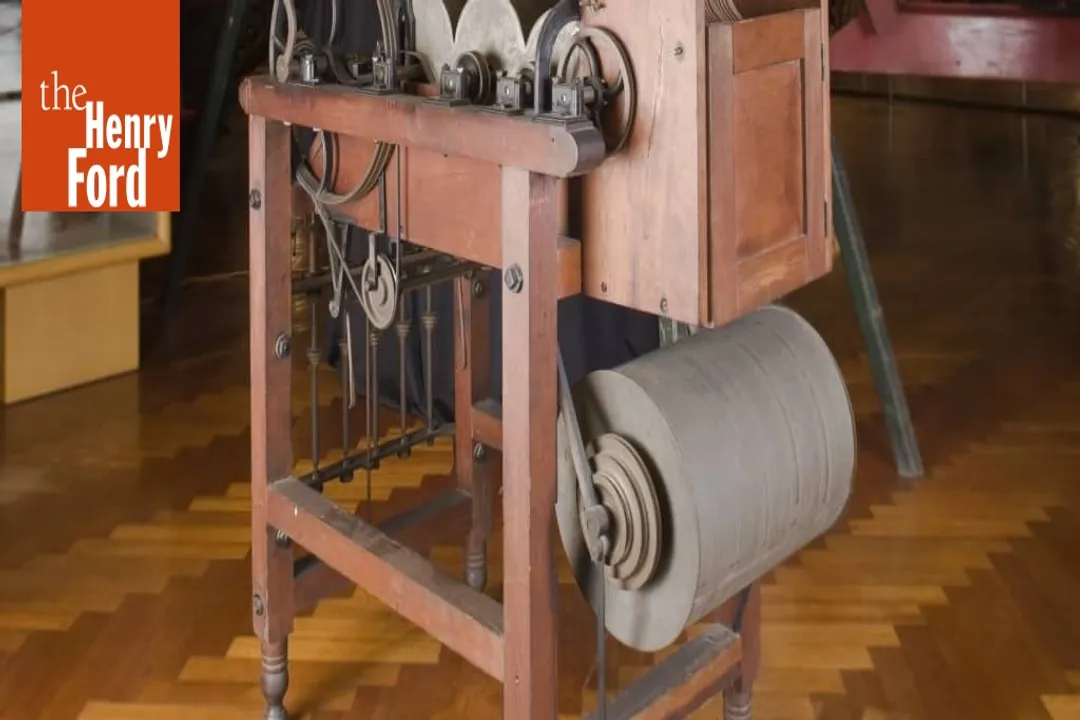
While the modern process separates every task into specialized machinery, an interesting historical outlier existed that attempted to consolidate the initial steps: the "plantation spinner" or "spinster". Built between 1835 and 1840, this compact, human-powered machine combined ginning, carding, and spinning into one unit. Its design was intended for enslaved plantation laborers. The sheer number of these combined units—around 3,000 in use across the South by the Civil War—highlights the intense need for localized, multi-step processing capability before the economy fully shifted to large-scale custom ginning. Ironically, these small integrated units became economically unviable after emancipation, illustrating how economic shifts instantly rendered certain machine designs obsolete. From the single-purpose, seed-separating engine to the sophisticated, high-speed air-jet spinner, every machine used in cotton processing represents an answer to a specific bottleneck, demonstrating how textile production has always been defined by mechanical ingenuity.
Related Questions
#Citations
Cotton gin - Wikipedia
Cotton Ginning, Carding, & Spinning Machine, 1835-1840
The History of Cotton Gin Machine
Automating Cotton Production | Baltimore Industry Tours
Cotton Gins - New Georgia Encyclopedia
Essential Equipment and Machinery in a Modern Cotton Mill