What is the name of the cotton spinning machine?

The quest to name the definitive cotton spinning machine quickly becomes a lesson in industrial history, revealing not one device, but a succession of groundbreaking inventions that fundamentally reshaped textile manufacturing. While the earliest machine to significantly multiply output was the Spinning Jenny, developed by James Hargreaves around 1764, it was just the opening act. The true story involves an evolutionary chain where each successor built upon the strengths and overcame the weaknesses of the previous model, moving spinning from a cottage industry task performed on a single wheel to a factory-based operation powered by water and steam.
# Jenny’s Start

The Spinning Jenny was a brilliant piece of mechanics for its time, allowing a single operator to spin multiple threads at once, often eight, though later iterations managed up to 120 spindles. This machine represented a massive leap in production capability over the traditional spinning wheel. However, its output had a distinct limitation: the yarn it produced was relatively soft and weak. Because the Jenny was operated entirely by hand, the mechanism did not impart the same amount of twist as later, more powerful machines, making its thread better suited for the weft—the softer, crosswise threads used in weaving—rather than the strong warp threads that form the structural foundation of the cloth. Early Jennies remained small enough to be used within a home workshop, keeping the process localized for a time.
# Water Frame

The next major machine to arrive was the Water Frame, credited to Richard Arkwright. This invention introduced the concept of external power, typically driven by a water wheel, hence its name. This change from manual operation to water power meant the machine had to be much larger and stationary, forcing production out of the home and into centralized mills, often situated near flowing water sources. The Water Frame's design provided a much greater amount of twist to the fiber, resulting in yarn that was significantly stronger and harder than that produced by the Jenny. This superior strength made Water Frame yarn ideal for use as the warp in weaving. The shift in power source necessitated a new organization of labor, where workers gathered at the mill site to attend to the machines, a crucial step toward the modern factory system.
# The Mule Machine

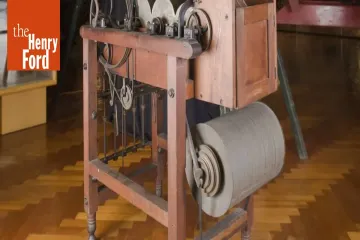
The definitive answer for high-quality, mass-produced cotton yarn arrived with the invention of the Spinning Mule by Samuel Crompton in 1779. The genius of the Mule was its hybrid nature; it effectively married the best aspects of the two prior inventions. It incorporated the flyer and bobbin system from the Water Frame, which maintained the twist, with the drawing mechanism from the Spinning Jenny, which attenuated the fibers. The result was a machine capable of producing yarn that was both incredibly fine and exceedingly strong. This capability allowed spinners to create high-quality, soft muslin fabrics that were previously impossible to manufacture economically. While early Mules were still hand-operated, later versions were adapted for water and eventually steam power, allowing them to spin hundreds of threads simultaneously.
To clarify the technological division of labor these three key machines established in the early stages of mechanization, here is a brief comparison focusing on their primary contribution to the finished textile:
| Machine Name | Inventor | Primary Power Source (Early) | Primary Yarn Quality | Best Use in Fabric |
|---|---|---|---|---|
| Spinning Jenny | James Hargreaves | Hand | Softer, weaker twist | Weft (cross threads) |
| Water Frame | Richard Arkwright | Water | Stronger, harder twist | Warp (structural threads) |
| Spinning Mule | Samuel Crompton | Hand / Water / Steam | Fine, soft, strong twist | Both, enabling fine muslins |
It is interesting to note that the technological separation—Jenny for weft and Frame for warp—created an immediate dependency in the weaving process; a weaver needed both types of yarn to create a complete cloth. Crompton's Mule elegantly solved this production bottleneck by offering a single machine that could meet both needs with superior quality, thereby streamlining the entire supply chain for textile manufacturers.
# Evolution of Power

The move from the hand-cranked Jenny to the water-powered Frame was perhaps the single most disruptive change in the production environment, even more so than the mechanical improvement of the Mule. When Arkwright's Water Frame required a dedicated building near a river to harness the necessary kinetic energy, the economic structure of spinning shifted away from independent artisans and into the hands of capitalists who could afford the building and the water rights. This physical requirement inadvertently created the factory system itself, concentrating labor, machinery, and management into a single location. A consequence often overlooked is that this concentration of labor, driven by the machine’s need for power, also led to new challenges regarding worker discipline and supervision, issues that the small-scale Jenny production never faced.

# Subsequent Improvements
While the Jenny, Frame, and Mule form the trinity of foundational cotton spinning machines from the 18th century, the advancements did not stop there. Subsequent engineers focused on automating the processes these inventors started. For instance, the early Spinning Mule still required a worker to manually spin and stretch the fibers during the drawing process. Later refinements involved automating this draw and spin cycle, leading to the Self-Acting Mule, improved significantly by Robert Smith and later, Richard Roberts. These later iterations brought in cams and other mechanical linkages to replace the human hand during the critical stages, further increasing consistency and speed. By the mid-19th century, machines were increasingly being driven by steam engines, releasing them from the geographical constraint of river locations and accelerating industrial growth across urban centers.
The sheer output difference between the initial hand spinning methods and these automated systems is staggering. Before the advent of these machines, a skilled spinner might manage perhaps five or six threads at a time, depending on their skill with the spinning wheel. Within a few decades, a single operator overseeing a Mule could manage the production of hundreds of consistent, high-quality strands, leading to textile prices plummeting and making cotton clothing accessible to nearly every economic class in Europe and beyond. Understanding which machine is being referenced—the Jenny, the Frame, or the Mule—is less about naming a machine and more about identifying which phase of the industrial revolution in textiles one is discussing.
#Videos
Monticello Spinning Jenny Operation - YouTube
Related Questions
#Citations
Spinning jenny - Wikipedia
The Spinning Jenny: A Woolen Revolution - Faribault Mill
Cotton Ginning, Carding, & Spinning Machine, 1835-1840
Frank Bachman - Invention of Spinning Machines - Heritage History
The Spinning Mule - Strutts North Mill Belper
Monticello Spinning Jenny Operation - YouTube
James Hargreaves and the Invention of the Spinning Jenny
Cotton-spinning machinery Facts for Kids