What card was used in the Jacquard loom?
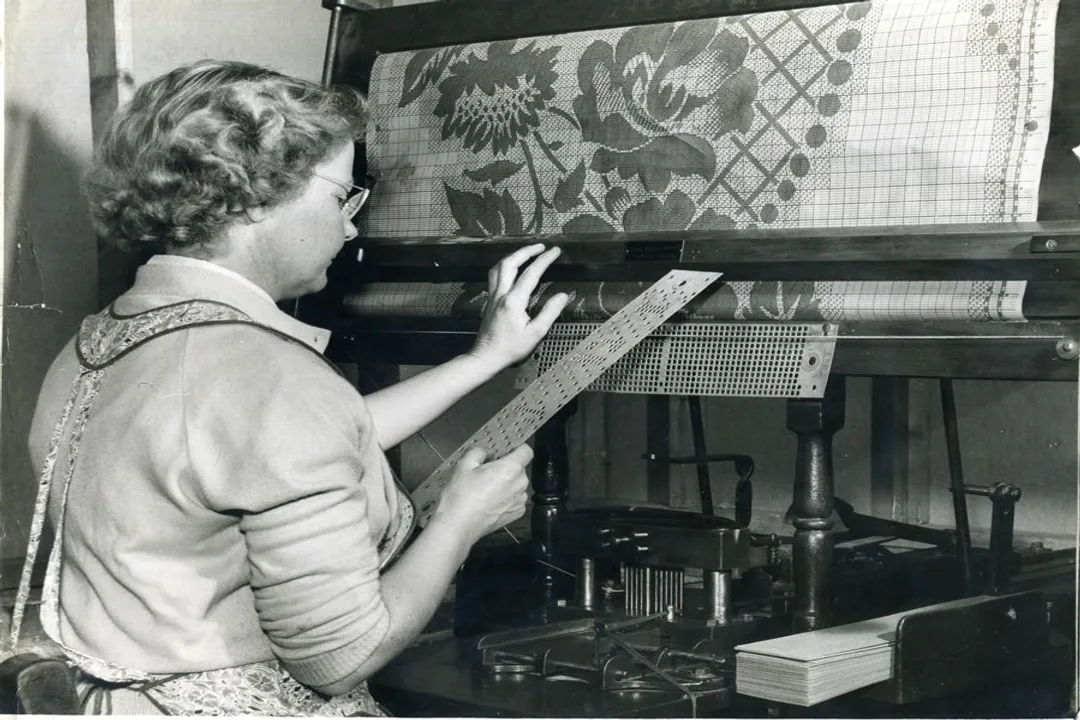
The mechanism that brought automation and programmable complexity to the textile world centered on a deceptively simple component: the punched card. [1][2][4] This seemingly ordinary piece of stiff material became the first widely adopted method for storing and executing complex instructions for a machine, forever changing the relationship between design and production. [4] Before this innovation, complex patterns in weaving often required intricate manual setups or specialized, fixed machinery that could only produce one style of fabric. [7] The introduction of the card system allowed the pattern itself to be separated from the loom's mechanics, making pattern changes as simple as swapping out the sequence of cards. [1]
# Inventor Genesis
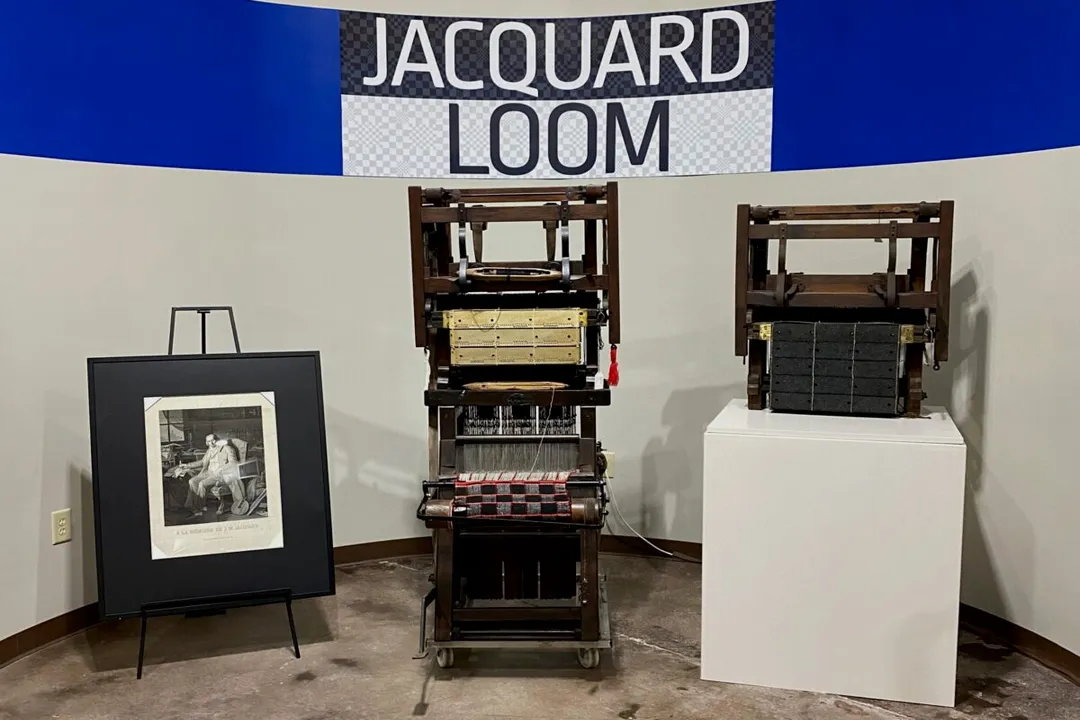
The breakthrough is credited to Joseph Marie Jacquard, who introduced his revolutionary loom mechanism around the beginning of the nineteenth century, with specific dates noted as 1801 [7][8][9] or shortly thereafter around 1804. [2] Jacquard’s work built upon earlier attempts to automate parts of the weaving process, but his system was the first to achieve true, generalized programmability for textile creation. [4] He effectively transformed the loom from a fixed tool into a machine that could follow coded instructions. [1] The invention was so significant that the machine bearing his name, the Jacquard loom, quickly became the standard for weaving intricate designs, making complex fabrics accessible beyond the most exclusive workshops. [7][8]
# Card Mechanics
The core function of the punched card was to act as a set of binary instructions for the loom's lifting mechanism. [8] Think of the loom as having hundreds or thousands of warp threads that need to be raised or lowered in a precise sequence to allow the shuttle carrying the weft thread to pass through and create the desired fabric structure. [1][5]
The card itself contained holes and unpunched (solid) areas. [8] When the stack of cards was fed through the machine, a sensing mechanism—often comprising needles or hooks—would interact with the card:
- If the mechanism encountered a hole in the card, it would pass through, resulting in one action (for example, leaving a specific warp thread in its resting position or allowing a specific hook to drop). [8]
- If the mechanism encountered a solid area on the card, it would be blocked, resulting in the opposite action (for example, causing a specific hook to lift the corresponding warp thread). [1][8]
Crucially, this interaction determined which set of warp threads would be lifted for that specific pass of the weft thread, known in weaving as a "pick". [7] Since a single textile pattern might require hundreds or thousands of distinct thread raises, a single card typically represented only one pick in the overall weave. [7]
# Linked Programs
A single card could not define an entire complex design; it only defined a single row of the pattern. [7] To weave a complete design, the loom required a sequence of these individual instruction cards. [6] Jacquard engineered a way to link these cards together end-to-end using metal hooks or strings, creating a continuous, sequential program. [1][2] As the loom completed one row, the mechanism advanced to the next card in the linked series, effectively reading the next instruction for the subsequent weft pass. [6]
This arrangement introduced an early concept of modularity into machinery. The program—the sequence of cards—could be detached from the hardware—the loom itself. [1] If a weaver wanted to produce a damask instead of a brocade, they didn't need to rebuild the internal mechanics of the machine; they simply needed to substitute one stack of cards for another. [4]
This modularity offers a fascinating comparative view when considering early industrial mechanics. While a cam-based machine from that era would physically encode the pattern into the shape of a rotating wheel, requiring significant physical rework to change the output, the Jacquard system encoded the pattern onto lightweight, replaceable media. [1] One could visualize this difference: Cam-based automation is akin to writing instructions directly into the machine's physical gears, whereas the Jacquard system is like using software—the hardware remains constant while the program dictates the result. [4]
# The Inherited Legacy
The profound implications of the Jacquard loom extended far beyond silk production. The concept of using punched cards to store and execute arbitrary, complex sequences of operations planted a seed in the minds of later thinkers grappling with calculation and data processing. [4]
The most famous inheritor of this idea was Charles Babbage. When Babbage conceived of his Analytical Engine, a purely mechanical precursor to the modern computer, he explicitly planned to employ Jacquard’s punched cards to input both the data and the operational instructions (the "program") for his calculations. [2][4] The hole/no-hole logic that determined which warp thread lifted perfectly mapped onto the binary logic required for computation—a state representing 'on' or 'off', 'true' or 'false'. [4]
This line of descent continued into the late nineteenth century with Herman Hollerith, who adapted the punched card principle for data tabulation, notably used in the 1890 U.S. Census. [4] Hollerith's system, which used electricity to read the presence or absence of a hole in a card, streamlined data processing in a way that mirrored Jacquard’s mechanical selection process years earlier. [4] The sheer scale difference is telling: a loom might require thousands of cards to define a single decorative fabric swatch, while Hollerith’s system might use a few cards per person to record census data, but the fundamental intellectual leap—encoding information onto a physical, machine-readable medium—remained consistent. [4][9]
# Enduring Significance
The Jacquard loom, driven by its simple punched cards, represents a key turning point where information control became mechanically distinct from the mechanical action itself. [1][4] The method of linking the cards together in a precise order, ensuring that row followed row without human intervention, established the basic concept of sequential processing that underpins all modern programming logic. [6] While the materials were cardboard and string, the underlying idea was pure information architecture. [1][9]
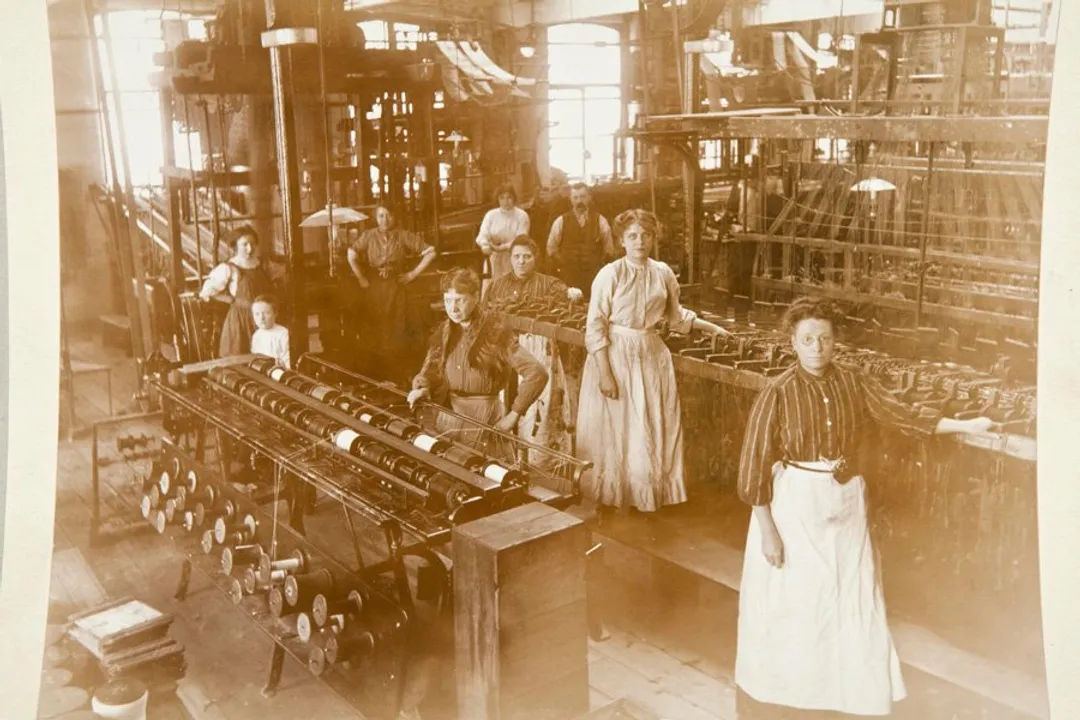
It is important to note the inherent fragility and maintenance demands of this system, which offers a practical counterpoint to its conceptual elegance. In a busy mill, these paper or stiff card programs were susceptible to humidity, wear, and accidental damage, potentially corrupting an entire sequence for a high-value fabric run. [6] A torn or slightly warped card could cause a flaw in the pattern that might only become noticeable after many yards of material were woven, demanding careful handling and regular replacement of the "software". [1] This reality underscores that even the earliest forms of automated control systems required diligent physical upkeep of the stored instructions themselves, a lesson that modern software maintenance tacitly carries forward, albeit with digital rather than physical decay. The Jacquard card, therefore, is not just a historical artifact of weaving; it is the first tangible representation of software in action, dictating the output of complex machinery through coded notation. [4]
This early adoption of a reproducible, external program set a precedent for the entire digital age that followed nearly a century later. [2] The humble, hole-filled card was the silent partner in ushering in the era of automated information processing. [4][9]
Related Questions
#Citations
1801: Punched cards control Jacquard loom | The Storage Engine
Jacquard machine - Wikipedia
Punch card from 1801 Jacquard loom - Facebook
Jacquard, Babbage, and Hollerith: Punch Card History
How a "punch card" weaving machine, invented by Joseph ... - Reddit
The Jaquard Loom at CMoA - Mimms Museum of Technology and Art
Programming patterns: the story of the Jacquard loom
Joseph-Marie Jacquard's Loom Uses Punched Cards to Store Patterns