How did James West impact society?

The everyday soundscape of the modern world—the clarity of a phone call, the recording on a digital assistant, the audio input on a laptop—owes an enormous debt to the ingenuity of one man: Dr. James Edward Maceo West. His work didn't just improve existing technology; it created the foundation for an entirely new category of small, efficient, and affordable audio capture devices that permeate nearly every electronic gadget we use today. [1][6] It is difficult to overstate the societal shift initiated by the electret condenser microphone (ECM), an invention that has quietly made global, instant, and personalized communication both portable and economical. [4]
# The Invention

In 1962, while working at Bell Labs, James West, alongside his colleague Gerhard Sessler, created the electret condenser microphone. [1][3][4] This was a significant departure from the bulky, power-hungry microphones prevalent at the time. [1] The fundamental breakthrough involved utilizing an electret material—a permanently charged dielectric—which eliminated the need for an external polarizing voltage that traditional condenser microphones required. [4] This innovation drastically reduced the size, power consumption, and cost of microphones. [1][4]
Before the ECM, microphones were often limited to stationary applications or bulky, dedicated equipment. West and Sessler's design allowed for miniaturization that was previously unimaginable. [1] This shift from large, stationary audio equipment to tiny, integrated components is a massive, subtle change in technological history. Think about the difference between an old reel-to-reel tape recorder and a modern smartphone; the ECM is a key component enabling that physical transformation, allowing voice to become an integrated feature rather than an add-on accessory. [1][4]
# Early Barriers
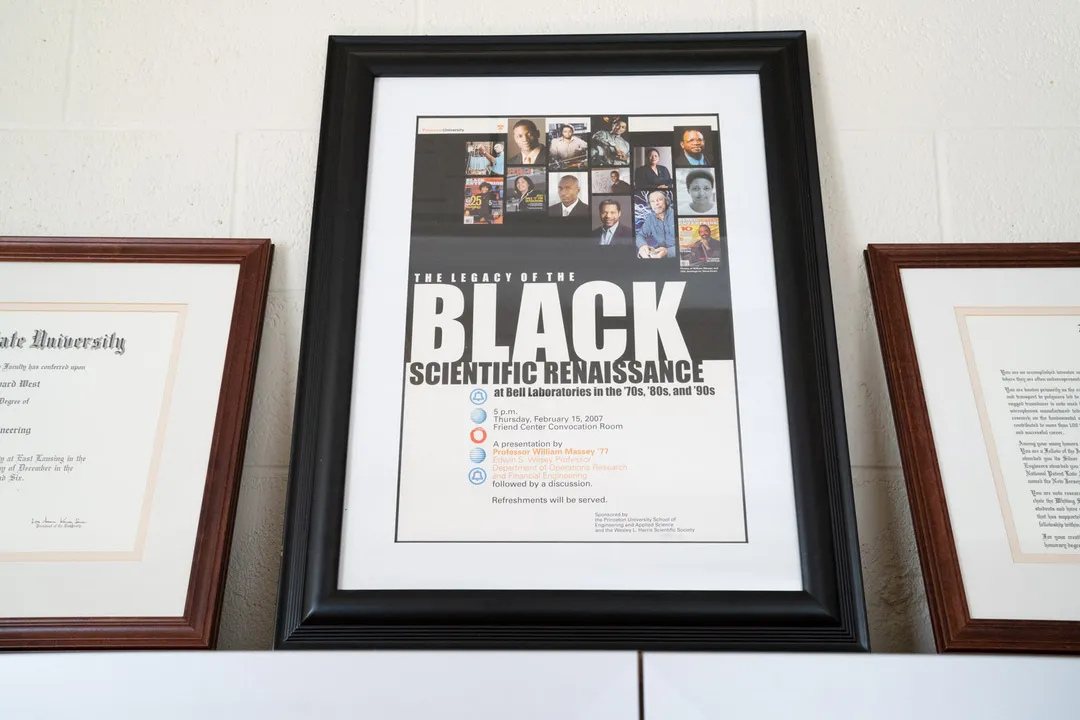
James West’s success in the laboratory was achieved despite significant institutional obstacles rooted in racial prejudice. [2][5] Born in 1931 in Farmville, Virginia, West’s ambition to pursue a career in science was met with discouragement early on. [8] After earning his Bachelor of Science degree in physics from Virginia State College (now Virginia State University) in 1954, he eventually joined Bell Labs in 1957. [8][2]
However, even after securing his position, West encountered bias that limited his professional trajectory. An early supervisor advised him against applying for professional engineering roles, citing his race as a barrier to advancement within the company structure. [2][5] This direct obstruction to growth illustrates the difficult climate many Black scientists navigated. West’s perseverance, first by focusing on the technical challenges presented to him, and later by achieving world-altering inventions, stands as a powerful counterpoint to those initial limitations. [2] It serves as a strong reminder that restricting access based on identity invariably stifles potential breakthroughs that could benefit everyone. [7]

# Global Reach
The societal impact of the ECM stems directly from its versatility and low cost, which drove adoption across countless industries. [1][4] The invention essentially democratized high-quality audio capture. [7] Because the microphone was small, inexpensive to manufacture, and required minimal power, it became the default choice for integrating sound into consumer electronics. [1][4]
The applications are staggering in their scope:
- Telecommunications: Modern cell phones rely heavily on ECM technology for clear voice transmission. [1][4]
- Assistive Technology: Hearing aids have been dramatically improved by the small size and efficiency of these microphones. [1][6]
- Recording and Security: Digital voice recorders, answering machines, and security and surveillance systems all utilize this technology for inconspicuous and reliable audio input. [1][4]
- Computing: Teleconferencing systems and voice-activated software on personal computers and tablets depend on these miniature transducers. [1][6]
If you consider the sheer volume of devices manufactured globally each year that require a microphone, James West’s 1962 invention is not merely an important patent; it is a persistent, invisible utility that underpins modern interaction. It’s a foundational technology, much like the transistor, that disappears into the product itself while enabling functionality. [1]
# Patents and Recognition
James West’s career was marked by prolific innovation beyond the ECM. Throughout his tenure at Bell Labs, which concluded with his retirement in 1992, he amassed an impressive intellectual property portfolio. [2][5] He currently holds more than 250 patents. [1][2][5] This body of work spans diverse areas, including acoustics, underwater sound detection, and biomedical instrumentation, indicating a broad and dedicated scientific curiosity. [2]
His contributions to science and invention have been recognized at the highest levels. In 1997, Dr. West was inducted into the National Inventors Hall of Fame. [1][2][5][6] This honor recognized the profound influence of the electret microphone on communication technology. Further validation came in 2007 when he was awarded the Presidential National Medal of Technology and Innovation by the U.S. government. [1][5]

# Future Focus
While his engineering achievements cemented his legacy, Dr. West has dedicated significant post-retirement energy to inspiring the next generation of scientists and inventors. [1][2][5] Recognizing the barriers he faced, he has become a vocal advocate for increasing diversity and opportunity in science, technology, engineering, and mathematics (STEM) fields, particularly for minority students. [1][5]
His efforts often involve working directly with young people, showing them the possibilities within science and encouraging them to pursue education in technical disciplines. [6] He emphasizes the importance of access to resources and mentorship, viewing the cultivation of talent as critical for continued societal and technological progress. [7] It is an interesting reflection point that a man whose work made personal communication easier for billions continues to focus his efforts on breaking down the personal barriers that prevent capable individuals from entering the field where such world-changing work is done. [2][7] By highlighting the tangible reality of his success, Dr. West provides a powerful example that success in invention is accessible to those who persist, regardless of the societal headwinds they face. [5]
# Lasting Legacy
James West's impact is a dual one: first, the tangible, ubiquitous technology of the electret microphone that powers modern communication; and second, the powerful example set by his life story. He took a specific, difficult problem—how to make a high-quality microphone small and cheap—and solved it in a way that fundamentally altered the design constraints of almost every subsequent electronic device. [1][4] This invention is not a historical footnote; it is an active ingredient in the connectivity that defines the early 21st century. [6] His sustained record of innovation, evidenced by his hundreds of patents, confirms his status as one of the most significant inventors of the modern era. [2][5] The way we hear the world today is demonstrably better, smaller, and clearer because James West refused to accept limitations, both technical and societal. [1][7]
Related Questions
#Citations
Listen up: James West forever changed the way we hear the world
James West's Biography - The HistoryMakers
Going beyond the horizon | USPTO
You should know James West, the Black inventor of the electret ...
Black History Maker in Technology: James Edward West
Celebrating Dr. James West: A Pioneer in Sound Technology
Just Imagine…Letting Voices Be Heard - Interactivity Foundation
James Edward Maceo West (1931- ) | BlackPast.org
Listen up: James West forever changed the way we hear the world