What does James Watt do?

James Watt stands as one of the most significant figures in the history of mechanical engineering, primarily recognized for his transformative work on the steam engine, an invention that fundamentally reshaped the world's industrial capabilities. [1][2] While the concept of using steam for power predates him by centuries, Watt's genius lay in applying meticulous scientific observation and practical engineering insight to overcome the inherent inefficiencies of existing machines. [4][6] His contributions effectively made steam power reliable, efficient, and widely applicable, setting the stage for the full scope of the Industrial Revolution. [2][5]
# Apprentice Skills
Watt's early life provided the foundational skills that would later define his inventive career. [1] Born in Greenock, Scotland, in 1736, he was the son of a shipwright and lenient parents who encouraged his early inclination toward mechanics and mathematics. [1][6][8] Though he was often too ill for regular schooling, his curiosity led him to explore mathematics, natural philosophy, and chemistry. [1] He showed an early aptitude for making models and instruments, skills that required precision far beyond that of a typical craftsman of the era. [1][6]
After a brief period apprenticed to an instrument maker in Glasgow, Watt traveled to London around the age of nineteen to further hone his craft. [1] He spent a year learning instrument-making techniques, gaining experience with delicate and precise work, which was crucial for the tolerances needed in high-efficiency machinery. [1] Returning to Glasgow, he set up his own business as a mathematical instrument maker near the University of Glasgow. [1][4]
It was through this university connection that his career trajectory shifted decisively toward steam power. [1] In 1759, he was introduced to Professor John Anderson, who asked him to repair a model of the Newcomen atmospheric engine, a machine used primarily for pumping water out of coal mines. [1][4][5] The model’s poor performance sparked Watt’s lifelong obsession with improving steam technology. [1][4]
# Steam Engine Faults
The Newcomen engine, invented by Thomas Newcomen around 1712, was revolutionary because it was the first commercially successful machine to harness steam power for practical work, mainly draining flooded mines. [5][6] However, it was incredibly wasteful of fuel, which was a major limiting factor on where mines could be profitably worked. [5] The principle of the Newcomen engine relied on creating a vacuum to allow atmospheric pressure to drive the piston down after the steam cylinder was filled with steam and then cooled by injecting cold water directly into the cylinder itself. [5][6]
Watt quickly identified the core inefficiency: the constant cycle of heating and cooling the cylinder with every stroke wasted enormous amounts of fuel. [5][6] The steam that filled the cylinder was used to heat the metal walls, and then, in the next step, this heat energy was immediately destroyed by the cold water injection used to condense the steam and create the vacuum. [5] The machine effectively wasted nearly 75 percent of the energy supplied by the coal in merely reheating the cylinder. [5]
Watt recognized that if the cylinder could be kept perpetually hot, the process would require far less steam and, therefore, far less coal. [5] This observation was the theoretical foundation upon which his first major patent was based. [4]
# Condenser Separation
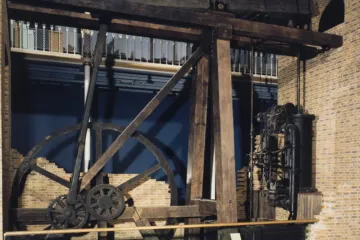
Watt’s breakthrough, developed around 1765, was the invention of the separate condenser. [1][2][4] This was not a mere tweak; it was a complete rethinking of the engine's thermodynamic cycle. [4] Instead of injecting cooling water directly into the main working cylinder, Watt diverted the used, lower-pressure steam into a separate chamber—the condenser—which was kept permanently cold. [2][5][6]
The process was elegant:
- Steam entered the main cylinder, pushing the piston up (or down, depending on the configuration).
- The steam was then exhausted from the main cylinder into the separate, cold condenser.
- The sudden cooling caused the steam to condense back into water, creating a vacuum.
- Atmospheric pressure then drove the piston for the power stroke. [2][4][5]
By isolating the cold condensing process from the working cylinder, Watt ensured the main cylinder remained hot, drastically reducing the energy wasted on reheating. [5][6] This invention alone is estimated to have reduced fuel consumption by roughly 75 percent compared to the Newcomen engine. [5]
A key analytical point here is that while the Newcomen engine was thermally inefficient, its practical constraint was location; it could only be economical where coal was cheap and abundant (i.e., at the mine itself). [5] Watt’s separate condenser technology decoupled operational cost from location. A far more efficient engine meant that factories could now be built in burgeoning urban centers near labor, markets, and transportation hubs, accelerating urbanization and industrial diversification away from just the coalfields. [1]
This initial invention earned Watt a patent in 1769. [1] However, initial manufacturing proved difficult, and the necessary high-precision machining techniques to create the required airtight seals were not yet fully developed, delaying commercial success. [1][4]
# Mechanical Advances
Having solved the fundamental thermodynamic problem, Watt’s focus shifted to expanding the engine’s utility beyond simple up-and-down pump work. [6] The Newcomen engine provided only one power stroke per cycle, driven by atmospheric pressure pushing the piston down after the vacuum formed, meaning it was inherently an atmospheric engine, not a steam-pressure engine. [6] Watt added several innovations to create a true, continuous rotary power source suitable for driving factory machinery, such as spinning frames and looms. [4][6]
# Rotary Motion
To convert the reciprocating (back-and-forth) motion into circular (rotary) motion required for driving machinery, Watt initially developed the sun and planet gear system. [4][6] This gear arrangement allowed the engine to turn a central shaft continuously. [6] This was an important stopgap, especially since he could not directly patent the use of the crank, which was already protected by an existing patent held by another inventor. [4]
# Double Action
Another major improvement was the double-acting engine. [4][6] Instead of only using steam to create a vacuum on one side while atmospheric pressure pushed the piston on the other, Watt introduced steam pressure to both sides of the piston alternately. [4][6] This meant that the piston was driven by steam during both the forward and return strokes, effectively doubling the power output and smoothing the engine's operation. [4][6]
# Parallel Motion
For a rotary engine to work smoothly, the connection between the piston rod and the rotating mechanism needed a complex linkage that allowed the piston to move in a straight vertical line while the beam it was attached to moved in an arc. [4][9] Watt spent years developing what he called his parallel motion mechanism, patented in 1784. [4][9] This linkage used a system of interconnected bars that ensured the piston rod moved nearly perfectly vertically, eliminating sideways thrust and wear on the cylinder walls. [4] This system is considered one of the finest examples of kinematic design in engineering history. [4]
# Engine Control
To maintain a steady speed regardless of load variation, Watt introduced the centrifugal governor. [4] This device used spinning weights that moved outward as the engine sped up, automatically adjusting the steam valve to slow the engine down, and vice-versa. [4] This self-regulating capability was essential for applications requiring consistent speeds, such as textile manufacturing. [4]
# Boulton Partnership
The sheer complexity and scale of manufacturing these highly precise components required capital and manufacturing expertise beyond what Watt possessed alone. [2][9] This necessity led to his crucial business relationship with Matthew Boulton, a successful manufacturer from Birmingham. [2][9] In 1775, Boulton and Watt formed a partnership to manufacture and sell the improved steam engines. [2][9]
Boulton provided the essential business acumen, capital investment, and access to skilled metalworkers and foundries necessary to produce the engines reliably. [2][9] Watt supplied the inventive genius and the detailed drawings. [2] This partnership was one of the most famous collaborations in industrial history, effectively combining engineering excellence with entrepreneurial drive. [2] Their arrangement was unique; they generally did not sell the engines outright. Instead, they charged a royalty fee equal to one-third of the coal saved by the user compared to the older Newcomen engines. [2][9] This royalty structure incentivized customers to adopt the more efficient, albeit expensive, Watt engine, as the savings guaranteed a return on investment. [2]
The success of the Boulton & Watt company grew steadily, moving from repairing old engines to installing hundreds of new ones across Britain and eventually exporting them internationally. [2][9] By the time the main patent expired in 1800, the firm was highly profitable, and Watt retired from the business, leaving it in the hands of his son, James Watt Jr., and Boulton’s son, Matthew Robinson Boulton. [1][2]
# Power Unit
James Watt’s enduring legacy extends into the very language we use to measure energy and work. [3][5] While his name is forever tied to the engine, his contributions to standardized measurement cemented his place in physics and engineering. [3] The fundamental unit of power in the International System of Units (SI) is named the Watt. [3][5]
A Watt is defined as one joule of energy per second. [3][5] Watt originally conceived of a unit called "horsepower" to market his engine’s capabilities to potential buyers, relating the engine's output to the known power of draft horses. [5] He estimated that one of his engines could do the work of approximately 12 horses. [5] However, the later adoption of his name as the standard unit for power—the Watt—solidified his contribution to the field of mechanical measurement itself. [3][5]
Considering the historical context, Watt’s initial work calculating the equivalent of horsepower offers a tangible starting point for understanding his impact. If a typical draft horse could perform about 33,000 foot-pounds of work per minute, and Watt’s engine could reliably exceed that rate, his innovation immediately provided engineers and industrialists with a standardized, repeatable metric to compare mechanical labor against traditional organic power sources. [5] This translation from the abstract concept of energy conversion into a practical, marketable unit like horsepower was as important as the thermodynamic efficiency itself for adoption. [5]
# Industrial Shift
The combined effect of Watt’s patented improvements—the separate condenser, double-acting cylinder, parallel motion, and governor—was the creation of a versatile, reliable machine that could be placed anywhere fuel was available. [1][4] This industrial power source began to replace water wheels and animal power across various sectors. [5]
While his improvements were largely focused on low-pressure engines—steam pressure was kept near atmospheric levels—the underlying principles revolutionized productivity in textiling, milling, and metalworking. [1][4] The efficiency gains meant coal usage dropped dramatically, making industrialization economically viable on a massive scale. [5]
Watt was recognized for his brilliance during his lifetime, receiving numerous honors. [1] He was elected a Fellow of the Royal Society of Edinburgh in 1784 and a Fellow of the Royal Society of London in 1785. [1] He continued to work and invent, though his later inventions were less impactful than his core steam engine work. [1] He passed away in 1819 at the age of 83. [1] The sheer breadth of his technical achievement—moving from a faulty university model to designing the engine that drove global commerce—demonstrates an exceptional combination of theoretical understanding and practical engineering execution. [4][6] His work fundamentally changed how humans harnessed energy, marking a decisive break from reliance on renewable, location-dependent sources like wind and water power. [5]
Related Questions
#Citations
James Watt - Wikipedia
James Watt | Biography, Inventions, Steam Engine ... - Britannica
James Watt - Magnet Academy - National MagLab
Discoveries - James Watt - Science Hall of Fame - Digital gallery
James Watt | SEE Science Center
Heroes of Progress, Pt. 13: James Watt | Sphere Ed
Inventors: James Watt
James Watt: Architect of Progress Through Innovation - Scotland's Wild
James Watt - ASME
Local Historic People: James Watt | Birmingham Museums