What is James E. West famous for?

The name James E. West is intrinsically linked to the way we communicate today, even if his face isn't as recognizable as the devices his work made possible. He is the inventor whose dedication to electrical engineering led to the creation of the electret microphone, a component so small and efficient that it became the standard for nearly every piece of personal electronic equipment, from cell phones to hearing aids. [1][5][6] This single invention fundamentally altered the landscape of acoustics and personal technology by shrinking down the heart of sound capture.
# Electret Microphone

The breakthrough moment came in 1962 while West was a researcher at Bell Laboratories. [1][5] Working alongside his colleague Gerhard Sessler, West co-invented the electret condenser microphone. [1][6] Before this development, microphones used in consumer electronics were often bulky, required external power sources, or were prohibitively expensive for widespread integration into small devices. [1]
West and Sessler pioneered the use of an electret material—a dielectric material that retains a permanent electric charge—in a condenser microphone design. [1][6] This innovation allowed the microphone to be manufactured in an incredibly small size, often just a few millimeters across, while maintaining high sensitivity and requiring very little power. [1][5] Imagine trying to fit a traditional, large diaphragm microphone into a modern smartphone; it simply would not work. West’s contribution provided the necessary solid-state foundation for miniaturization in audio technology. [1]
The ubiquity of the electret microphone is staggering. It is estimated that billions of these devices are produced annually. [1] They are the essential element for voice recording in everything from answering machines and video cameras to computers and, most notably, virtually every modern telephone and hearing aid. [1][6] This technology didn't just improve existing products; it enabled entirely new product categories that relied on compact, affordable audio input. Thinking about the sheer volume of communication happening across digital platforms today, it’s clear that the infrastructure for voice transmission relies heavily on this quiet, tiny innovation from the early 1960s. [1]
# Academic Roots
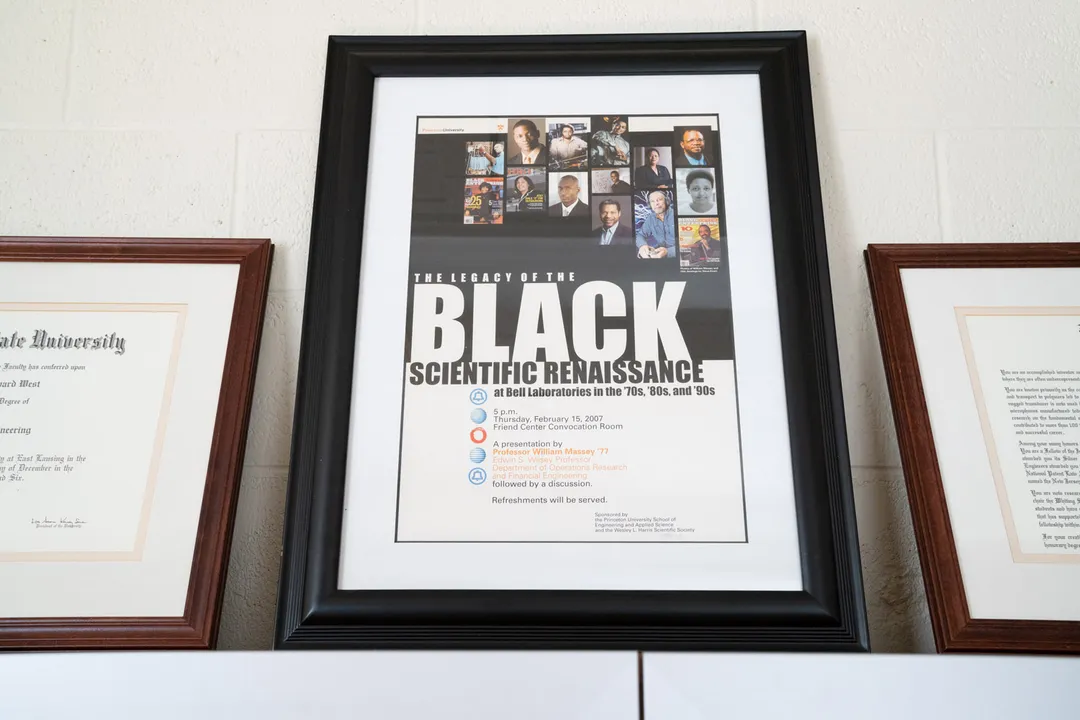
James Edward Maceo West’s path to such a monumental invention was paved through rigorous education and determination. [3][4] Born in Farmville, Virginia, his early life instilled a strong work ethic. [3] He served in the U.S. Army, including during the Korean War, before dedicating himself to higher education. [1]
He earned his Bachelor of Science degree from Fisk University in 1954. [1][2][3] Following this, he set his sights on advanced study in electrical engineering, leading him to Johns Hopkins University. [2] In 1967, West achieved a significant milestone, becoming the first African American to receive a Ph.D. in Electrical Engineering from that institution. [1][2][3] Navigating the academic and professional worlds as a minority required a level of focus and perseverance that often goes unmentioned in simple biographical sketches, underscoring the personal commitment required to reach the highest levels of technical expertise. [3]

# Bell Laboratories Tenure
Upon completing his graduate studies, West’s career trajectory settled at Bell Laboratories, where he would spend four decades researching and developing acoustic devices. [1][5] While the electret microphone is his most famous achievement, his work was much broader. [1][5] He was an active researcher holding over 40 patents across various fields. [1][5]
His interests extended beyond simple telephony; he conducted significant research into sonar technology and other underwater acoustic applications. [1] This diversification within acoustics showcases an engineer dedicated to applying fundamental principles across different practical domains, rather than specializing in only one narrow field. [2] His long tenure at a premier research facility like Bell Labs provided the environment necessary to nurture long-term projects, like the electret concept, which required years of patient refinement before commercial viability. [1]
# Recognition and Service
West’s contributions have earned him some of the highest honors in American science and engineering. [4] In 1997, he was awarded the National Medal of Technology and Innovation by President Bill Clinton, recognizing his role in advancing American technology. [1][4][7] This award specifically recognized his work in acoustic transduction, confirming the national significance of the electret principle he helped establish. [7]
His standing in the scientific community is further evidenced by his fellowship in the Institute of Electrical and Electronics Engineers (IEEE). [2] Furthermore, he has served the Acoustical Society of America (ASA), an organization dedicated to the science of sound, not only as a Fellow but also as its President. [1][2]
Beyond his patents and titles, West has consistently championed the importance of diversity in the scientific workforce. [1][5] He has dedicated considerable effort to encouraging minorities and women to pursue careers in science and engineering. [5] This commitment to mentorship and advocacy demonstrates an understanding that innovation relies not just on individual genius, but on cultivating the next generation of diverse thinkers capable of tackling future challenges. [1]

# Lasting Influence
The impact of James E. West’s work is best understood by considering what might have been had the electret microphone not been developed when it was. One can look at the technological evolution of the mid-20th century and see a trend toward smaller, solid-state electronics replacing bulky vacuum tube technology. West’s invention fits perfectly into this transition for audio interfaces. [1]
Consider the comparison between early 20th-century radio transmitters, which required large carbon microphones, and today’s near-invisible microphones in smart glasses or earbuds. The transition wasn't just about making things smaller; it was about making them mass-producible at low cost while retaining high fidelity. The electret design achieved both, which is why it dominates the market today over many other potential microphone designs. The value isn't just in the science, but in the economic democratization of sound capture it enabled. [1][5]
To truly appreciate West's contribution, one must look at the sheer breadth of his patent portfolio. While the electret microphone is the flagship, having over 40 patents suggests a mind constantly solving problems across acoustic physics. For aspiring engineers looking at his career, this serves as a quiet reminder that foundational success often builds upon a deep, broad base of expertise, not just one lucky breakthrough. [1][5] His legacy, therefore, is two-fold: the tangible, universally used technology and the inspiring example of an accomplished professional who actively worked to open doors for others in the technical fields. [1][3]
Related Questions
#Citations
James West (inventor) - Wikipedia
James West - Johns Hopkins Whiting School of Engineering
James West's Biography - The HistoryMakers
James Edward Maceo West
Dr. James E. West: Electret Microphone Inventor
James West (inventor) Facts for Kids
[PDF] James E. West, PH.D. Acoustical Science Inventor, Electret ...
James E. West | The Franklin Institute
Going beyond the horizon | USPTO