How did James West change the world?

James West fundamentally altered the landscape of modern communication and recording, an achievement rooted in a single, unassuming electrical component: the electret microphone. [1][6] His work, conducted while employed at Bell Laboratories, did more than just improve audio capture; it paved the way for the miniaturization that defines nearly every piece of personal electronic equipment we rely on today. [6][8] Before his breakthrough, capturing high-quality sound required relatively bulky, complex, and power-hungry devices, but West’s innovation offered a path toward small, efficient, and ubiquitous audio input. [7]
# Beginnings in Science

Born in 1931, [5] James Edward Maceo West's early life hinted at the technical aptitude that would later define his professional career. [2] He displayed an interest in mechanics and electronics from a young age, reportedly beginning his tinkering with devices in his early teens. [2] His path toward significant scientific contribution was not necessarily linear, but it was marked by determination, eventually leading him to Temple University for his undergraduate studies. [2] Following this, he continued his education, obtaining a master's degree from the University of Michigan. [2]
West joined the esteemed halls of Bell Laboratories in 1957. [2][9] At the time, Bell Labs was a powerhouse of innovation, fostering an environment where groundbreaking research frequently occurred. [9] His initial assignments involved working on transducers—devices that convert one form of energy into another—which set the stage for his most famous contribution to the field of acoustics. [9]
# The Electret Discovery
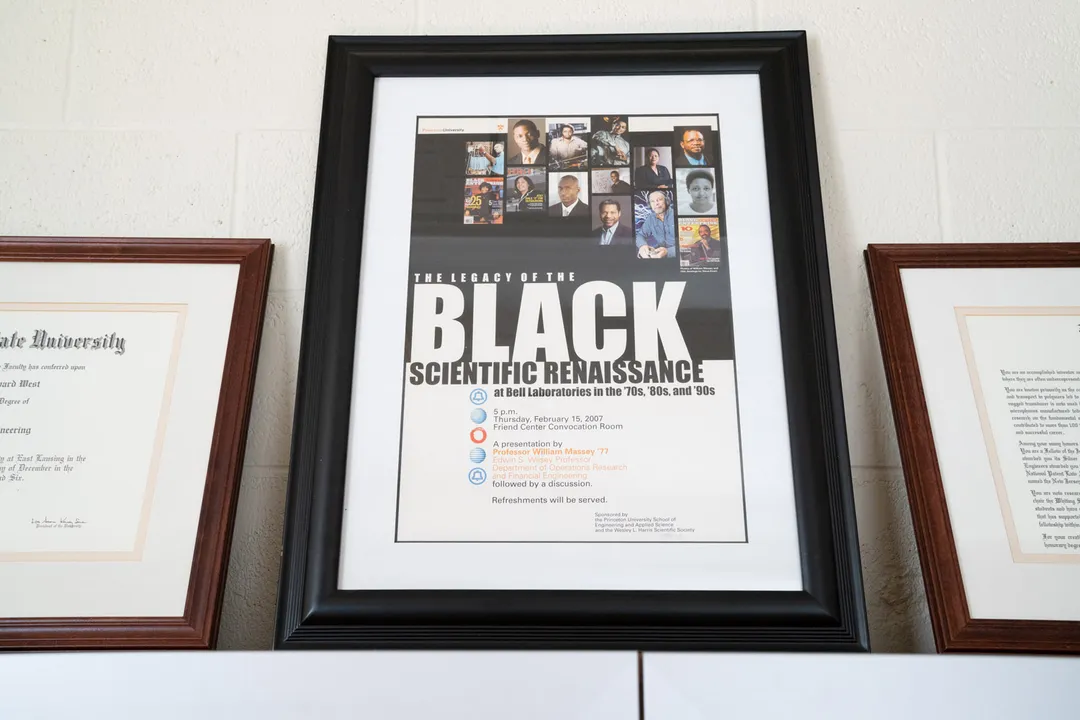
The development that secured West's place in technological history occurred in 1960. [1][6][7] Working alongside his colleague Gerhard Sessler, [6][7] West was tasked with developing a better microphone technology. [1] The existing standard for high-fidelity sound recording was the condenser microphone, which, while excellent in quality, was cumbersome and required external polarization voltage to operate effectively. [6][7] This requirement made them unsuitable for portable or small-scale devices. [6]
The critical innovation was perfecting the electret microphone. [1][3][7] An electret, in principle, is a dielectric material that has a quasi-permanent electric charge or dipole polarization, functioning much like a permanent magnet does for magnetism. [7] West and Sessler focused on finding the right material to hold this necessary charge reliably and efficiently. [7] They successfully developed a method utilizing a thin layer of Teflon coated with a proprietary polymer. [7] This material allowed the microphone to retain the necessary charge permanently, eliminating the need for external power sources to maintain the electrostatic field required for operation. [7]
This was a profound step in materials science applied to acoustics. Think of the difference: prior to this, a high-quality mic might require a bulky power supply or a large, rigid casing to maintain the necessary electrical potential. West’s refinement meant that the entire functioning element could be reduced to something minuscule and stable. [6] An interesting aspect of this invention is how it bypassed the need for constant energy input—the electret itself became the constant polarization source. It is a testament to clever material engineering that this complex electrical function could be locked into a solid material, offering performance nearly matching the larger, powered condenser types. [1] The result was a microphone that was small, durable, inexpensive to manufacture, and highly sensitive, making it revolutionary for mass production. [6]
# Redefining Audio Reach
The immediate impact of the electret microphone was to democratize high-quality audio capture. [1][8] Because of its small size and low power requirements, this technology could be embedded almost anywhere. [6]
To truly grasp the scale of this transformation, consider the shift from the 1950s desk telephone to the modern smartphone. The older equipment relied on much larger carbon or dynamic microphones. [7] West’s invention, and the variations it spawned, allowed for the sleek, integrated microphones we now take for granted.
The sheer ubiquity of the electret microphone principle is astonishing. It is estimated that over 90 percent of all microphones manufactured today rely on the technology that West helped perfect. [4][6] This is not just confined to telephones; nearly every device that needs to listen—from camcorders and laptops to digital voice recorders and sophisticated hearing aids—is utilizing a descendant of that 1960s Bell Labs breakthrough. [1][8] It is a foundational technology that underpins modern digital communication, streaming, and personal recording capabilities. [4]
| Device Type | Pre-Electret Microphone Tech (Typical) | Post-Electret Integration |
|---|---|---|
| Landline Telephone | Carbon Button or Large Dynamic | Miniaturized Electret Capsule |
| Early Camcorder | Large Condenser or Dynamic | Small, lightweight Electret Array |
| Hearing Aid | Specialized, low-power dynamic | High-sensitivity Electret |
| Modern Smartphone | MEMS variation based on Electret principle | Integrated across multiple units |
This level of integration suggests an interesting paradox in the economics of invention. While West’s work is central to billions of devices worldwide, the very nature of a foundational, patented component absorbed into massive consumer electronics manufacturing often means the direct financial rewards for the inventor are far less than the societal value created. [9] This reality underscores why recognition through national honors becomes so important for inventors who create world-changing, yet often invisible, technology. [4]
# A Career Focused Forward
James West’s contributions were not limited to that single, defining invention. [9] After the initial success, he continued his work at Bell Labs, focusing on transducer technology, including developing ferroelectric ceramic microphones and ultrasonic devices. [2][9] His dedication to research earned him numerous patents over his career. [5] He later transitioned into academia, taking on a professorship at Johns Hopkins University, where he continued to apply his expertise. [1][9]
Beyond the laboratory, West became deeply committed to ensuring that the next generation, particularly those from underrepresented backgrounds, had the opportunity to succeed in science and engineering. [4][9] He recognized the importance of having diverse perspectives contributing to innovation, advocating for better inclusion in technical fields. [9] He has consistently emphasized the concept of "paying it forward," suggesting that success in a scientific career comes with an obligation to mentor and guide others. [9]
His efforts in mentoring often centered on demystifying the process of invention and patenting, encouraging young people to see the practical application of science in their daily lives. [4] Through his teaching and advocacy, West served as a tangible example that significant scientific achievement is accessible through diligence and specialized knowledge, regardless of background. [9]

# Recognition and Lasting Impact
The sheer scale of the electret microphone's deployment eventually brought substantial recognition to its primary developers. [6] In 1997, James West was honored with the National Medal of Technology by President Bill Clinton, one of the nation's highest honors for technological achievement. [4][5] This was a significant acknowledgment, placing his work on par with other monumental American inventions. [4]
Furthermore, his accomplishments were cemented when he was inducted into the National Inventors Hall of Fame. [4] These accolades serve not just to honor West himself, but also to shine a light on the critical, yet often overlooked, role of materials science in everyday electronics. [7]
The transformation James West initiated is one of pervasive miniaturization. [6] It is a subtle change that, upon reflection, defines our modern relationship with technology. We now carry devices capable of recording high-fidelity audio for hours in our pockets, a capability that would have required equipment the size of a small suitcase just a few decades prior. [1] This is the quiet revolution James West delivered: he didn't just invent a microphone; he provided the tiny, efficient ear for the digital age. [8] His legacy is not found in a single, massive machine, but in the nearly invisible component that gives voice to almost every piece of personal communication technology across the globe. [1][6]
Related Questions
#Citations
Listen up: James West forever changed the way we hear the world
James West's Biography - The HistoryMakers
You should know James West, the Black inventor of the electret ...
Going beyond the horizon | USPTO
James Edward Maceo West (1931- ) | BlackPast.org
Listen up: James West forever changed the way we hear the world
Jim West's marvellous microphone | Opinion - Chemistry World
Dr. James West: The Black Innovator Who Gave the World a Voice
Sound Reasoning - Johns Hopkins Magazine