Has the sewing machine changed over time?

The way we construct textiles, from the simplest seam to the most intricate garment, has undergone a profound transformation over the last two and a half centuries. The sewing machine, often taken for granted today, represents one of the most significant mechanical shifts in human history, drastically altering industry, commerce, and the daily life of nearly everyone, particularly women. [3][6] While the history of hand sewing stretches back tens of thousands of years with the simple bone needle, the history of its mechanical counterpart is a relatively brief but intensely dramatic episode of innovation and industrial warfare. [3]
# Early Concepts

The motivation to mechanize sewing arose from the early Industrial Revolution, which began in Great Britain around 1760. [3] New inventions in spinning and weaving led to an abundance of fabric that outpaced the ability of tailors and seamstresses to sew it together by hand, making the sewing machine concept almost inevitable. [3] Early pioneers focused on mimicking the complex motions of hand sewing, often using single threads and needles that had to be pushed entirely through the material before being pulled back, a process too finicky for the technology of the time. [2][6]
The first documented patent related to this technology came in 1755 when Charles Weisenthal, a German physician working in England, patented a specialized needle with an eye at the pointed end. [3][5] This needle design proved crucial, as it became a standard element for functional machines later on. [3] A few decades later, in 1790, Thomas Saint produced detailed patent drawings for a machine intended for leather and canvas that cleverly incorporated a needle bar and a feed mechanism to advance the material uniformly. [5] However, there is no evidence Saint ever built a working prototype. [3]
The early 1800s saw inventors trying to bridge the gap between design and reality, often meeting resistance. In 1810, German stocking weaver Balthasar Krems created a machine specifically for sewing caps. [3] Though it may not have worked well or received a patent, Krems is credited with creating the needle format we use today—eye at the point. [3] Later, Josef Madersperger received a patent in 1815, but faced widespread rejection rooted in technophobia—the fear that new technology would eliminate jobs. [3] This social anxiety proved to be a significant impediment for several decades. [3] The French inventor Barthélemy Thimonnier created what is widely considered the first commercially viable machine in 1829, using a hooked needle for a chain stitch. He even established the world’s first sewing machine factory, securing a contract for French army uniforms, but in 1831, a mob of angry tailors burned his factory down. [3][5]
# Lockstitch Emerges

The true foundation for modern, strong seams arrived with the lockstitch concept, which uses two interlocking threads rather than a single chain stitch. [3] Walter Hunt, an American mechanic, designed a crude machine in 1834 that employed this two-thread interlocking stitch, featuring a curved needle with the eye at the point, similar to a machine that would later work. [3] Despite this breakthrough, Hunt never patented his design, reportedly out of concern that he would put seamstresses out of work. [3]
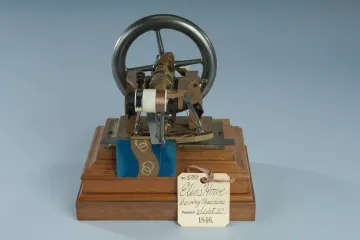
The patent for the first genuinely practical sewing machine arrived in 1846 when Elias Howe secured his patent. [3][6] Howe combined several necessary elements: the eye-at-the-point needle (though still curved), a shuttle underneath the cloth to create the lockstitch, and an automatic feed mechanism. [3] Unfortunately for Howe, his machine was heavy, clumsy, and prone to jamming; it was not much better in practice than Hunt’s earlier version, and tailors found it too expensive and troublesome compared to hiring hand labor. [3]
# Singer's Revolution
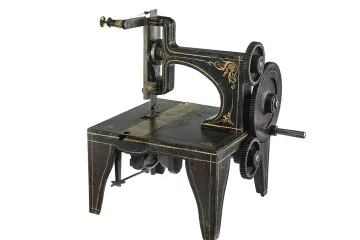
While Howe struggled to finance production, other mechanics were improving upon the concept, notably Isaac Singer. [3] Singer, a businessman with an actor’s flair for marketing, patented his improvements in 1850. [3] He made the shuttle move in a straight line instead of a circle and utilized straight needles, an improvement on Howe’s curved design. [3] More importantly, Singer added features that made the machine usable by non-experts: the presser foot to hold the fabric down, tension control, and the ability to stitch in a curve. [3][5]
Singer, along with his savvy partner Edward Cabot Clark, pivoted the machine away from industrial use—where Howe originally aimed—and directly toward the home. [3] The initial price tag of $100 (a substantial sum then) was prohibitive. [3] To solve this, Clark introduced the installment purchasing plan, the first of its kind, making the machine accessible to a wider population. [3][6] Singer also applied industrial techniques, such as interchangeable parts, to mass-produce the machines, slashing the price by 50%. [3]
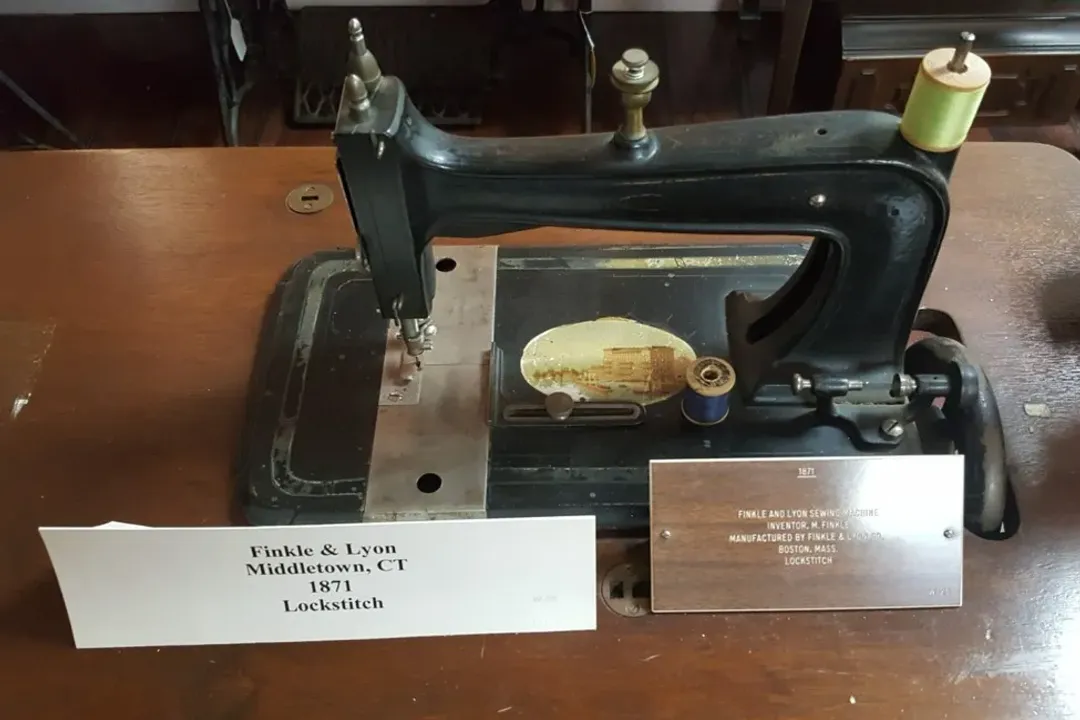
The mid-1850s were marked by the Sewing Machine Patent Wars. [3] Howe sued Singer and others for infringement, and by 1854, a commission ruled Howe’s patent valid, forcing all manufacturers to pay him royalties. [3] This conflict led to the first patent pool in U.S. history in 1856, the Sewing Machine Combination, which included Singer, Howe, and Wheeler & Wilson. [3] This combination standardized technology across the industry until Howe's original patent expired in 1877. [3]
It is an interesting paradox that the initial resistance to the machine from skilled laborers—tailors and seamstresses who feared job loss—instead created a massive new sector of employment. [3] Because the machines were too expensive for poor urban "shirtwomen" who earned perhaps $1.50 for a 14-hour day, owners purchased the heavy industrial models in bulk, established sweatshops, and hired these women to operate them for low wages in centralized locations. [6] While the machine ended the cottage industry, it did not eliminate the hardship for the working class; it simply relocated and reorganized it. [6]
# Home Adoption
The sewing machine’s impact on the burgeoning middle class was significant, facilitating the Cult of Domesticity—the idealization of the woman as the manager of the home. [6] When middle-class families could afford the machine (which often sat proudly in the living room as a status symbol), it was seen as proof that the wife was managing her domain scientifically. [6] Manufacturers aggressively marketed to women, hiring female demonstrators to prove they could master the complex mechanisms. [3] In fact, many women discovered a mechanical aptitude that surprised their male counterparts, mastering the intricate mechanics needed for oiling and tightening screws, essentially acting as women as mechanics. There were even medical concerns raised at the time, with some doctors suggesting the foot-pedal operation could negatively affect women’s reproductive health. [6]
The convenience it brought was undeniable: sewing a shirt by hand took about 14 hours, but a machine could do it in just over an hour. [2] This time saving, combined with the widespread availability of size-graded paper patterns developed by Ebenezer Butterick starting in 1863, democratized fashion construction for the home sewer. [6] By the turn of the century, the machine had shed its elite status; prices dropped so significantly—Sears advertised one for as low as $10.45 by 1902—that the machine transitioned from a proud display piece to a tucked-away necessity as ready-to-wear clothing grew more common. [6]
# Electric Power
The progression continued from human or foot power to external energy sources. The mechanical machines, powered by a treadle operated by the foot, were functional but required physical effort. [5][6] Singer introduced the first practical electric sewing machine for home use in 1889. [3] Despite this early introduction, widespread adoption was tethered to national electrification efforts. Only after programs like the Rural Electrification Act of 1936 did the number of homes with electricity approach 85% by the 1950s, which marked the golden age of sewing in post-war America. [3]
Innovations in stitch capability followed the power upgrade. While Singer managed a cam-based zig-zag stitch in 1936, the German brand Necchi popularized the zig-zag machine for the home market in 1947. [3] This was critical for working with modern, stretchable knits and for making durable buttonholes. [3] In the 1950s, lightweight machines using cams became available, offering decorative stitches and the ability to sew sideways and backward. [3]
# Modern Machines
The shift from mechanical complexity to digital sophistication marks the next major evolution. The Singer Athena 2000 in 1975 introduced the world to the electronic sewing machine, featuring 15 pre-set patterns. [3] This was quickly succeeded by the Touchtronic 2001 in 1978, the first machine with memory, capable of recalling 27 different stitches using an electric "brain". [3]
Today’s machines are packed with features unimaginable to Howe or Singer. They often connect to computers, allowing users to access vast libraries of downloaded embroidery designs or input their own custom patterns. [3][5] User interfaces have been modernized with LCD screens that clearly display stitch selection, recommended needle/foot sizes, and even error messages, streamlining the process and reducing reliance on bulky printed manuals. [3] Brands like Janome, Brother, and Juki now stand alongside the legacy names, offering specialized and computerized tools. [3] For someone accustomed to the constant maintenance of a 19th-century model—worrying about oiling points and tightening tension screws—the modern experience is fundamentally different. The operator’s primary skill has moved from being a manual mechanic to a digital interface navigator, managing software selections rather than physical adjustments, though the underlying principle of the lockstitch remains. [3] This allows for an incredible degree of precision and speed across domestic, craft, and industrial applications, from quilting to upholstery. [3][5]
The sewing machine has not only changed mechanically—from wood and iron to metal and microchips—but it has consistently redefined the relationship between human skill and machine capability across industries, proving itself to be a durable and adaptable marvel. [3][5]
#Videos
How the Sewing Machine Changed Daily Life - YouTube
Related Questions
#Citations
The Complete History of a Sewing Machine | GoldStar Tool | Blog
Sewing Revolution: The Machine That Changed America
How the Sewing Machine Changed Daily Life - YouTube
What was the timeline for sewing machines taking over? - Reddit
The Remarkable Story Behind the Sewing Machine's Evolution
A Sewing Revolution | The New York Historical