Who invented tracking time?
The concept of tracking time didn't spring from a single "aha!" moment or a single inventor; it evolved over millennia, driven first by necessity and later by a relentless pursuit of accuracy. Initially, time was simply what the sky dictated. Ancient peoples noted the regular, predictable cycles of the sun moving across the sky, the phases of the moon, and the rising and setting of specific star patterns to organize their lives for planting, hunting, and worship. [4][10] This foundational understanding was less an invention and more an observation of the cosmos, but it formed the bedrock upon which all subsequent measurement systems were built. [10]
# Sun Moon Stars
The very first crude methods involved tracking shadows. Simple vertical markers, the precursors to the sundial, allowed early civilizations to divide the daylight hours into manageable segments. [3] However, this method was inherently flawed: it was useless at night or on heavily overcast days. [4] To compensate for these limitations, societies began developing ways to measure the passing of time independently of direct sunlight. [3] This need to measure both day and night, and to structure religious or agricultural routines consistently, pushed innovation forward. [4]
# Babylonian Divisions
The real mathematical structure we use today—the seconds and minutes—comes from a source thousands of years old, stemming from the Sumerians and later Babylonians. [3][8] They developed a sexagesimal (base-60) numeral system, which proved highly practical for astronomical calculations. [3][4] While the Egyptians also made significant strides, notably dividing the day and night into twelve hours each, it was the Babylonian system that gifted us the division of the hour into 60 minutes and the minute into 60 seconds. [4][8] This system, established around the second millennium BCE, is a testament to the longevity of mathematical systems chosen well. It’s fascinating to consider that the structure defining our modern deadlines and meeting schedules originated from ancient star-gazers tracking cycles using a system based on the number 60. [8]

# Flowing Time
Once the abstract divisions were set, the next challenge was creating a portable, consistent device to count those divisions when the sun wasn't visible. This led to the development of flow-based devices. [3] The ancient Egyptians invented the water clock, or clepsydra, perhaps as early as the 15th century BCE. [4] These devices measured time by allowing water to drain at a controlled rate from one vessel into another. [3] While water clocks were more reliable than sundials because they worked day or night, they had their own quirks; the rate of flow changed as the water level dropped, meaning the earlier hours were measured differently than the later ones unless the vessel was specially shaped. [3] Other cultures experimented with time measured by burning candles or sticks of incense, each serving a similar purpose: providing a consistent, albeit imperfect, measure of elapsed duration for ritual or administrative tasks. [3]
When we examine these early tools—sundials, water clocks, candle clocks—we see a progression in human intent. The sundial reflects a desire to mark the solar day; the water clock reflects a growing desire to subdivide that day uniformly for scheduled activities, perhaps best exemplified by the strict needs of early monastic life that required fixed times for prayer. [3][4]
# Gear Driven Ages
The biggest qualitative leap occurred in medieval Europe with the advent of purely mechanical timekeeping devices. [3][4] Around the late 13th and early 14th centuries, the first weight-driven mechanical clocks began appearing, often installed in towers in major towns or within monasteries. [3][4] These clocks didn't rely on water or fire; they used weights and a rudimentary escapement mechanism—the part that allows the gears to advance step-by-step, rather than all at once. [3] This was the critical invention: a self-regulating mechanism that could count uniform intervals driven purely by gravity and mechanics. Early clocks were often complex and expensive, designed more as public statements of civic organization or religious devotion than personal accessories. [3]
For a long time, these early mechanical clocks, while revolutionary, were not particularly accurate. The mechanism used to regulate the power release was imprecise, leading to errors that could amount to several minutes per day. [3] This level of imprecision was acceptable for signaling prayer times or ringing the town bell, but it became a major impediment as societies industrialized and commerce required greater standardization.

# Accuracy Matters
The quest for higher accuracy eventually centered on finding a better regulator than the rudimentary escapements found in early tower clocks. This search identified the pendulum as the key component. [4] In 1656, the Dutch scientist Christiaan Huygens applied the properties of the pendulum—its consistent swing period—to clock design, creating the first truly accurate pendulum clock. [3][4] This invention drastically reduced timekeeping error, sometimes down to less than a minute per day. [3]
Following this, the focus shifted from stationary clocks to portable timekeeping necessary for global expansion and navigation. Before the accurate pendulum clock, determining longitude at sea was nearly impossible without precise time. [3] The challenge was creating a clock that could maintain its accuracy despite the rocking motion of a ship. This problem was famously tackled by English carpenter and clockmaker John Harrison. [3] Over decades, Harrison developed a series of increasingly accurate marine chronometers, culminating in his H4 model in the 1760s, which proved accurate enough to solve the longitude problem at sea. [3] Harrison’s work wasn't just an invention of a better clock; it was the invention of reliable location tracking tied directly to timekeeping accuracy.
| Timekeeping Era | Primary Device | Key Driver/Purpose | Inventor Highlight |
|---|---|---|---|
| Ancient (Pre-1000 BCE) | Shadow Markers/Natural Cycles | Agriculture, Religious Ritual | (No single inventor) |
| Early Measurement (1500 BCE) | Clepsydra (Water Clock) | Nighttime measurement, monastic scheduling | Egyptians |
| Mechanical Dawn (1300 CE) | Weight-Driven Tower Clock | Civic organization, signaling | Anonymous Medieval Artisans |
| Precision Mechanics (1656 CE) | Pendulum Clock | Scientific measurement, higher accuracy | Christiaan Huygens |
| Global Navigation (1760s CE) | Marine Chronometer | Maritime navigation, commerce | John Harrison |
It is important to recognize that for centuries, the time being measured was often local solar time. Every town set its noon based on when the sun was highest overhead. The standardization we now take for granted—where a minute in London is the same as a minute in Paris—only became truly necessary and achievable with the advent of reliable mechanical timekeeping like Harrison's, which then paved the way for standardized time zones in the late 19th century to manage railways and telegraphs. [4] The mechanical clock, therefore, didn't just measure time; it began to enforce time standardization across distances.
# Atomic Standard
While Harrison's chronometers were revolutionary, they were still susceptible to temperature and mechanical drift over very long periods. The final stage of timekeeping involved harnessing the most stable phenomenon known to science: atomic resonance. [4] The concept relies on the fact that atoms, when excited, emit or absorb energy at incredibly consistent frequencies. [4]
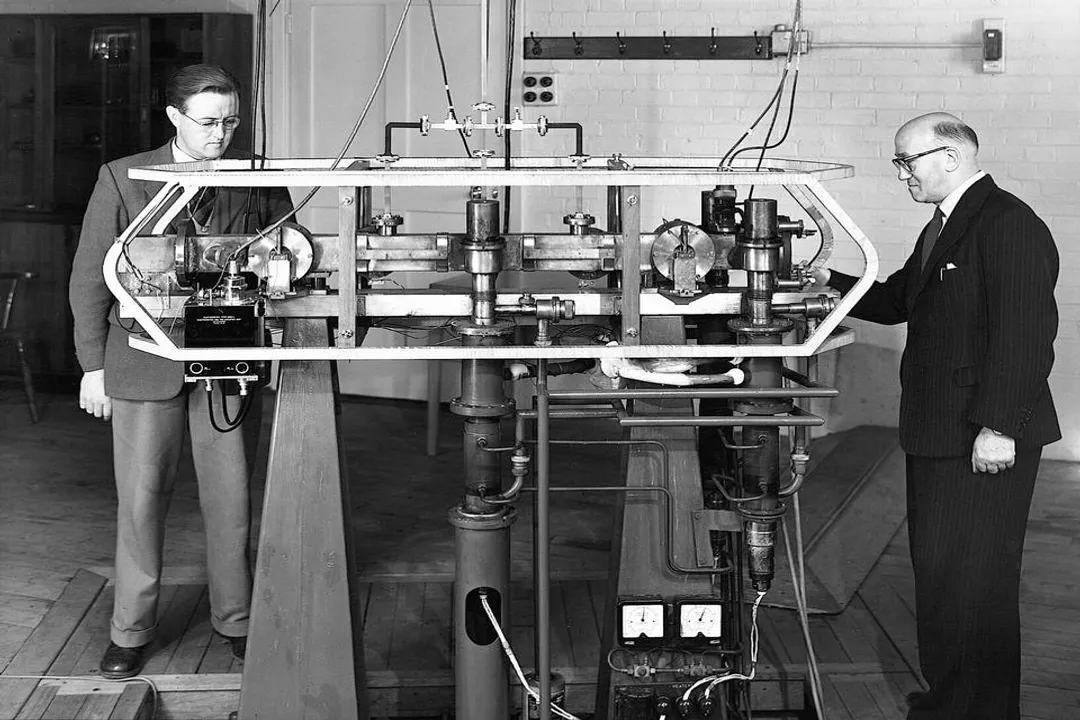
The groundwork for this modern age began in the 1920s and 1930s, but the first practical atomic clock was built in 1949 at the US National Bureau of Standards (now the NIST). [4] This first device used the cesium atom, which oscillates millions of times per second. [4] The standard definition of the second was officially changed in 1967 to be based on the cesium atom’s resonance frequency, defining one second as exactly 9,192,631,770 cycles of radiation corresponding to the transition between two energy levels of the cesium-133 atom. [4] Modern atomic clocks are far more precise, often losing or gaining less than a second over millions of years. [4] Today, the tracking of time, often coordinated through bodies like the US Naval Observatory, relies on these atomic time scales, providing the fundamental reference for everything from GPS satellites to global financial transactions. [4]
So, who invented tracking time? It was the ancient observers who named the cycles, the Babylonians who assigned the mathematical structure, the medieval engineers who harnessed gravity and gears, Huygens and Harrison who solved the problem of precision, and the 20th-century physicists who put the atom on the clock face. It is not a single invention but an ongoing human project of refinement.
#Videos
HISTORY OF TIME KEEPING | 2nd Grade - Science - YouTube
Related Questions
#Citations
History of timekeeping devices - Wikipedia
Who Invented the Measurement of Time? - Scientific American
The History of Timekeeping | M.S. Rau
A Brief History of Atomic Time | NIST
A (very) brief history of time - Fathom Consulting
Nine quick facts about the history of timekeeping - BBC
A brief history of time – as told by a watchmaker - The Conversation
When Did Humans Start Using Seconds, Minutes, and Hours as the ...
HISTORY OF TIME KEEPING | 2nd Grade - Science - YouTube
Who Invented Time? The Human Odyssey of Measuring Eternity