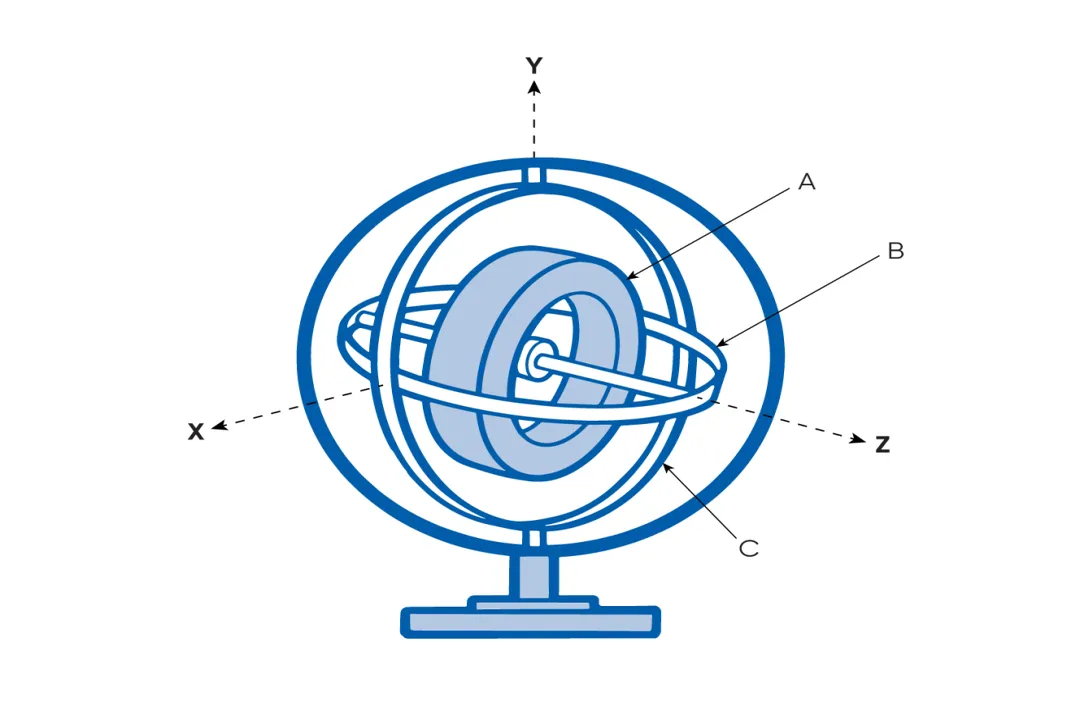
In a classic mechanical gyroscope, what is the angular relationship between the pivot axes of the spinning wheel's innermost gimbal ring and the outer gimbal ring?
They are set orthogonally (at a ninety-degree angle) to each other.
The functionality of a traditional mechanical gyroscope, designed to maintain rotational alignment in space, hinges on the precise construction of its gimbal system. The gimbal system comprises a series of pivoted frames that isolate the spinning rotor from external support movement. Specifically, the spinning wheel’s axle is fixed within the innermost ring. This inner ring is then mounted within an outer ring, and the crucial design element is that the pivot axes of these two rings are deliberately set orthogonal to one another, meaning they form a perfect ninety-degree angle. This orthogonal configuration grants the rotor three degrees of rotational freedom relative to its fixed base, allowing its spin axis to remain spatially fixed regardless of how the external base frame is tilted or rotated.