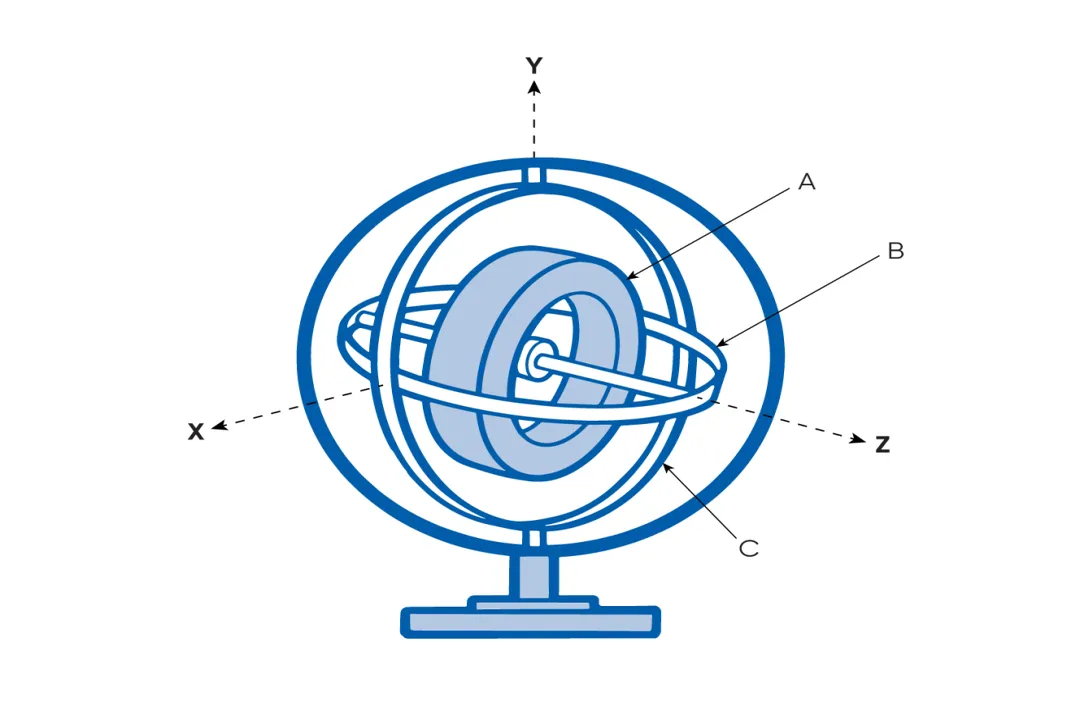
How do MEMS Gyroscopes, common in consumer electronics like smartphones, detect rotation?
By oscillating a microscopic proof mass and detecting the resulting Coriolis effect as a change in capacitance.
MEMS (Microelectromechanical Systems) Gyroscopes represent a radical departure from traditional mechanical spinning wheels, emerging from microelectronics development in the 1960s. These devices achieve rotation sensing without a large spinning rotor. Instead, they operate by employing a microscopic structure known as a proof mass which is intentionally made to oscillate back and forth. When the device undergoes rotation, the Earth’s rotation or the device’s motion induces the Coriolis effect upon this oscillating mass. The resulting deflection is then measured not mechanically, but electronically, typically by detecting the resulting change in capacitance between the oscillating mass and fixed electrodes, allowing for small, inexpensive orientation sensing in consumer devices.