Who invented the ocean shipping container?
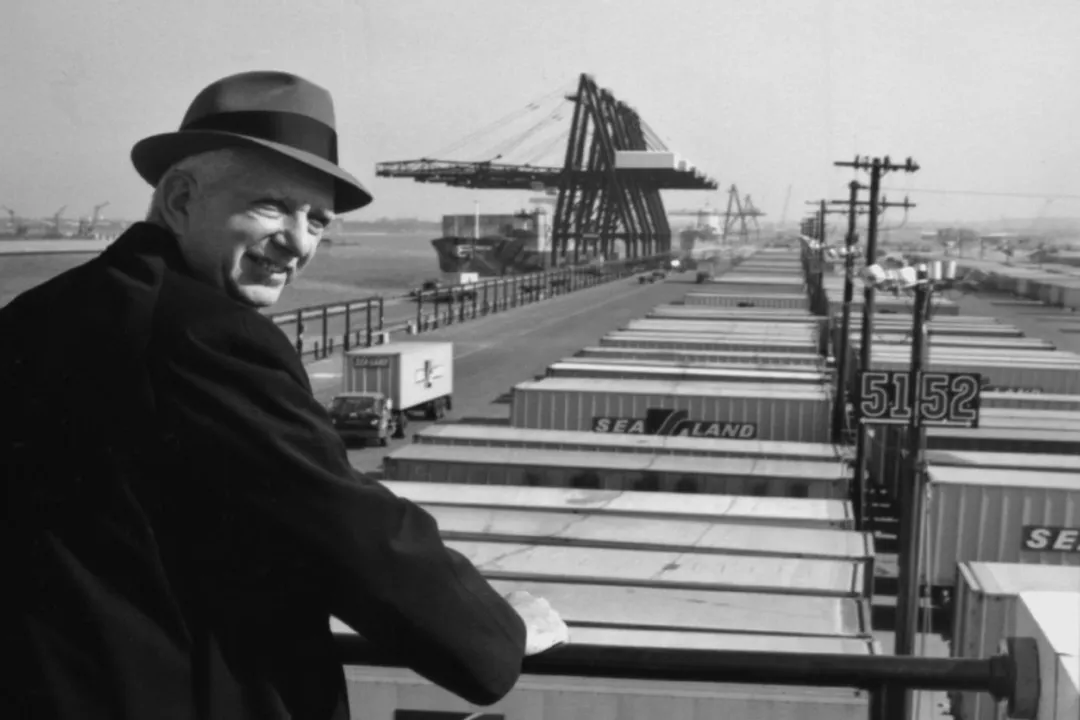
The world runs on standardized steel boxes, a fact that underpins nearly all modern commerce, yet the man behind this logistical revolution remains relatively unknown to the general public. The change that utterly reshaped global trade—containerization—did not originate in a naval architecture firm or a government agency, but in the mind of a North Carolina trucker named Malcolm "Malcom" Purcell McLean. Born in Maxton in 1913, McLean did not have the means for college after high school, prompting him to launch his first business venture in 1935 with his siblings: McLean Trucking Co.. They began by hauling empty tobacco barrels, with McLean himself behind the wheel of one of the initial fleet.
# Before Steel Boxes
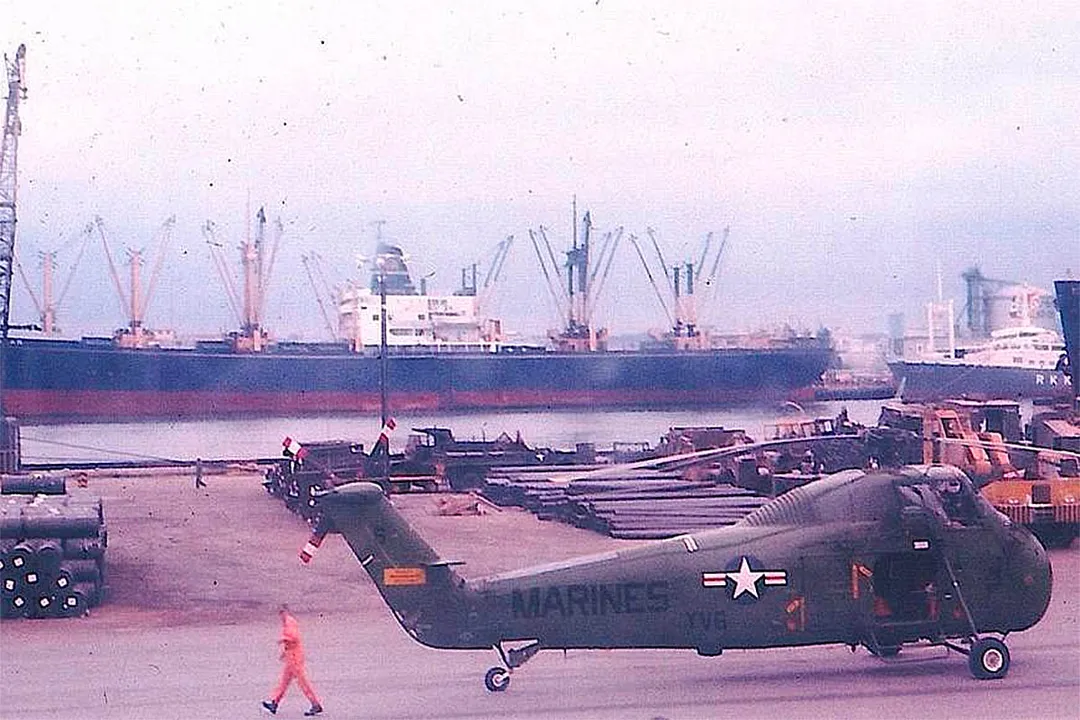
Before McLean’s intervention, moving goods from shore to ship was a grinding, slow-motion dance known as break-bulk shipping. Cargo arrived at the quayside in disparate forms—sacks, barrels, wooden crates, or simply wrapped items—and dockworkers, the longshoremen, had to manually load every single piece into the hold of the vessel. This was heavy, dangerous, and incredibly time-consuming labor. Shipping documents detail that unloading and loading a single cargo ship could easily consume up to three weeks. This inefficiency was not just a matter of slow loading; it meant vast amounts of capital tied up in ships sitting idle at the dock.
# The Trucker's Frustration

McLean’s years as a hauler provided him with a unique, ground-level view of this bottleneck. The insight that would change everything struck him near Thanksgiving in 1937. He was stuck waiting in line for hours at a New Jersey pier just to get his cotton-loaded truck unloaded. Watching the manual transfer of goods made him wonder why the process couldn't be streamlined. His core question was simple: If the cargo is already loaded onto my trailer, why can't the trailer itself be lifted and placed directly onto the ship?. By the 1950s, McLean’s trucking enterprise had ballooned to over 1,700 trucks, but he was still acutely aware of the inefficiencies that burdened all transportation modes. When he sold his trucking company, which was worth $12 million by the mid-1950s, he used the capital to gamble on realizing this vision.
# First Vision Trailerships
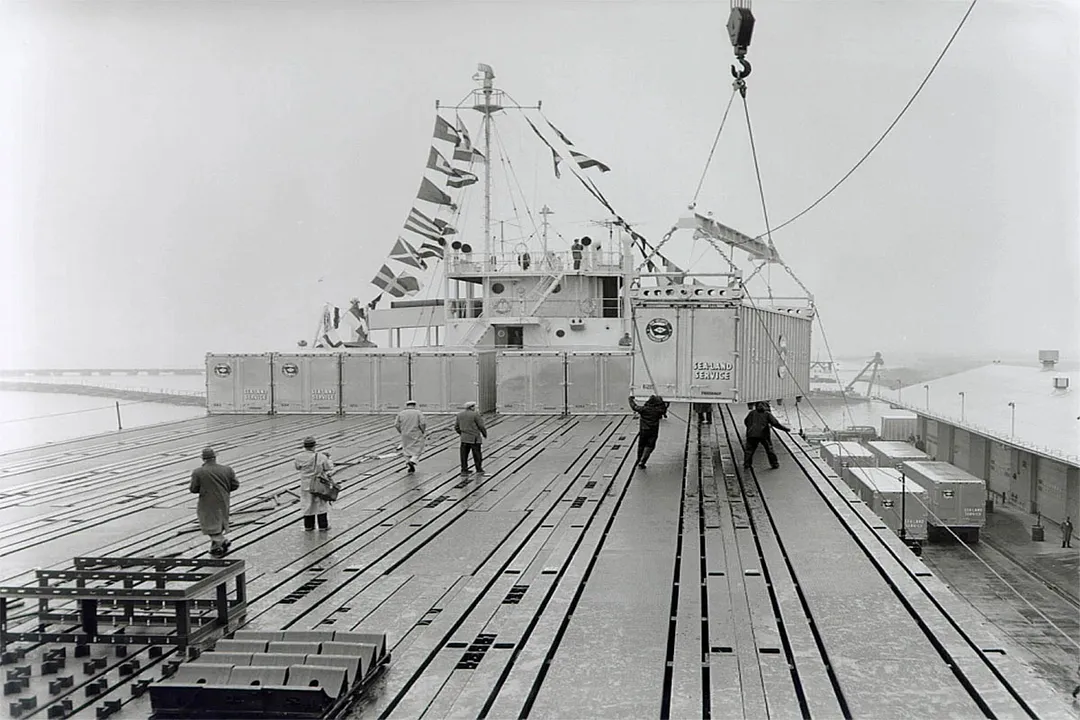
McLean pursued his idea by purchasing two World War II-era oil tankers and renaming his venture Sea-Land Service. His first attempt at realizing his dream was to use the entire truck trailer, what were then called "trailerships". In 1952, he was already developing plans for carrying his company's trucks along the Atlantic coast. The converted Ideal X sailed in April 1956 from Port Newark to Houston carrying 58 of these aluminum trailer vans. While this was a breakthrough, it quickly became evident that using the full trailer chassis aboard the ship was wasteful. The chassis took up too much valuable space, resulting in significant "broken stowage"—wasted volume within the ship's hold.
# Engineering the Standard
The problem of wasted space required a pivot from shipping the truck body to shipping a standardized box. This shift necessitated key engineering innovations, which McLean achieved by collaborating with engineer Keith Tantlinger. Tantlinger provided the fundamental physical solutions that made true intermodal transport possible. He designed the crucial corner blocks that allowed cranes to lift the boxes precisely and developed the twist lock mechanism that let containers lock securely onto each other, enabling them to be stacked neatly like large building blocks.
This combination of McLean’s insight into intermodal transfer and Tantlinger’s physical design created something revolutionary: a standardized steel box that could move without its contents ever being touched by manual labor between the initial loading dock and the final destination. It is important to note that McLean's was not the first use of standardized boxes; some sources credit British traders using horse-drawn containers in the 1800s, and US/Australian military containers during WWII. Even before Ideal X, engineer Robert Faludi built a prototype intermodal system in Los Angeles in 1955, and a Clifford J. Rogers was already shipping containers shortly before McLean’s maiden voyage. However, McLean’s contribution was implementing this concept on a commercially viable, massive scale between different modes of transport.

# The Maiden Voyage
On April 26, 1956, the refitted tanker, the SS Ideal X, set sail from the Port Newark-Elizabeth Marine Terminal bound for Houston. It carried 58 of these new containers. The transformation in efficiency was immediate and staggering. Loading the vessel, which had previously required days of agonizing labor, took less than eight hours. The cost savings were phenomenal: manual loading was quoted at $5.86 per ton, whereas the containerized method brought the cost down to a mere 16 cents per ton. This represented a 36-fold reduction in handling cost for that portion of the journey. The first voyage proved that the concept was sound, even if the reception was hostile.
# Union Resistance
The massive leap in efficiency naturally threatened the livelihoods of the workers it replaced. As one top official from the International Longshoremen’s Association reportedly exclaimed upon seeing the ship depart, "I’d like to sink that son of a bitch". Indeed, dockworkers staged strikes in response to the development. McLean, however, understood that a ship only makes money when it is at sea, and the dramatically shortened turnaround time made his system economically superior, regardless of the initial resistance. This economic reality forced the industry to adapt, even if slowly.
When considering the initial cost reduction, one must factor in the hidden capital drain of the old system. If loading and unloading took three weeks, a ship might spend six weeks of its operational life idle for a single round trip. McLean’s system effectively doubled the potential annual operational output of a vessel simply by keeping it moving. This focus on flow over stuff is what made the concept an undeniable economic force.

# Making It Global
To truly revolutionize transport, the box needed to be universal. While McLean’s company initially held patents for its design, the true unlocking of global trade required mass adoption that transcended one company’s reach. McLean took the strategic step of making his patented design royalty-free and offering it to the International Organization for Standardization (ISO). This move, which some later viewed as a missed opportunity for exclusive profit, was the essential business decision for creating a truly global standard. By giving the technical blueprint away, he ensured that ports, ships, and rail lines worldwide would adopt the same dimensions, thereby creating a massive, interconnected ecosystem. The result was the creation of standards like ISO 668, defining the dimensions that are now commonplace, such as the 20-foot long, 8-foot wide, and 8-foot high box. The strength of the container is now inseparable from the supporting infrastructure designed around its uniform requirements: specialized gantry cranes, railcars, and truck chassis built to handle these specific modular units.
# War Catalyst
Despite the initial success between New Jersey and Texas, containerization adoption was slow through the 1960s as many ports lacked the necessary cranes, and the industry remained steeped in tradition. However, the system received a massive external validation and expansion opportunity with the Vietnam War. In 1967, the US military turned to Sea-Land to manage the rapid deployment of equipment and supplies. The ability to seal cargo at the origin point, ship it securely across oceans, and deliver it directly to the troops via trucks or rail proved indispensable. This large-scale military contract accounted for an estimated 40% of Sea-Land’s revenue between 1968 and 1969, rapidly forcing further adaptation by global ports.
# Legacy Echoes
McLean sold Sea-Land Service in 1969 for $160 million. Even after selling the business that proved his concept, McLean returned to innovation, later launching United States Lines and developing enormous "econoships" designed for slow, fuel-efficient, round-the-world service in the 1970s oil crisis era. He even founded Trailer Bridge, Inc. in 1991 after filing for bankruptcy following the failure of his large oil price gambles. McLean passed away in 2001, at the age of 87.
The scope of his influence is immense. One analysis suggested that the shipping container has driven globalization more than all international trade agreements combined over the last five decades. Today, over 90% of purchased consumer items have traveled inside one of these boxes, and modern vessels can carry over 20,000 Twenty-Foot Equivalent Units (TEU). While McLean himself may not have achieved household name status commensurate with his impact, his innovation—the simple, standardized, stackable steel box—is responsible for the lower prices on almost every item manufactured across the globe. His work is often ranked alongside that of Robert Fulton in terms of maritime trade revolution, cementing Malcom McLean's place as the true architect of modern logistics.
Related Questions
#Citations
Malcom McLean - Wikipedia
The History of the Shipping Container created in 1956 | IncoDocs
The birth of the shipping container - Eveon Containers
Who Invented Shipping Containers?
The History of the Shipping Container - InBox Projects
The History of the Shipping Container: The Birth of the World's First ...
Who Made America? | Innovators | Malcom McLean - PBS