Who invented rope making?
The quest to name the single inventor of rope is akin to trying to identify the first person to use a stone—the creation was so fundamentally necessary that it arose independently and incrementally across deep time, long before written records existed to capture the name of the pioneer. Rope, or at least its conceptual ancestor, is perhaps one of humanity’s oldest, yet most frequently overlooked, technological achievements, ranking alongside fire and the wheel in terms of foundational importance to civilization. The evidence suggests that the idea of binding fibers together for strength pre-dates recorded history by tens of thousands of years, belonging to the collective ingenuity of our ancient ancestors, from Neanderthals to early Homo sapiens.
# Deep Prehistory
Pinpointing the first piece of cordage is difficult because natural fibers decay rapidly, leaving behind few physical remains. What we rely on are impressions or the tools associated with manufacture. One of the earliest, albeit controversial, pieces of physical evidence for deliberately twisted cordage comes from the Abri du Maras site in France, attributed to Neanderthals and dated to around $38,000$ B.C.. This artifact, however, is exceptionally small—just $6.2$ mm long and $0.5$ mm wide—leading some researchers to question whether it represents a functional rope or a naturally occurring twisted plant matter, like a vine tendril, or even debris caught in a water vortex. The very existence of such a fine, three-ply structure, if intentional, speaks to a sophisticated grasp of material manipulation by early hominids.
What sets a true rope apart from a simple bundle of fibers is the controlled application of torsion, which increases the tensile strength far beyond the sum of its individual parts. The real invention, therefore, may not have been the material itself—which could have been animal sinew, hair, or grass—but the understanding that opposing twists held material together under severe stress.
# Tool Evidence
If the Abri du Maras find represents the earliest use, then the Hohle Fels Cave in Germany provides evidence for a potential manufacturing technique associated with modern humans arriving in Europe. In $2016$, researchers announced the discovery of a tool fashioned from mammoth ivory, dated to approximately $40,000$ years ago, found within the Aurignacian layer. This object is notable because it possesses four holes lined with precisely cut spiral incisions. While similar pierced batons have existed in the archaeological record, this particular find, combined with rigorous experimental testing, strongly suggests it was a technological aid for twisting fibers into rope, definitively answering "how rope was made in the Paleolithic" for these early people.
Other key archaeological markers exist further down the timeline, though none pinpoint a single inventor:
- Impressions of a three-ply rope were found in the Lascaux Caves, potentially dating back $15,000$ to $17,000$ B.C., though the rope’s actual age relative to the famous paintings is uncertain.
- Fragments showing a single-ply "Z" twist, perhaps qualifying as yarn rather than rope, date to roughly $17,000$ B.C. at Ohalo II in Israel.
- A preserved piece of three-strand plaited cord, dating to $10,000$ B.C., was recovered from Coves de Santa Maira in Spain.
This progression shows a gradual refinement from simple twists toward complex, multi-ply structures, even before the advent of settled agriculture.

# Ancient Mastery
Moving into the age of established civilizations, we find the first documentation and mechanical sophistication applied to rope making, shifting the story from inference to recorded practice. Around $4,000$ B.C. (or $6,000$ years ago), the Ancient Egyptians stand out as the first culture to create specialized instruments for producing long lengths of cordage mechanically and quickly. They utilized local materials like papyrus, water reeds, grass, and leather. Wall paintings within Egyptian tombs depict the process, showing that they employed handheld spindles to twist the yarns into stronger structures.
The Egyptian mastery of rope was essential for the monumental engineering feats of the era, such as hauling and lifting the massive stones used in pyramid construction. When we look at the complexity of structures like the pyramids or the lifting mechanisms needed for obelisks, it becomes clear that the development of reliable, consistent rope acted as a critical technological prerequisite for scaling up all other aspects of their building and transportation efforts. Without a standardized, strong binding material, the physical limits on load size and height would have been severely constrained.
The technique of braiding, a step beyond simple twisting, was also introduced by the Egyptians, significantly boosting both strength and durability. By around $1390$ B.C., tombs show people making two-ply rope using weighted spinners, and the rope seals remaining on artifacts like King Tut’s tomb (c. $1328$ B.C.) show structural similarity to modern ropes, relying on three-ply construction.
# Global Material Diversity
As different geographies developed, so did the local selection of raw materials. While the core process of twisting remained structurally similar across continents, the input fibers varied widely based on climate and availability.
| Material Source | Geographic Context/Timeframe | Key Characteristics |
|---|---|---|
| Local Fibers/Sinew/Hide | Prehistoric/Indigenous Americas | Used animal sinew, rawhide, and local barks. Native Americans reportedly made dogbane rope considered superior in softness to early European versions. |
| Papyrus/Reeds/Date Palm | Ancient Egypt (c. $4000$ B.C.) | Used for early, sophisticated rope making; often reinforced with resin or wax. |
| Hemp | China (c. $2800$ B.C.), Europe | Strong fiber; the Chinese were using it for rope during the Han Dynasty. It was crucial in Colonial America, though it had to be treated with tar to resist water damage for maritime use. |
| Manila (Abaca) | Tropical regions, later global trade | Waterproof, but limited to tropical cultivation areas initially. Became the material of choice for nautical lines due to its strength and reduced shrinking when wet. |
| Coir | Tropical climates | Derived from coconut shells; weaker but resistant to rot in saltwater. |
| Sisal | Tropical climates, formalized trade post-$1810$ | A weaker fiber that provided a slight stretch, making it excellent for mooring ropes. |
The shift toward specialized materials demonstrates an ongoing, collective invention process driven by necessity—sailors needed waterproof line, and settlers needed durable cordage for daily tasks, leading to the importation and standardization of fibers like Manila and Jute.

# Process Refinement
Regardless of the fiber source, the ancient method involved creating a ropewalk: long, low structures often placed outside urban areas due to fire risk. These walks could stretch a quarter of a mile or more, allowing for the continuous laying of strands into long, unbroken ropes. The fundamental technique involves spinning fibers into yarn, bundling those yarns into strands, and then twisting multiple strands together in the opposite direction to create the final rope, ensuring its structure locks together. Even in the Middle Ages, simple machines called rope jacks were used to mechanically twist the fibers in these ropewalks. The basic geometry of twisting has not fundamentally changed from the Egyptian era to the Colonial period, where a ropemaker might use a simple hand-cranked tool, sometimes assisted by a bicycle-like mechanism later on to speed up the process across the long walk.
It is a fascinating point of comparison that while rope making was common in the Americas, the colonists often relied on skills passed down from Indigenous Americans, who were using similar two- and three-ply twisting structures but employed superior local materials like dogbane.
# Modernization and Steel
The next major leap in rope technology came not from a new plant fiber but from a completely different material class: metal. The search for stronger, more reliable line, spurred by expanding maritime trade and industrial needs that outpaced the slow ropewalk production, eventually led to wire rope.
The invention of the first practical steel wire rope is credited to German engineer Wilhelm August Julius Albert in $1834$. Albert patented a method for producing parallel stranded steel ropes. While this discovery was hugely significant—a clear moment where a specific person can be named as the inventor of a type of rope—it often goes under-recognized because its importance was rooted in solving an engineering problem rather than immediate commercial appeal. Steel ropes quickly proved stronger and more durable than their textile predecessors, finding initial applications in mining. This innovation provided the necessary strength for major $19$th-century projects, such as being used for the suspension cables of the Brooklyn Bridge in $1870$.
The Industrial Revolution fully transformed the craft from a dedicated, low-lying ropewalk operation to a mechanized factory process, initially using steam power before transitioning to electricity.
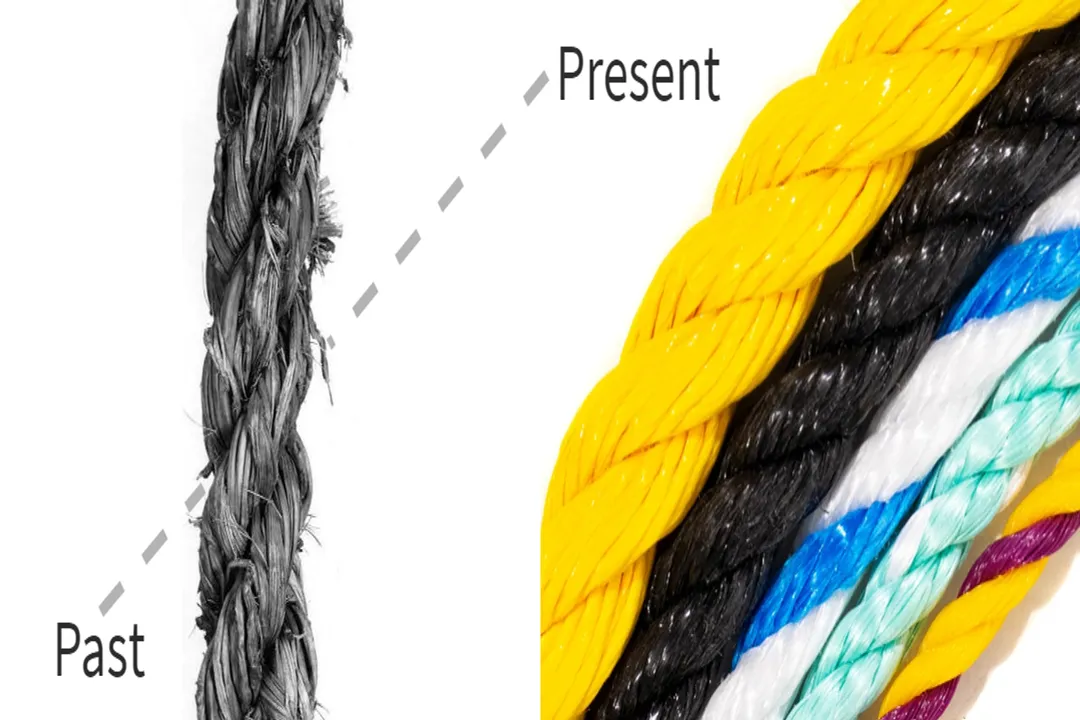
The final major shift arrived in the $20$th century with the birth of synthetics. Nylon, commercially available around the $1940$s, offered unparalleled strength, elasticity, and resistance to rot and UV degradation, making it perfect for military and rescue applications when natural fiber supplies were threatened. Subsequent materials like polyester and polypropylene expanded capabilities further, offering tailored properties such as floating or chemical resistance.
In summary, the invention of rope making is not attributable to one person but is a layered history. The concept of controlled twisting appears to originate with Paleolithic tool users, possibly Neanderthals, $40,000$ years ago. The systematic, documented, and mechanized craft begins with the Ancient Egyptians around $4000$ B.C.. And the inventor of the next true revolution—the wire rope—was Wilhelm August Julius Albert in $1834$.

# Actionable Insight on Modern Choice
For any modern reader looking to appreciate the historical context while selecting a product, understanding the legacy of material selection is key. If you are choosing a modern line for a task where weight and elasticity are beneficial—such as climbing or securing a load that might experience shock loading—you are following the design philosophy established by the post-$1940$s adoption of Nylon. Conversely, selecting Polypropylene for a docking line because it floats and resists rot directly echoes the historical trade-offs made by ancient mariners who needed to choose between waterproof but harder-to-grow Manila, or the more available, but less reliable, tarred hemp. The principles that drove the choice between sisal and coir millennia ago still dictate material selection today, only now the options are refined synthetic polymers instead of local plants.
Related Questions
#Citations
The history of rope making | Rope Source
The Invention of Rope - Rope and Cord
Evolution of Rope Making | Origins and Early Innovations
The Ancient History of Ropes - Eurofuni
From Ancient Tool to Modern Marvel: The History and Global Impact ...
1. History of Ropemaking
[PDF] AHS-Education-Rope-Making.pdf - Arizona Historical Society
How rope was made 40,000 years ago - ScienceDaily