Who invented nitrogen removal processes?
The fundamental limiting factor for life on Earth, despite an atmosphere composed of nearly 80 percent nitrogen gas (), was the ability to harness that nitrogen for biological needs. This inert atmospheric gas is essential for building proteins and DNA, yet its strong triple bond makes it incredibly difficult to convert into useful compounds like ammonia (). The invention that broke this natural barrier, effectively creating a new source of reactive nitrogen for humanity, was the high-pressure synthesis process developed by the German chemist Fritz Haber. [1][3] This development, perfected for industrial scale, remains one of the most significant technological achievements in human history, fundamentally altering global agriculture and population capacity. [7]
# Inert Gas Problem
Before the early 20th century, agriculture was wholly dependent on natural sources of reactive nitrogen compounds. These natural sources included manures, guano deposits mined from islands, and the slow, natural process of biological nitrogen fixation carried out by specific bacteria. [5] As global populations began to grow rapidly during the Industrial Revolution, this natural supply chain proved increasingly fragile and insufficient to meet the escalating demand for food. [7] The scientific challenge, therefore, was to artificially replicate the conversion of inert atmospheric nitrogen into ammonia, a compound easily integrated into fertilizers. The chemical equation for this synthesis is remarkably simple on paper: one molecule of nitrogen gas reacts with three molecules of hydrogen gas to form two molecules of ammonia (). [6]
The real difficulty lay not in writing the equation but in forcing the reaction to proceed at a practical rate. At standard atmospheric temperatures and pressures, the reaction is incredibly slow because the molecule is so stable; it requires an enormous amount of energy, known as activation energy, to break those bonds. [6] Chemists knew that raising the temperature would speed up the reaction, but high temperatures thermodynamically favored the reverse reaction—ammonia breaking back down into nitrogen and hydrogen—meaning high heat actively worked against achieving a useful yield. [6] This thermodynamic conundrum presented a scientific dead end for many researchers looking for an industrial solution. [3]
# Fritz Haber
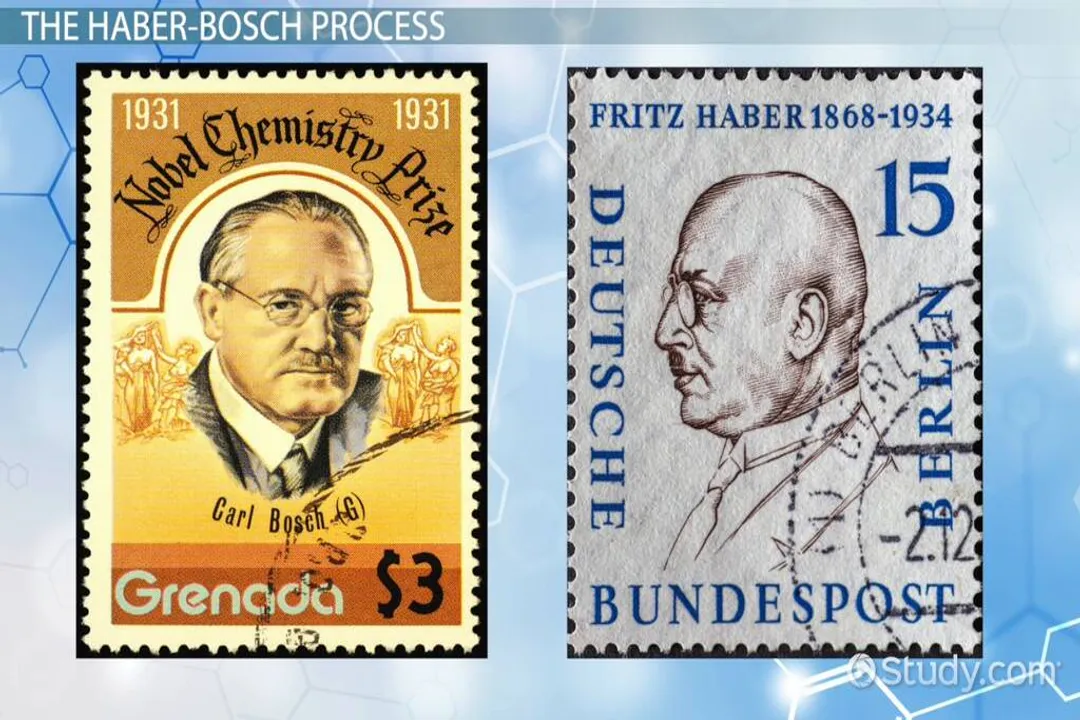
The chemist who managed to navigate this thermodynamic trap was Fritz Haber, born in 1868. [1][9] His work was driven by the necessity of finding a sustainable source of nitrogen for fertilizers, a search that became increasingly urgent as food shortages loomed. [5][7] Haber was a German chemist who dedicated himself to solving this complex problem of industrial synthesis. [1] He approached the challenge by manipulating the pressure component of the reaction. [3]
Haber theorized that if the reaction could not be pushed forward effectively by high heat alone, conditions needed to be established that favored the product side of the equation according to Le Chatelier's principle. Since the reaction produces fewer moles of gas (two moles of from four moles of reactants and ), increasing the pressure would thermodynamically favor the formation of ammonia. [6] By designing apparatus capable of safely handling extreme conditions, Haber made his initial breakthrough in synthesizing ammonia from its elements. [3][4] The initial development of the process, which bears his name, earned him the Nobel Prize in Chemistry in 1918. [2]

# High Pressure Synthesis
The invention was not just about high pressure, however; it required an artful combination of extreme variables and the introduction of a specific chemical agent to act as a mediator. [6] Haber successfully determined the necessary operating conditions: extremely high pressures, typically around 150 to 250 atmospheres, combined with moderately high temperatures, usually between and . [6] Critically, these temperatures were high enough to give the reaction a reasonable speed, yet low enough to prevent the ammonia product from immediately decomposing back into its constituent gases. [3]
Even with the correct temperature and pressure, the reaction kinetics remained sluggish. This is where the necessity of a catalyst became paramount. [6] Haber identified that iron-based catalysts, sometimes promoted with other metal oxides, were highly effective at lowering the activation energy barrier sufficiently to allow the reaction to proceed at industrially viable speeds under the chosen pressure and temperature settings. [6] This combination—precise temperature control, immense pressure containment, and an effective catalyst—was the essence of the invention that unlocked atmospheric nitrogen. [4]
| Variable | Condition/Component | Significance |
|---|---|---|
| Reactants | and (from air and natural gas/steam) | The essential building blocks of life |
| Pressure | $150-250$ atmospheres | Thermodynamically shifted equilibrium toward ammonia production [6] |
| Temperature | to | Balanced reaction rate against product decomposition [3] |
| Catalyst | Iron-based with promoters | Reduced activation energy for practical reaction speed [6] |
The successful demonstration of the process allowed for the extraction of nitrogen directly from the air to create synthetic fertilizer, marking a definitive break from the limitations of natural nitrogen sources. [7][8] It must be noted that while Haber developed the initial laboratory process, it was his colleague Carl Bosch who was instrumental in scaling the chemistry up to the massive industrial quantities required for global impact. [7]
# Dual Legacy
The legacy of the Haber process is deeply paradoxical, creating both sustenance for billions and instruments of mass destruction. [5] On the one hand, the ability to synthesize ammonia meant humanity could create virtually limitless synthetic fertilizer, primarily in the form of ammonium nitrate. [7] This invention is often cited as the primary driver allowing the Earth’s population to expand from approximately 1.6 billion in 1900 to the current figures, as food production could scale up far beyond what traditional farming methods could sustain. [5]
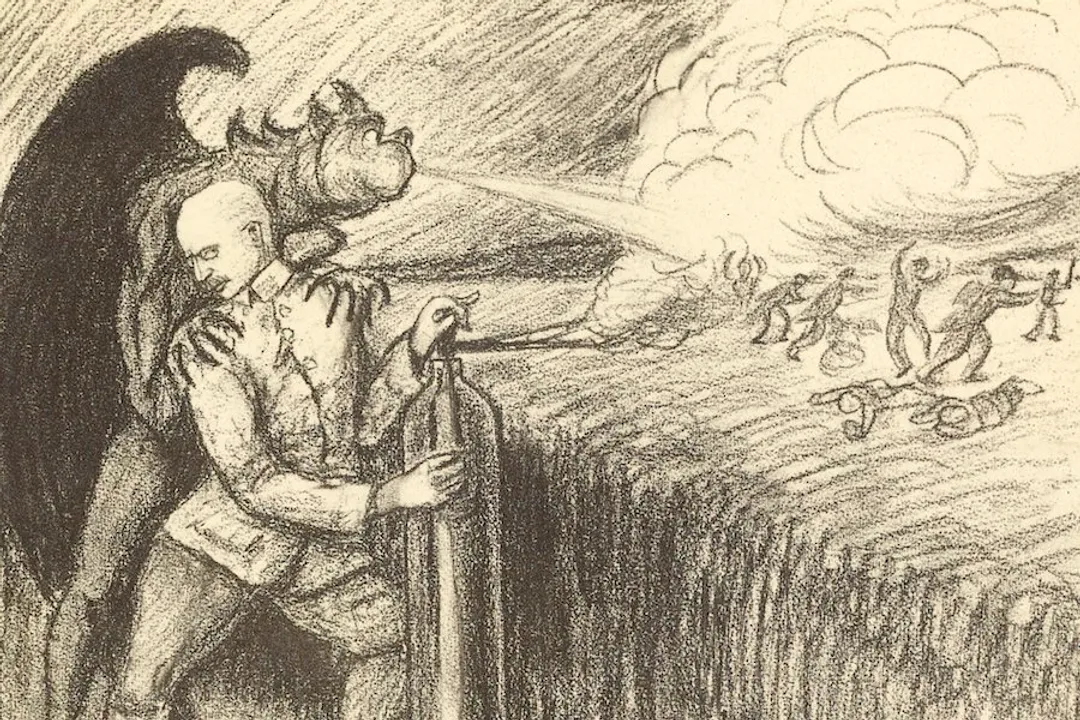
On the other hand, the very same facility used to create fertilizer could be, and was, diverted to military applications. Haber himself was deeply involved in the German war effort during World War I. [4] The ammonia synthesized via his process was a precursor for making nitric acid, which is necessary for manufacturing explosives. [5] Furthermore, Haber’s expertise was applied directly to developing chemical warfare agents, most infamously chlorine gas used in the Second Battle of Ypres. [5] The profound moral weight of this dual-use technology—feeding the world versus killing millions—is inseparable from the story of the invention itself. [5] Understanding the inventor requires appreciating this stark contrast between life-giving sustenance and devastating weaponry. [5]
The reliance created by this process has also geographically concentrated food security in ways it never was before. Before Haber, a nation’s ability to feed itself was tied to its local sources of arable land, guano, or active nitrogen-fixing fields. After the widespread adoption of synthetic fertilizer, a nation's agricultural output became heavily dependent on access to the resources required to run a Haber-Bosch plant: typically hydrogen (often derived from natural gas) and the specialized high-pressure equipment. [7] This shift represents a subtle, though immense, form of industrial dependency that underpins modern geopolitics and food systems. [7]
# Industrial Scale
While Fritz Haber won recognition for the foundational chemical discovery, translating that chemistry into a functioning, continuous industrial plant required immense engineering achievement, often attributed to Carl Bosch. [7] The equipment had to withstand pressures and temperatures that were unprecedented in chemical manufacturing at the time. [3] The sheer scale required to service global agriculture meant that the development was not a one-time laboratory success but a continuous engineering effort throughout the 1910s and 1920s to refine the process for efficiency and longevity. [7]
The initial plants utilized the nitrogen from the air—a seemingly inexhaustible resource—and hydrogen, typically produced via the steam reforming of natural gas or coal, which provides a ready supply of hydrogen atoms. [6] The constant circulation of the gases through the catalyst bed, with separation of the product ammonia, allowed for a continuous process where unreacted gases were fed back into the reactor loop, maximizing efficiency. [6] Without this successful scaling, the process would have remained a scientific curiosity rather than the foundation of modern food production that it became. [7] The industrialization of the Haber process remains a prime example of how fundamental chemical science, when paired with rigorous engineering, can fundamentally alter the trajectory of human civilization by solving a constraint previously thought absolute. [3]
Related Questions
#Citations
Fritz Haber
Fritz Haber – Facts
Fritz Haber
Fritz Haber | Biography & Facts
The Legacy of Fritz Haber: Who Fed Billions and Killed ...
From fertiliser to Zyklon B: 100 years of the scientific ...
Haber Develops Process for Extracting Nitrogen from the Air
Fritz Haber, Father of Chemical Warfare | Biography & ...