Which country invented the balloon?
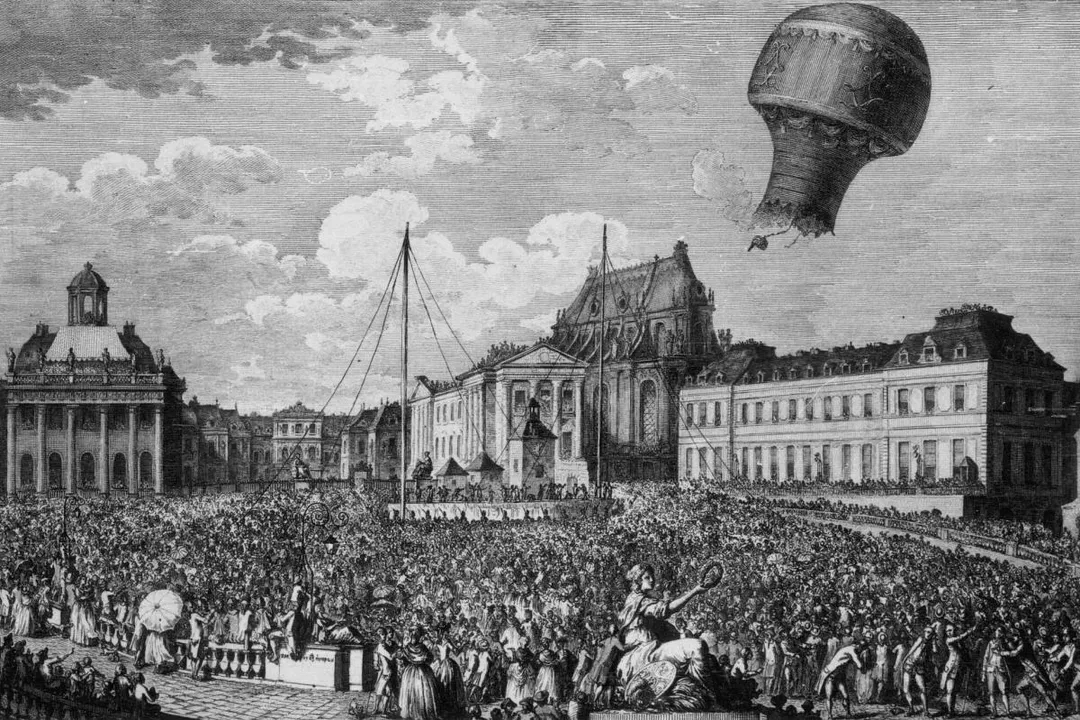
The nation credited with inventing the first successful self-propelled, lighter-than-air flying machine—the hot air balloon—is France. This monumental achievement belongs to the brothers Joseph-Michel and Jacques-Étienne Montgolfier, who successfully launched their creation in the summer and autumn of 1783. [1][4] It is a fascinating tale of sibling collaboration, public spectacle, and a rapid technological race that changed the understanding of human capability forever. [3][4]
# Brothers' Invention

The Montgolfiers, paper manufacturers from Annonay, France, were exploring ways to use smoke or hot air to lift lightweight materials. [4] Their initial experiments likely focused on how hot air, being less dense than cooler air, could provide lift, perhaps inspired by observing smoke rising from their own paper-making processes. [3] While the exact moment of "eureka" is lost to time, their dedication led to a series of increasingly ambitious tests. [4]
The first public demonstration, which involved an unmanned flight, took place on June 4, 1783, in their hometown of Annonay. [1][4] This first successful flight utilized a large silk bag covered in paper, which carried the craft skyward. [4] The demonstration was performed before the Estates of the Vivarais region, serving as a public announcement of their success. [4] They had proven the principle: hot air could carry weight aloft. [1]
# Royal Spectacle
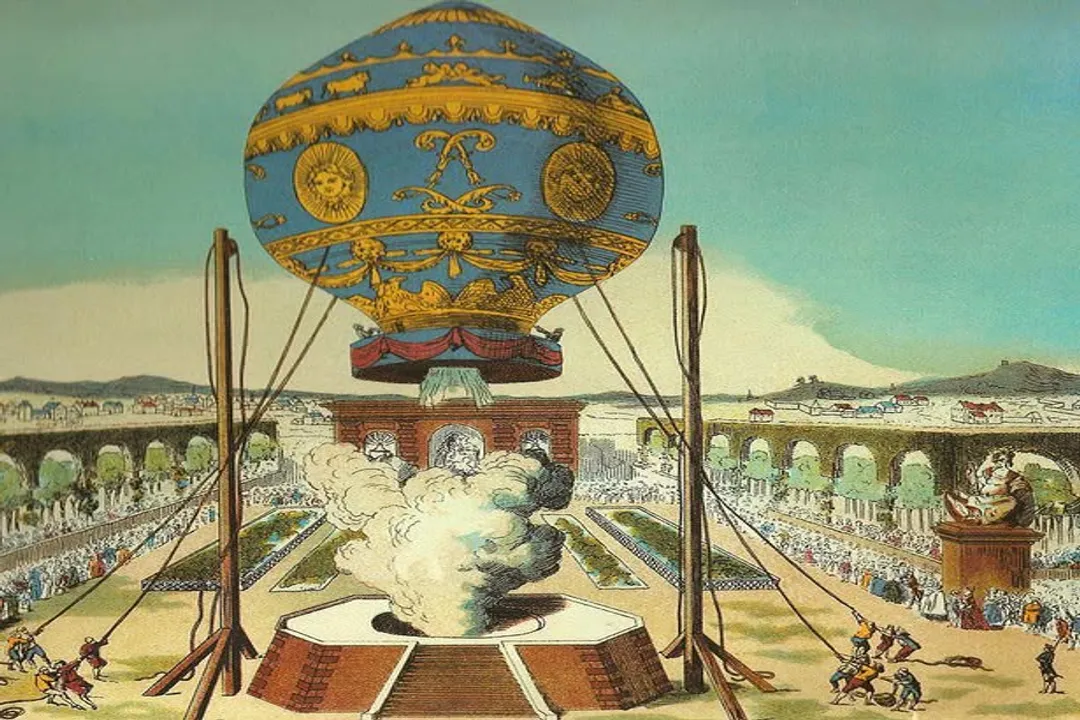
The news of the Annonay launch quickly reached Paris, capturing the attention of the French Royal Academy of Sciences and, crucially, the royal court. [4] This interest culminated in an invitation to perform a demonstration for King Louis XVI and Queen Marie Antoinette at the opulent Palace of Versailles. [2]
The flight staged at Versailles on September 19, 1783, was not just a scientific demonstration; it was high theater. [2][8] To prove that living beings could survive the journey, the basket carried a payload of animals: a sheep, a duck, and a rooster. [2][4] The animals were chosen specifically to test the effects of altitude on different biological systems, though the duck was likely included as a control, as it was expected to handle altitude better than the others. [4] The flight was a success, and the animals returned safely, paving the way for human passengers. [4] It is worth noting that the Montgolfier flight at Versailles was a massive public event, funded and orchestrated to showcase French ingenuity to the monarchy, which undoubtedly influenced the perceived importance of the achievement at the time. [2]

# First Ascent
With the animal trials complete, the next logical, and most dangerous, step was a manned flight. [1] The honor of the first tethered ascent went to Jean-François Pilâtre de Rozier on October 15, 1783. [1][4][8] He rose about 84 feet (25.5 meters) while tied to the ground, confirming that a human could manage the ascent and descent within the craft. [4]
The true milestone—the first free manned flight—occurred on November 21, 1783, in Paris. [1][4][8] Pilâtre de Rozier was joined this time by the Marquis d'Arlandes. [1][4] Their Montgolfière soared over the city, staying aloft for approximately 25 minutes and covering a distance of about 9 kilometers (5.5 miles). [1][4] This seminal event effectively inaugurated the age of aviation and is still celebrated today as Montgolfier Day. [8] The immediate success of the Montgolfiers firmly established France as the birthplace of successful manned ballooning. [1][4]
# Gas Competition Emerges
While the Montgolfier brothers were perfecting their hot air technology, another group of French scientists was racing to create a different type of lighter-than-air craft: the gas balloon. [1][4] The key figure in this parallel development was Jacques Charles, who focused on using hydrogen gas, which offered superior lifting capacity compared to heated air. [1][4]
Charles’s team launched their unmanned hydrogen balloon on August 27, 1783. [1][4] Shortly thereafter, on December 1, 1783, Charles himself made the first manned ascent in a hydrogen-filled balloon, flying with Nicolas-Louis Robert. [1][4] This manned gas flight occurred just nineteen days before the Montgolfiers’ historic free flight with de Rozier and d'Arlandes in Paris. [1]
It is important to distinguish between these two initial successes. The Montgolfiers invented the hot air balloon, while Charles invented the hydrogen gas balloon. [1] Both groups were French, and both achieved their critical milestones within months of each other, creating a fascinating period of simultaneous innovation. [4]
| Flight Type | Inventor(s) | Fuel/Gas | Date of First Manned Flight | Country |
|---|---|---|---|---|
| Hot Air Balloon | Montgolfier Brothers | Heated Air | November 21, 1783 | France |
| Gas Balloon | Jacques Charles | Hydrogen | December 1, 1783 | France |
The fact that two entirely different, working designs for lighter-than-air travel were perfected in the same country, by different teams, within weeks of each other speaks volumes about the scientific atmosphere in late 18th-century France. [1][4] Had Charles launched his manned flight even a month earlier, history might remember him as the sole pioneer, rather than the innovator of the competing technology. [1] The hot air principle was simpler and required less specialized gas, making the Montgolfiers’ initial public success more accessible, even if the gas balloon proved more enduring for long-distance travel. [3]
# Evolution of the Balloon
The term "balloon" today often brings to mind the colorful, buoyant decorations used at parties, which represent an entirely separate branch of this history. [6] The modern party balloon, typically made of latex rubber, was not a product of 18th-century French science but rather of 20th-century engineering. [6]
The inventor recognized for the party balloon is Neil Tillotson, an engineer working in the United States. [6] In 1930, Tillotson created the first mass-producible latex rubber balloon. [6] His work initially stemmed from engineering needs for World War II barrage balloons, which were large, uninflated rubber targets designed to deter enemy aircraft. [6] When the war ended, Tillotson adapted his manufacturing techniques to create the smaller, colorful toys we know today, marking a shift from atmospheric science to consumer novelty. [6]
# Global Adoption
Once the principle was established in France, the concept of lighter-than-air flight spread rapidly across Europe and eventually the world. [4] While the initial invention is definitively French, different regions soon adopted and adapted the technology for different purposes, from military reconnaissance to sport and tourism. [4]
Today, regions famous for ballooning, such as Cappadocia in Turkey, have become synonymous with the spectacle of mass ascents, drawing visitors from around the globe to experience the dawn flight over unique landscapes. [9] However, while places like Cappadocia offer an unparalleled experience of ballooning, they build upon the foundational science first proven by the Montgolfiers in the fields outside Annonay and Paris. [9] This modern use highlights the transition from a scientific breakthrough to a global cultural phenomenon, where the vessel itself becomes the destination. [5][9] The enduring appeal lies in the unique, silent, and panoramic view offered from above, a perspective first granted to humanity by those initial French experiments. [4]
Related Questions
#Citations
Balloon - Wikipedia
The first hot air balloon flight 19 September 1783 - Versailles
Hot Air History - Balloon Fiesta
History - Plano Balloon Festival
A Brief History of Party Balloons - BalloonLab
The History of Hot Air Balloons: When Were They Invented?
Bristol International Balloon Fiesta - Facebook
The history of ballooning