What was the first propeller ship?
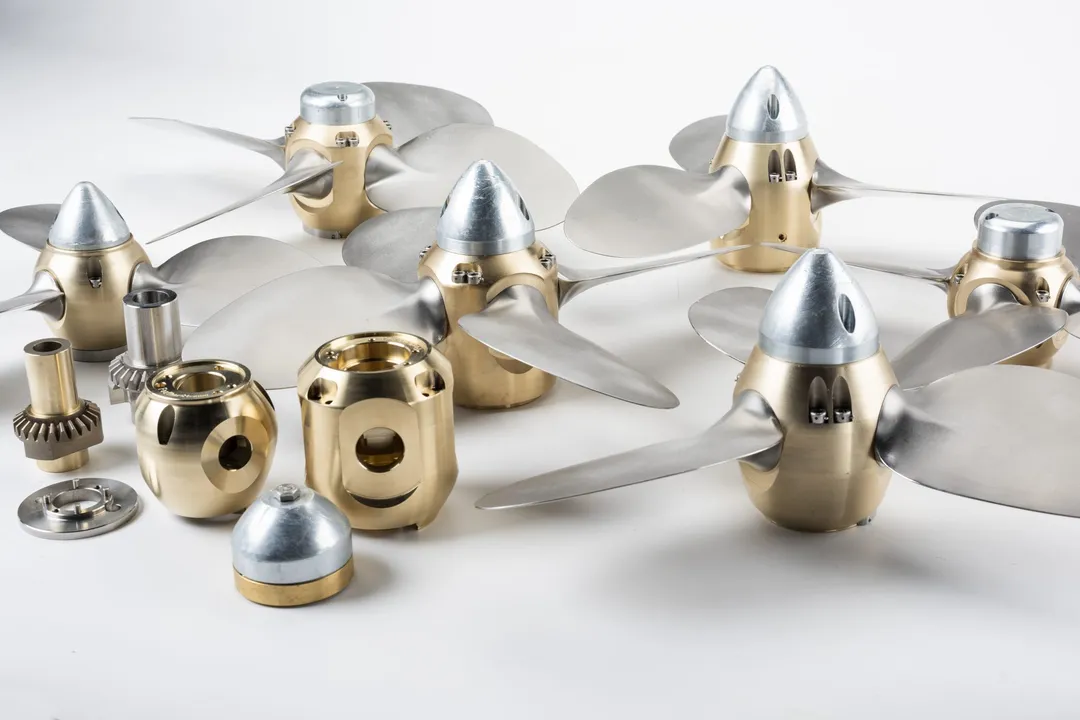
The vessel that ultimately set maritime technology on a new course was the SS Archimedes, the first steamship to rely solely on a screw propeller for propulsion in regular commercial use. [1][5][6] Her appearance signaled the beginning of the end for the bulky, exposed paddlewheel, an apparatus that had defined early steam navigation since ships like the Savannah sailed in 1819, relying on sails and retractable paddlewheels. [5] The story of the Archimedes is not just about a ship, but about the acceptance of a revolutionary, yet initially skeptical, mechanical concept developed by Francis Pettit Smith. [2][7]
# Smith's Patent

The foundational element for the Archimedes was the screw propeller itself. Before this innovation, steam-powered vessels primarily utilized paddlewheels, which were effective in calmer waters but complicated to maintain and offered a large profile above the waterline. [4] Francis Pettit Smith secured the critical step toward practical application when he patented his design for a screw propeller in 1836. [2][4][6][7] This patent signaled a serious engineering effort to move propulsion beneath the waterline, an idea that had been explored for centuries but had not yet found a commercially viable form. [6]
It is worth noting that Smith was not entirely alone in this pursuit; figures like John Ericsson were also working on screw propulsion around the same period. [4] However, Smith’s design, and the subsequent ship built to test it, captured the immediate spotlight, proving the concept’s potential to outperform established methods. [4]
# Building the Vessel
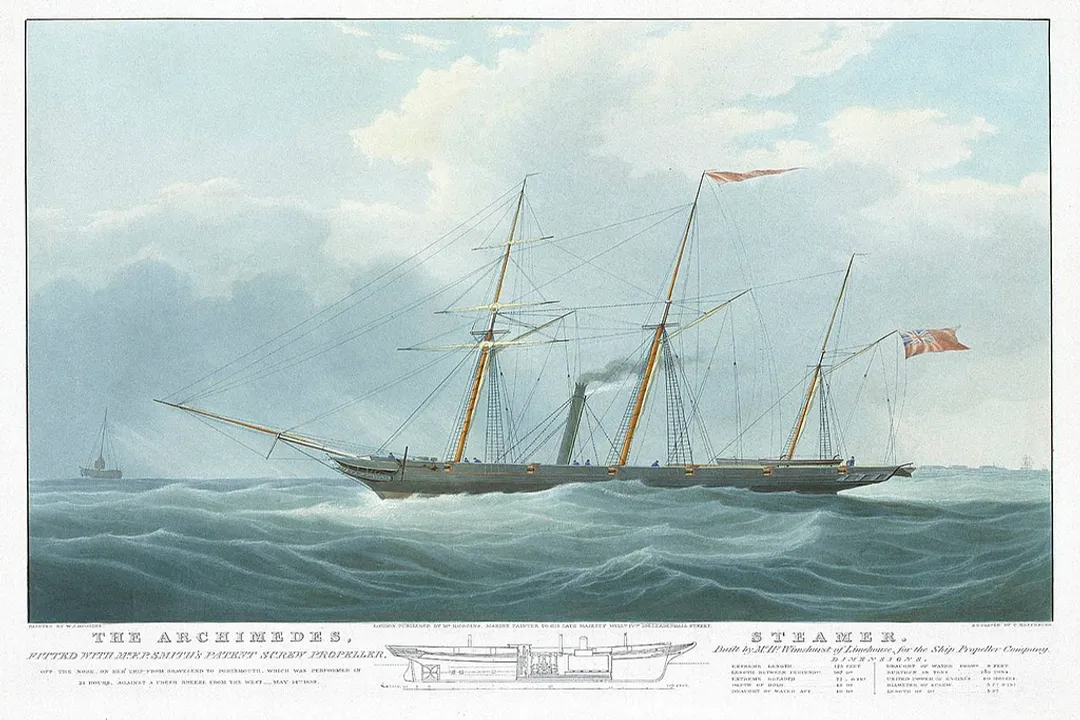
The construction of the SS Archimedes took place at the yard of John & Charles Laird in Birkenhead. [1] The vessel was constructed in 1838, [1][7] though its first smoky trials and entry into service are frequently cited as occurring in 1839. [2][3][5] Contemporary accounts suggest the ship was specifically designed for river navigation, measuring approximately 107 feet in length and 23 feet in beam. [4] This was a relatively small vessel, ideal for proving a new technology without the massive financial risk associated with a full-scale ocean liner.
Smith’s design incorporated an improved screw propeller, which was the key to its eventual success. [1] The initial testing, however, did not go smoothly enough to immediately convince the maritime establishment.

# Initial Commercial Failure
Despite the technical novelty, the Archimedes was initially rejected for commercial service by the General Steam Navigation Company. [1] The primary objection was rooted in speed—or the perceived lack thereof. [1] In the competitive early steamship market, speed was paramount, and the initial trials of the screw steamer were not fast enough to persuade established operators to switch from their trusted paddlewheelers. [1]
This initial rejection highlights a common friction point in technological adoption: the gulf between a promising laboratory success and reliable, profit-generating commercial performance. [1][7] It took more than just a patent and a single prototype to change deeply ingrained industrial practice.
If we examine the mechanical vulnerabilities, the rejection is almost understandable from a pure performance metric perspective, even if it was short-sighted. Paddlewheels, while large, provided massive surface area for immediate thrust, whereas early screw propellers struggled to generate sufficient immediate power without excessive drag or vibration. [4] A common pitfall for early adopters is focusing solely on the novelty rather than the performance parity with existing systems. The Archimedes needed more refinement to match—or better—the established speed benchmarks of the day.
# Admiralty Testing
Following the lack of commercial success with the private company, the Archimedes found a new purpose that would cement its place in history: scientific evaluation by the government. [1] In 1840, the ship was purchased by the Admiralty for experimental use. [1] This governmental interest was crucial, as it provided the resources and the mandate to rigorously test the screw propeller against the existing standard, the paddlewheel. [4]
The Admiralty’s involvement essentially funded the refinement stage the ship needed. The experiments carried out aboard the Archimedes demonstrated the superior efficiency of the screw propeller over paddlewheels, providing the hard data necessary to drive widespread adoption in the naval and merchant sectors alike. [4] Once the empirical evidence was undeniable, the tide began to turn rapidly toward submerged screws.
# The Submerged Advantage
The long-term significance of the Archimedes lies in the inherent physical advantages of the propeller configuration it championed. Paddlewheels, no matter how well built, required large, dedicated structures—the paddle boxes—that protruded significantly from the hull, often near the center of buoyancy. [4] These structures added weight, complicated the ship’s stability profile, and, critically, presented a massive, easily damaged surface area vulnerable to enemy fire or even heavy seas. [4]
The success of the Archimedes implicitly validated a future where ships could present a much cleaner profile. Thinking about naval architecture from this angle, the move to propellers was not merely about a better way to turn water into thrust; it was about improving the hull itself. [4] By eliminating the paddlebox, designers could create stronger, sleeker hulls less susceptible to catastrophic damage from a single well-placed cannon shot, or simply less prone to being ripped apart by a massive wave catching the wheel sideways. This shift enabled designers to concentrate strength and volume where it was needed most, leading directly to faster, more durable vessels for both commerce and defense.
# A New Era of Propulsion
The eventual success of the Archimedes and the screw propeller technology it carried marked a definitive turning point in naval history. [6] While the original vessel had a slow start and required official endorsement to prove its worth, its existence provided the necessary template and proof of concept for naval architects globally. [1][4]
This transition was not immediate, but it was irreversible. The ability to generate reliable, powerful thrust entirely beneath the waterline, protected by the hull structure, allowed ships to operate more effectively in rougher weather and made them inherently more survivable in conflict situations. The Laird brothers, having built this pioneering vessel, would go on to build many more screw-driven ships, solidifying their reputation in the new technological landscape. [1] The legacy of the SS Archimedes is thus twofold: it was the first commercial success story for the screw propeller, and it was the physical evidence that unlocked the next century of naval engineering, moving far beyond the constraints imposed by the older paddlewheel design. [4][6]
#Videos
SS Archimedes - the Sea Trials - YouTube
Related Questions
#Citations
SS Archimedes - Wikipedia
Propellers: A complete history - CJR Propulsion
1839 throwback: The SS Archimedes, the first ship with a propeller ...
The Early History Of The Screw Propeller - U.S. Naval Institute
TIL that the first screw propeller-driven steamship was named the SS ...
Boat Propeller History - Darglow Engineering
SS Archimedes - the Sea Trials - YouTube