What was the first Lambretta scooter?
The story of the Lambretta begins not with a grand pronouncement, but from the ashes of a continent attempting to rebuild itself. Following the devastating conclusion of the Second World War, Europe faced a massive shortfall in personal transportation options. [2][6] People needed practical, affordable, and easy-to-run vehicles, and the established motorcycle market often fell short of these pressing needs for the average citizen. [2] It was into this gap that the vision of an Italian industrialist, Ferdinando Innocenti, stepped forward, leading to the creation of one of the most recognizable two-wheeled icons in history. [1][4]
# Postwar Need
Innocenti, already a successful manufacturer of steel tubing used in wartime construction, possessed the manufacturing capability and engineering acumen to pivot quickly to consumer goods. [1][4] His goal was to create a simple scooter that could serve the masses—something fundamentally different from the existing motorized bicycles or heavier motorcycles. [6] This desire to create an accessible machine meant that every design choice, from the bodywork to the engine size, had to prioritize ease of use and low maintenance. [2] The foundation for the Lambretta was laid by adapting wartime technology, specifically looking at concepts like the German DKW scooter, but refining them for Italian tastes and industrial realities. [6]
# First Model
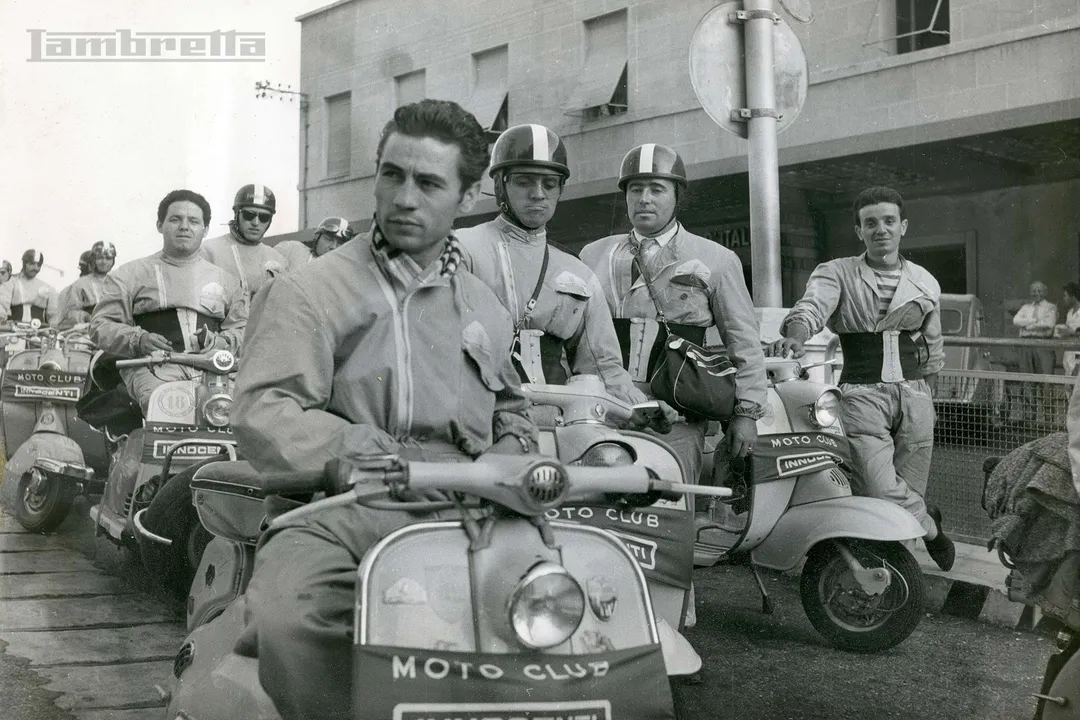
The machine that officially debuted as the first production Lambretta was the Model A, often simply referred to as the Lambretta Model A 125. [2][6] This inaugural scooter rolled out of the Innocenti factory gates in Milan in 1947. [1][6] This timing is crucial; it arrived shortly after the launch of its primary rival, the Vespa, establishing an immediate competition that would define the scooter landscape for decades. [2][6]
The Model A 125 was characterized by its utilitarian design, a clear indicator of its post-war origins and focus on function over flair. [2] It featured a small, pressed-steel frame and relied on a two-stroke, 125cc engine. [6] One notable early feature was the inclusion of an innovative design element that would become a hallmark of the brand: the frame-mounted engine, a technical choice that distinguished it from its main competitor. [6] While the early models shared a certain visual kinship with other scooters of the era, the engineering beneath the skin set the Lambretta apart immediately. [2]
# Technical Details
The engine specs for the earliest versions were modest, reflecting the necessity for fuel economy and simple mechanics. [6] The 125cc engine was capable of producing modest horsepower, enough for city commuting and short-range travel, which was precisely what the market demanded. [2] Initial braking systems were often rudimentary drum brakes, standard for the time, paired with small wheels designed for maneuverability in crowded urban settings. [6] The transmission was typically a three-speed gearbox, controlled by a gear selector mounted on the headset, a setup that required a bit of learning but became intuitive for regular riders. [2]
A key technical differentiator, even in these first iterations, was the front suspension setup. While the Vespa famously used a single-sided trailing link suspension, Lambretta often utilized a swinging arm or leading link design on its early models, offering a slightly different ride characteristic. [6]
- Engine Type: Two-stroke, single-cylinder [6]
- Displacement: 125 cc [2][6]
- Launch Year: 1947 [1][6]
- Body Style: Pressed steel monocoque construction [2]
When looking at the evolution, it's interesting to observe how quickly Innocenti iterated. While the Model A was the first, its immediate successor, the Model B, introduced necessary refinements based on initial rider feedback, such as a slightly improved rear suspension setup. [2] This rapid adaptation speaks to the manufacturer's commitment to creating a practical, user-friendly vehicle, a commitment that later led to iconic models like the Series 1 and the LD. [4][5][8]

# A Different Philosophy
It is impossible to discuss the first Lambretta without contrasting it with the scooter that dominated the public imagination: the Vespa. [2] While both machines emerged to satisfy the same basic need, their engineering philosophies diverged significantly, which in turn shaped the identity of each brand. [6]
The Vespa, built by Piaggio, utilized a monocoque frame—the body was the structure—and famously featured an all-encompassing leg shield that offered excellent weather protection. [2][6] This design became instantly recognizable. [2]
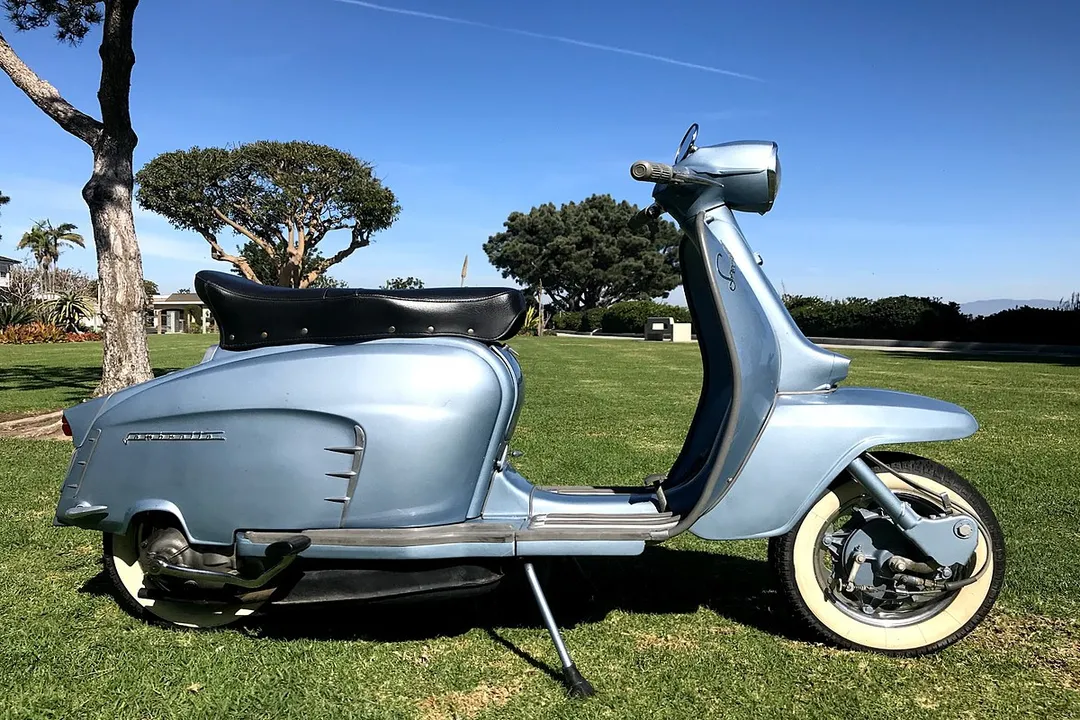
Lambretta, starting with the Model A, leaned toward a more motorcycle-like construction, even while using pressed steel. [2][6] The engine was largely exposed, and the bodywork, while present, was more akin to fairings than a structural shell. [6] This difference is subtly visible even in the later, more famous models like the Series 1 (introduced around 1958). [7][8] The Series 1, for instance, still maintained a clear separation between the frame and the body panels, unlike the fully integrated Vespa bodywork. [7] For the rider accustomed to motorcycles, the Lambretta felt different, often offering a slightly more neutral or direct handling characteristic due to its frame architecture. [6] This initial mechanical divergence ensured that Lambretta developed a loyal following among those who perhaps found the early Vespa too enclosed or too distinctly "step-through" in its feel. [2]
An interesting point of divergence that persisted through the early designs was how the spare wheel was managed. While early Vespas often carried the spare on the front fender or rear rack, the Lambretta models often integrated the spare wheel mounting into the bodywork, sometimes tucked neatly below the seat or on the side panel, depending on the specific variant emerging from the initial design concept. [6]
# Early Market Adoption

The introduction of the Model A and its immediate successors marked the true beginning of the scooter craze in Italy and across much of Europe. [6] In the late 1940s and early 1950s, owning a car was simply out of reach for the vast majority of the population. [2] Scooters like the Lambretta provided personal mobility that was previously unattainable, allowing workers to commute further and families to enjoy weekend trips. [2]
The early Lambrettas were seen as somewhat more masculine or technically oriented compared to the Vespa, which was often marketed toward women or as a family vehicle. [2][6] This perception, whether entirely accurate based on performance or simply due to marketing differences, helped establish Lambretta's initial user base: mechanics, engineers, and riders seeking a reliable workhorse with a hint of engineering pedigree. [2]
The success was not limited to Italy. Innocenti quickly recognized the global potential, and even in these early years, the groundwork was laid for export markets, leading to license-built versions appearing in places like Spain, Argentina, and eventually the UK, often through agreements that allowed local production to meet specific regional demands and tariffs. [2][4]
# The Legacy of the Beginning
Although the Model A and B were crucial proving grounds, the design language that most enthusiasts recognize as the quintessential early Lambretta crystallized with the subsequent models, particularly the LD (Lusso/Deluxe) series launched in 1955, which retained many of the core structural principles established by the 1947 machine but added flair and better performance. [5] Following that, the LI Series 1 in 1958 cemented the scooter's position as a stylish cultural icon, moving it firmly from post-war utility to desirable fashion accessory. [8][7]
However, it is essential to remember that without the humble 1947 Model A, none of those later successes would have occurred. The Model A established the brand identity through its robust, if somewhat basic, engineering approach. [6] It proved that Innocenti could successfully enter the market and offer a legitimate alternative to Piaggio. [2] The initial 125cc platform provided the baseline engine capacity that would evolve, eventually leading to larger, faster scooters capable of highway travel. [6]
If you are looking at a vintage Lambretta today, understanding the context of the first model helps explain the DNA present even in later classics. For instance, the characteristic three-bolt hub design, which simplifies wheel changes on later models, has roots traceable back to the initial engineering decisions made to keep maintenance simple on the earliest models. [6] Even the visual language, the slightly more upright stance compared to a Vespa, traces back to the structural choices made in 1947 to favor a rugged frame over a fully enveloping body shell. This early technical choice created an inherent modularity that made mid-life repairs or modifications comparatively straightforward for a skilled owner or local mechanic, fostering a culture of self-reliance among riders that Vespa ownership didn't always encourage to the same degree.
The transition from the initial austerity of the Model A to the sleek sophistication of the LI series showcases one of the most rapid and successful industrial design shifts of the mid-20th century. Starting from necessity, the Lambretta quickly learned to command desire, all thanks to that foundational 1947 machine which proved the concept worked. [1][2] The very first scooter was pragmatic; its descendants became legends of style and subculture. [7][8]
Related Questions
#Citations
History | Lambretta
Lambretta - Wikipedia
History - Lambretta Scooters
Model History - Casa Lambretta
Innocenti Lambretta 150LD- 1958 - Lane Motor Museum
A Brief History of the Lambretta Scooter - LCGB
1959 Lambretta Li 150 Series 1 Scooter - Audrain Auto Museum
His first scooter...welcome to the world of Lambretta. - Facebook