What was the first anchor?
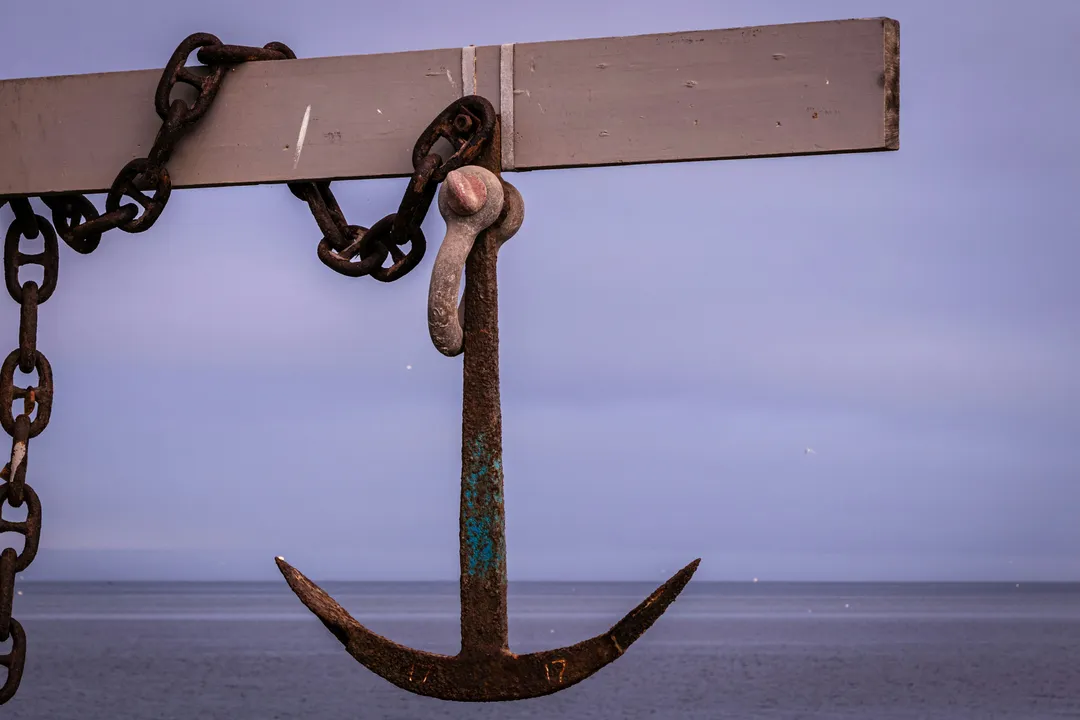
The quest to define the very first anchor is less about finding a singular blueprint and more about tracing a long, slow climb out of pure necessity. For millennia, keeping a floating vessel in place was a matter of adding enough weight to overcome the forces of wind and current. The simplest answer, supported by archaeological finds, suggests the most ancient anchors were just that: heavy rocks or stone plates, perhaps tied to a crude length of rope. Evidence points to these basic mooring elements existing alongside some of the earliest seafaring craft, with rock anchors discovered originating as far back as the Bronze Age.
# Primitive Mass

Maritime civilizations like the ancient Egyptians, who were building ships between 5000 and 6000 BCE, likely utilized the heaviest stones they could manage. Pottery from this era shows crude ship representations with what is believed to be a weight hanging from the prow, intended as an anchor. While this mass strategy works for a fixed, permanent mooring, it fails dramatically when the sailor needs portability. Moving a stone heavy enough to secure a large galley in a deep delta, for instance, was nearly impossible. Furthermore, a simple weight offers no true mechanical grip; it relies entirely on overcoming friction and seabed composition.
To combat the inevitable, aimless dragging of these simple weights across soft seabeds, mariners developed a slight conceptual leap. They started affixing natural elements to the stone to create protrusions that could potentially hook into the bottom—these are often referred to as Killicks. This involved lashing tree branches to the stone weight, effectively creating the first rudimentary "teeth" or flukes designed to catch the bottom material. While this was an improvement, these primitive tackle systems were still prone to dragging on hard bottoms or becoming completely buried in thick mud.
# Greek Innovation

The ancient Greeks, whose lives were intrinsically tied to the sea for trade, exploration, and naval might, are widely credited with inventing the anchor as we begin to recognize its functional design. Faced with the challenges of long sea journeys where docking was impossible, they moved beyond simple, unshaped stones. The early Greek solution involved using weight contained in a more manageable form: baskets of stones or large sacks filled with sand.
The concept of the fluke as a deliberate digging mechanism began here. According to records, these early Greek anchors held by friction and weight, but they enhanced this by using lashing tree branches to the stone to form teeth or "flukes" to better fasten themselves into the bottom. The word they used to describe these anchors often translated to “teeth” (ὀδὁντες in Greek).
A significant milestone occurred by 400 B.C. with the development of the mushroom anchor. This design was a flattened stone—often carved—with a hole drilled through the center. A triangular eyebolt was attached at the top, which served the important function of “tripping” the anchor out of the seabed when pulling it up. This marked a critical stage: the anchor was no longer just a passive weight, but a shaped object designed for active engagement and disengagement with the sea floor.

# Establishing Form

While the mushroom anchor was a key invention, the general shape that would persist for centuries began to appear shortly before this period. The first recognizable form resembling a modern anchor—two hooked arms opposing a perpendicular stock—is documented on Greek and Syrian coins dating to about 750 B.C.. This “Old Fashioned” or “Common” anchor type persisted for nearly twenty-six centuries. Flukes, in this context, were essentially the arms designed to hook into the bottom. Early Roman iron anchors, in use from the Republican period, modeled these earlier wooden anchors, often featuring a stock made of lead.
The evolution continued with the Romans, who likely refined the arm and fluke design to make extraction easier. By the 1st Century A.D., Roman anchors had a design closely aligning with what we think of as traditional today, using a wooden shank, wooden arms/flukes, and a perpendicular stock, though the stock was often made of antimony or a hard lead alloy. It is also recorded that the concept of the fluke was advanced in antiquity; originally, anchors might only have had one tooth, but a second was added later, creating a double-fluked design that more closely resembled modern shapes, save for the absence of a stock in some ancient depictions.
By 700 A.D., Scandinavians were forging similar iron anchors that incorporated wooden stocks, sometimes flaring the ends of the arms into flattened palms to better distribute pressure across the soil. In a fascinating historical sidebar, the Britons fighting Caesar used an even stranger setup: heavy stones secured with the world’s first anchor chains made of iron links. Because the iron links were so heavy, they had to use very short lengths, forcing them to anchor almost vertically. This severely impacted ship design, forcing them to evolve unusually high headboards to survive the constant plunging motion, illustrating how the anchor rode—whether rope or chain—was as consequential as the weight itself.
# Portability vs. Holding

The long dominance of the stock-based, two-fluke anchor highlights a fundamental tension in early maritime engineering: the trade-off between holding power and practicality. The earliest anchors were simple, heavy shapes relying on mass. The Greeks' early innovations introduced mechanical grip via the fluke, which allowed for a lighter device to achieve the same holding power as a massive, unshaped rock, thereby increasing portability. However, this advancement came at a cost: the addition of a stock and complex shape meant the anchor could still be inconvenient to handle and stow on smaller vessels.
Imagine a merchant galley arriving at a busy, muddy port like the Nile Delta. They need an anchor that sets quickly and reliably in the soft sediment. A heavy stone-and-sandbag arrangement would sink too deep to retrieve easily, but a sophisticated iron design could hold fast with less overall weight, making retrieval feasible for the crew. This constant need for efficiency in a non-permanent mooring environment is what drove the development of anchors that dug in rather than just sat down. This engineering choice—favoring a lighter, shape-dependent hold over sheer, immovable mass—is arguably the most significant conceptual jump made from the Bronze Age right up to the 19th century.
# The Age of Metal
For nearly two millennia after the Roman period, anchor design stagnated, with knowledge of the best composite designs seemingly lost after Rome’s fall. While Viking ships carried small iron anchors, the classic two-fluke, stocked design did not see widespread reliable return until the great navigators of the 15th century began utilizing rediscovered designs.
The real transformation began in the 19th century when metallurgy and the ability to create consistent, strong welds improved. Until then, anchors were often imperfect due to poor iron quality, causing the arms to part at the crown when being hauled from firm ground. A major shift occurred when inventors focused on stockless designs to improve handling and stowage, even though early attempts were met with skepticism regarding their holding consistency on uneven ground.
For instance, Richard Francis Hawkins patented a "Stockless" or "Patent" anchor in 1821 that had hinged flukes intended to bite simultaneously. While praised as the "first real improvement" since antiquity, it was reportedly dismissed by the Dutch Navy for poor performance in mud and was not widely adopted at the time, suggesting the underlying metallurgy or the understanding of scope—the ratio of rode to depth—was still catching up to the new shapes. It wasn't until the late 1850s with the Improved Martin anchor, made only from forged iron without welds, that the self-canting, close-stowing design gained traction.
# Legacy of the First Design
The Admiralty Pattern anchor, which maintained the two symmetrical arms and a fixed stock, remained standard issue for navies well into the 1800s, demonstrating the trust placed in that ancient, proven configuration. Even with the advent of specialized modern anchors like the Danforth (1940s) or the Spade (1990s), the essential function remains the same as the Greek basket of stones: using a mechanical shape to resist movement along the seabed.
If we are looking for the first recognizable anchor, it is a rock with lashed branches (the Killick), as it introduced the concept of the fluke. If we seek the first standardized metal shape, the evidence points toward the two-fluke, stocked iron anchor depicted on Greek and Syrian coins around 750 B.C., which was later perfected by the Romans. Ultimately, the earliest known predecessor is the simple, heavy stone utilized by the Egyptians thousands of years before recorded history, proving that the most fundamental aspect of anchoring—weight—is still essential today, as modern systems often use heavy chain to add necessary weight near the anchor point to ensure the flukes pull horizontally into the bottom, maximizing the "catenary" effect.
Related Questions
#Citations
History of the anchor - Wikipedia
The Anchor Was Invented in Ancient Greece - Greek Boston
A Brief History of Anchors
History of the Anchor Patent
How the Ancient Greeks Invented the Anchors for Boats
Anchors of the Seaport
Fun Facts About Anchor Patent Art - Woodchart.com
Understanding Anchors - Classic Sailing
The history behind anchors: types, curiosities and their evolution
History of Anchor Design