What did Henry Ford create first?
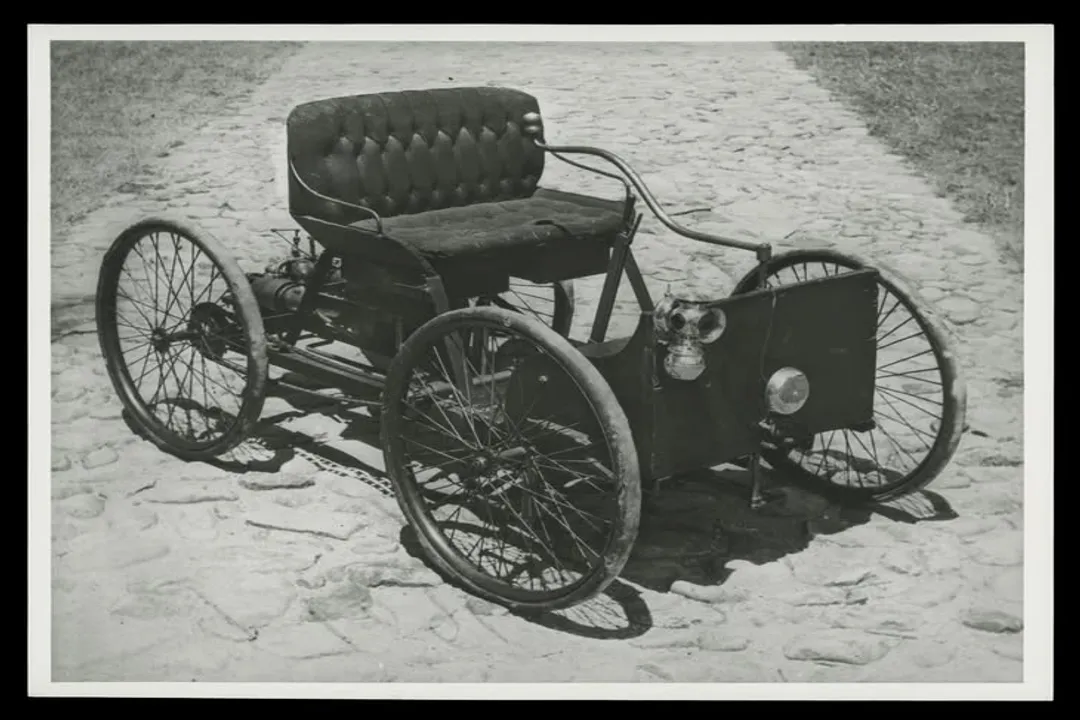
The initial self-propelled machine Henry Ford successfully created was the Quadricycle, built in 1896. [1][5][6] This creation marked the true beginning of his life’s work in the automotive world, preceding the founding of the Ford Motor Company by several years. [1][9] While his name is often synonymous with the Model T or the moving assembly line, the Quadricycle represented the essential, foundational spark—a working gasoline-powered vehicle born from his relentless experimentation in a Detroit shed. [1][6]
# Early Engineering
Before he achieved fame as an industrialist, Henry Ford was an engineer deeply engaged with the potential of the internal combustion engine. [6][7] His employment at the Edison Illuminating Company in Detroit as a chief engineer provided him with the technical knowledge and steady income necessary to pursue his private projects. [1][6][7] Ford wasn't just interested in automobiles; he was fascinated by how engines could be scaled down and adapted for personal transportation. [6] He spent years tinkering, often taking apart and reassembling existing mechanical devices, seeking a reliable power source that didn't rely on steam or electricity, which were the dominant early automotive technologies. [6] His vision wasn't just to build a car, but one powered by gasoline that could be owned and operated by an individual. [1]
# The Machine Built
The Quadricycle itself was a testament to ingenuity born from necessity and limited resources. [4] It was constructed primarily from parts Ford could acquire or salvage, reflecting an immediate, practical mindset that recognized the value of accessible materials. [4][6] The vehicle utilized a two-cylinder, four-horsepower gasoline engine that Ford designed and assembled himself. [1][6][8] It was an interesting hybrid of modern propulsion and established two-wheeled technology. The frame structure was built around components sourced from a bicycle, including the tires and much of the running gear. [4][6] It rode on four light bicycle wheels, hence the name Quadricycle. [8] Steering was managed not with a wheel, as we know it today, but with a tiller, similar to that used on a boat. [1] The machine featured a chain drive connected to the rear wheels, giving it a look more akin to a heavy-duty motorized carriage than the low-slung cars that would follow. [6] Looking back at this construction, it’s clear that Ford’s initial success stemmed from his ability to adopt existing, proven bicycle technology for the chassis. This pragmatic approach, using components that were already standardized and relatively inexpensive, instantly lowered the barrier to entry for early automotive design compared to attempting to invent every single part from scratch—a resourcefulness that indirectly paved the way for the cost-saving techniques he would later perfect in manufacturing. [4][6]

# First Movement
The culmination of this private effort arrived on June 4, 1896. [1][5][6] This was the date Henry Ford took his Quadricycle out for its first successful drive on the streets of Detroit. [1][6] The test run reportedly took place on Bagley Avenue. [1][6] Although the distance covered was not significant—just a short trial run—the moment was monumental. [1][6] The vehicle operated under its own power, proving that Ford’s design concept was viable. [1] This first drive confirmed that a lightweight, gasoline-powered vehicle could function effectively on common roads, validating the years of late nights spent working in his small shop. [6] The vehicle was quite loud and rudimentary, but it worked exactly as intended: it moved under its own power, marking a distinct point where automobile creation moved from theory to practice for Ford. [1]
# Next Iterations
The Quadricycle was revolutionary for Ford personally, but it was not designed for the marketplace; it was an experiment in motion. [1] Ford understood that this first version was merely a stepping stone. [9] Following its success, he continued refining his design, building a second, more powerful version of the Quadricycle. [1][5] He also experimented with a different engine configuration, briefly testing a four-cylinder engine. [1] These subsequent designs, which improved upon the initial concept, were important in gathering the necessary experience that would later contribute to securing financial backing for his first company ventures. [5][9]
It is important to delineate this initial engineering feat from his business formation timeline. While the Quadricycle was finished and tested in 1896, Ford’s first automobile venture, the Detroit Automobile Company, was established in 1899, and ultimately failed to produce a commercially successful vehicle. [3] He was later involved with the Henry Ford Company (1901), which also did not yield the breakthrough product he sought. [3] The final, successful vehicle that led to the formation of the current Ford Motor Company—the one that survived and thrived—was not the Quadricycle, but rather later designs that incorporated the practical lessons learned from those early, raw experiments. [1][3] The Quadricycle’s role was solely to prove the possibility of personal motorized transport, which was an engineering triumph, but it lacked the refinement and scalable design required for mass market penetration, a lesson he only truly mastered later when developing vehicles like the Model A and subsequently the Model T. [1][9] In fact, one might observe that the Quadricycle’s existence demonstrates a classic bifurcation in technological history: the initial success is often a raw proof-of-concept built by an individual inventor, whereas the enduring legacy requires the establishment of an industrial system capable of producing that concept reliably and cheaply for the masses. [3] Ford’s creation of the Quadricycle solved the first problem; his later work solved the second.
# Legacy of the First Creation
Henry Ford’s first creation, the Quadricycle, stands as the physical object that launched his career in the automotive industry. [1][9] It was the culmination of his ambition to create a reliable, self-propelled road machine using gasoline as fuel. [6] The basic architecture—four wheels, an internal combustion engine, and a simple conveyance—established the fundamental configuration that defined the early automobile before truly specialized designs took hold. [6][8] Though long gone, the Quadricycle remains the symbolic starting point from which the vast global enterprise known today as Ford Motor Company eventually grew. [1][3] It represents the moment an engineer decided to build his vision, rather than just dream about it. [7]
Summary of Key Creation Details:
| Attribute | Detail | Source Support |
|---|---|---|
| Name | Quadricycle | [1][8] |
| Year Completed | 1896 | [1][5][6] |
| Engine Type | Two-Cylinder Gasoline | [1][6][8] |
| Horsepower | Approximately Four HP | [1][6][8] |
| Steering Method | Tiller | [1] |
| Frame Basis | Bicycle Components | [4][6] |
| First Drive Date | June 4, 1896 | [1][5][6] |
The Quadricycle was not merely a hobby project; it was the essential mechanical blueprint that proved Henry Ford’s core concept was sound, making his later, more famous industrial achievements possible. [9]
#Videos
History of Henry Ford's Quadricycle - YouTube
Related Questions
#Citations
Henry Ford's Quadricycle | Articles
Henry Ford - Wikipedia
Henry Ford built his first automobile, the Quadricycle ... - Facebook
Henry Ford Unveiled His First Automobile 122 Years Ago This Month
History of Henry Ford's Quadricycle - YouTube
Henry Ford - Biography, Inventions & Assembly Line - History.com
The Birth of Ford Motor Company