What did da Vinci invent?
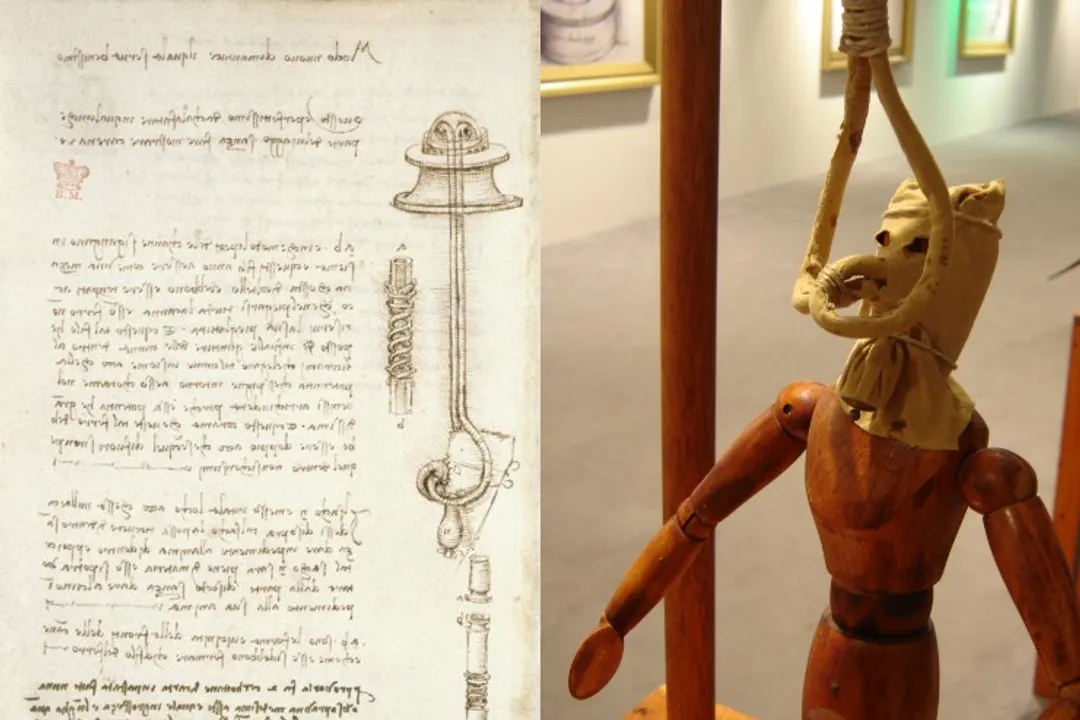
The name Leonardo da Vinci immediately summons images of the Mona Lisa's enigmatic gaze or the profound drama of The Last Supper, yet to confine him to the canvas is to miss the roaring engine of his true passion: invention. While his paintings secured his fame in his own time, it was his relentless scientific inquiry and mechanical inventiveness, recorded across thousands of pages of notebooks, that placed him centuries ahead of the standard thinking of the Renaissance. He was, by every measure, the quintessential Universal Genius, driven by the principle of saper vedere—knowing how to see the underlying structure of the world through rigorous observation.
# Notebook Focus

The surviving documents, known collectively as the codices, are the clearest window into this inventive mind. Leonardo amassed over 10,000 pages detailing everything from the swirl of water to the anatomy of the human heart. He worked in mirror script, writing from right to left—a natural habit for a left-hander—which was not necessarily intended as a secret code, but perhaps rather as a way to avoid smudging his ink, though it certainly added a layer of obscurity. These writings were intended as a colossal, encyclopedic work, a synthesis of all knowledge gained through experience, intended for eventual publication. He planned treatises on painting, architecture, mechanics, and anatomy, yet much remained in preliminary form when he died, leaving the monumental task of compilation to his devoted pupil, Francesco Melzi.
# Anatomy Science

Before we delve into his fantastical machines, it is crucial to appreciate the scientific foundation upon which they were built. Leonardo treated anatomy not just as a prerequisite for painting lifelike figures, but as an independent, vital area of study. He dissected around thirty human bodies over three decades in centers like Milan and Florence, meticulously recording his findings. His work was physiological as well as structural; he sought to understand how the parts functioned as well as what they looked like.
His anatomical drawings are famed for synthesizing experience into precise visual demonstrations, pioneering modern scientific illustration. He was the first to describe the double S-curve of the human backbone and drew detailed cross-sections of the heart, correctly observing how the mitral valve functioned during the opening phase—a depiction later referenced by a modern heart surgeon. His comparative anatomy studies extended to animals, including horses (in preparation for his massive Sforza monument), dogs, and bears. This scientific rigor, rooted in direct observation, informed his art and his engineering in equal measure.
# Flight Concepts

Perhaps no area of Leonardo’s notebooks captures the imagination quite like his attempts to conquer the air. His obsession with flight stemmed from childhood observations, leading him to study birds extensively, culminating in the coherent manuscript, the Codex on the Flight of Birds, around 1505.
He conceptualized several devices:
- Ornithopters: These machines featured membrane-covered wings designed to flap, mimicking birds or bats. The pilot was to power them using levers and pedals, relying entirely on muscle strength.
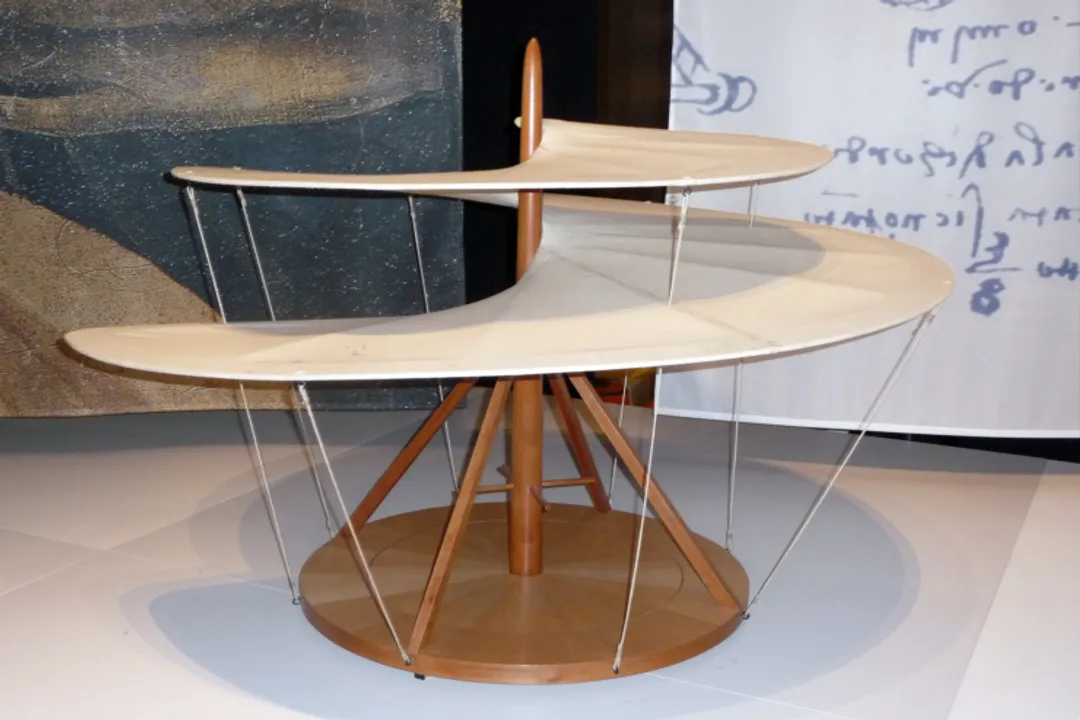
- Helical Airscrew: Sketched in the 1480s, this single, screw-shaped blade is universally recognized as the direct precursor to the modern helicopter.
- Gliders: Realizing muscle power was insufficient for flapping flight, he also designed gliders where the wings were fixed, relying on launching speed for lift and steering for control.
The primary hurdle for all his atmospheric designs was power. Even the helical airscrew, conceptually sound regarding lift generation, lacked a powerful enough engine to rotate the rotor sufficiently against its own weight. Furthermore, he showed foresight regarding safety, sketching an early form of the airbag—leather sacks tied around a pilot intended to cushion impacts from low-altitude falls onto water or ground. While a 2000 attempt by Adrian Nicholas successfully tested a replica parachute design for a smooth, albeit short, controlled descent, the flight of his flapping ornithopters remained purely theoretical.
# Warfare Devices
Leonardo’s engineering prowess was often employed in the service of his military patrons, such as Ludovico Sforza in Milan and Cesare Borgia. His designs for war machines were often visually terrifying, intended to break enemy morale as much as ranks.
Among the most striking military concepts are:
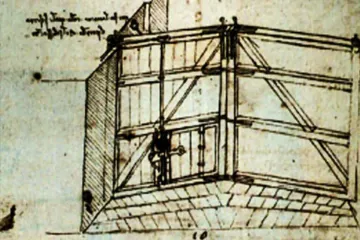
- The Armored Car (Tank): A conical vehicle designed to be propelled by internal cranks, surrounded by cannons for 360-degree firing. However, the drawing contains a famous mechanical error: the internal gearing is configured so the wheels turn in opposite directions, rendering the vehicle immobile as drawn. Whether this was a genuine oversight or a deliberate inclusion to sabotage its immediate implementation remains debated.
- The Steam Cannon (Architonnerre): Leonardo claimed this design originated with Archimedes, involving heating a chamber where water was introduced to create a massive, gunpowder-free steam explosion capable of hurling a heavy ball significant distances. The primary drawback, which limited its Renaissance practicality, was its inability to function in the rain. This concept, however, reveals his early understanding of utilizing pressurized steam—a principle that would later power the Industrial Revolution.
- Giant Crossbow and Scythed Chariot: These reflected a study of existing military engineering principles, which Leonardo sought to enhance. The crossbow was monstrously large, likely more for psychological impact than practical use.
It is important to note the apparent conflict between his compassionate nature—evident in his anatomical studies and later reluctance to publish destructive designs—and his work as a military engineer. Some historians suggest he intentionally built flaws into his most devastating war designs, such as the tank, to prevent their effective deployment, which would align with his conscience while fulfilling his contract.
# Water Systems
Controlling and navigating the fluid element of water occupied Leonardo as much as the air did. His hydrodynamics studies led to several compelling, forward-looking inventions:
- Submarine: This design is remarkably modern, featuring a streamlined hull and side hulls used as ballast tanks. By flooding these tanks, the vessel would sink; by forcing the water out, it would rise, mirroring the fundamental operation of contemporary submersibles. While his sketch lacked visible propulsion or rudders, the core diving mechanism was sound, and he even conceptualized an emergency breathing bag for the crew. His reluctance to share details about this invention suggests he recognized the immense destructive power it offered naval warfare.
- Diving Suit: Designed potentially for sabotage against enemy ships in the Venetian lagoon, the suit was leather, featured glass eye-pieces, and included a snorkel system connected to a floating cork buoy for air supply. A key innovation was the use of flexible, spirally reinforced tubing to allow the diver movement while managing water pressure, a concept successfully replicated in modern testing.
- Water Strider: A device intended to allow a person to walk on water, relying on the principle of buoyancy—the displacement of water equal to the wearer's weight. This required extremely large, sealed shoes, which, while impractical due to size, demonstrated a mastery of Archimedes’ principle.
# Architecture and Motion
Leonardo’s engineering spanned construction and pure mechanics. In civil engineering, his designs included hydraulic machines, plans for movable dikes to protect Venice, and a famous project for Ottoman Sultan Beyazid II: a Self-Supporting Bridge spanning the Golden Horn in Istanbul. This design, requiring no fasteners and relying on interlocking notched beams for structural integrity, was deemed impossible by the Sultan but has been successfully reproduced in modern scale models, confirming its theoretical validity.
In the realm of pure mechanics and movement, his sketches reveal an understanding of principles that would take centuries to be codified:
- Mechanical Automata: He designed devices purely for spectacle and entertainment for his patrons, such as the Mechanical Knight (a robot capable of standing, moving its arms, and turning its head via internal pulleys and gears) and the Mechanical Lion, which walked and presented lilies (the symbol of the French crown). These were not just crude clockwork; they were complex attempts to mimic the figura istrumentale dell'omo (man's instrumental figure).
- Automobile: A three-wheeled vehicle driven by a spring mechanism, similar to a large wind-up toy, which replicated designs from his Codex Atlanticus. While replicated models can move surprisingly fast (up to 50 km/h), their range is very limited, suggesting they served as novelties for courtly demonstration rather than practical transport.
- Musical Instruments: A genuine, realized mechanical concept was the Viola Organista. This was an experimental bowed keyboard instrument, conceived in the late 1480s, which used continuously rotating wheels to draw a bow across the strings—an idea that draws analogies to modern fanbelts.
The sheer variety is astounding. Leonardo sketched devices for grinding convex lenses, proposed a rudimentary theory of plate tectonics, and even conceived of the double hull for ships. An interesting pattern emerges when comparing his successful theoretical explorations to his massive, unrealized projects: the Viola organista was a self-contained, achievable mechanism, whereas the enormous bronze equestrian statue for Sforza, which consumed years of his life, was entirely dependent on political stability and massive bronze resources that dried up with war. This contrast highlights that his capacity for invention often outstripped the available resources or the immediate political will to fund truly colossal undertakings.
When analyzing the sheer volume of mechanical drawings, it becomes clear that for Leonardo, the act of demonstrating the principle through drawing—his dimostrazione—was often the true end product. He mastered creating technical drawings that functioned as blueprints, showing internal parts through "exploded views," but for many kinetic designs, the final step of refinement into a guaranteed working model was either interrupted by his next consuming obsession or deliberately stalled by his own moral compass regarding weaponry. The legacy, therefore, is not just a list of things he built, but the vast, interconnected system of observation, analysis, and graphical representation he invented for understanding the world.
#Videos
Thousands of Pages of Inventions, Ideas and Flying Machines | PBS
I made all of Da Vinci's Inventions! - YouTube
Related Questions
#Citations
Science and inventions of Leonardo da Vinci - Wikipedia
The Inventions of Leonardo Da Vinci
Leonardo da Vinci - His most important inventions - Nico Franz
10 of Leonardo da Vinci's Most Important Inventions | History Hit
Thousands of Pages of Inventions, Ideas and Flying Machines | PBS
Inventor | Leonardo Da Vinci - The Genius - Museum of Science
Leonardo da Vinci | Paintings, Art, Last Supper ... - Britannica
Leonardo Da Vinci: Machines and Robots