Did Leonardo da Vinci ever invent anything?
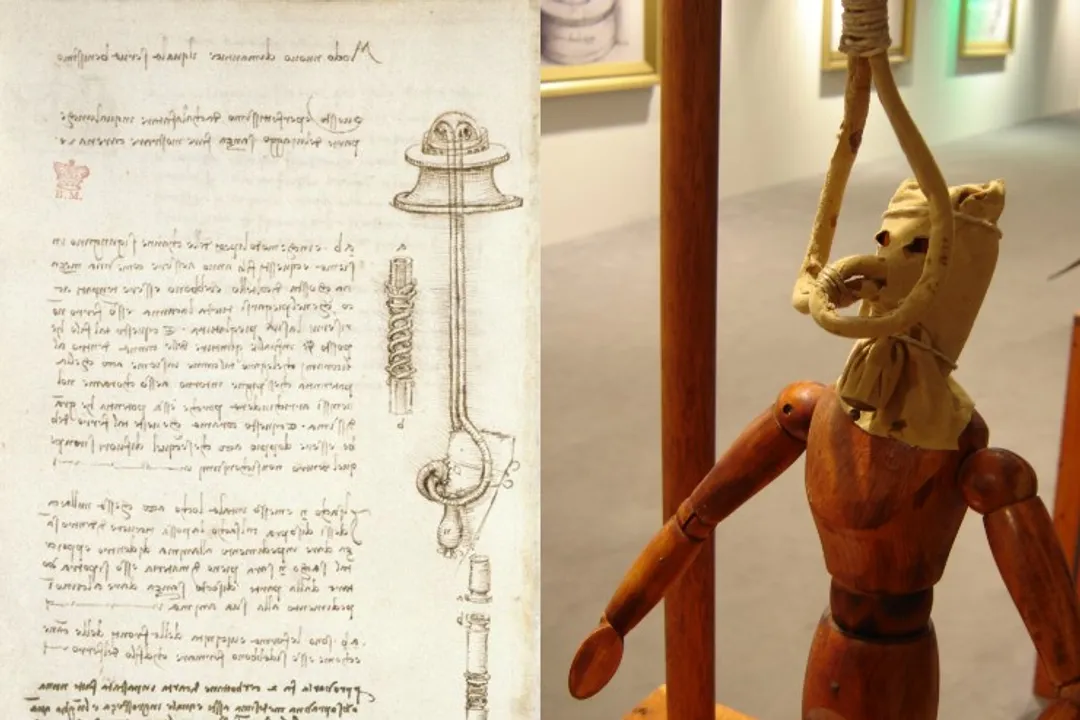
The question of whether Leonardo da Vinci actually invented anything often sparks more debate than a simple yes or no allows, forcing a closer look at what we mean by "invention" in the context of the Renaissance. [1] He was undeniably a prolific visionary, filling thousands of notebook pages with concepts that far outpaced the technology of his era. [2] Instead of viewing him as a mere tinkerer who produced working models, it is more accurate to see him as perhaps the greatest conceptual engineer in history, sketching out blueprints for objects centuries before their practical realization. [4] The true measure of his genius lies not just in whether a machine flew, but in the detailed, scientific understanding of mechanics and nature contained within his drawings. [5][7]
# Design Versus Device
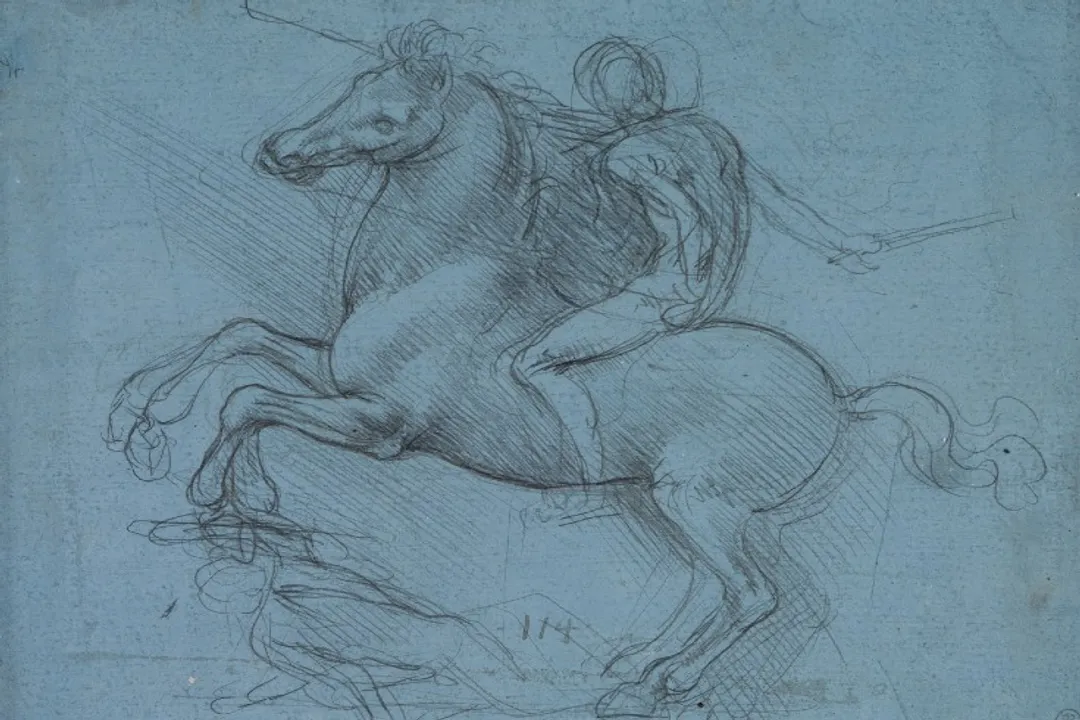
The primary source of confusion regarding Da Vinci's inventions stems from the difference between a documented design and a successfully constructed device. [1] Many of his most famous contributions—the aerial screw, the armored fighting vehicle, or various hydraulic machines—remained confined to his codices, written in his distinctive mirror script. [1][6] While he was a practicing engineer employed by patrons like Ludovico Sforza in Milan and later by Cesare Borgia and King Francis I of France, his commissions often focused on military engineering, stage machinery, and architectural projects, rather than building speculative personal inventions. [4][1]
It is widely acknowledged that a significant portion of his engineering work was never physically built during his lifetime. [5] For example, his detailed designs for flying machines—including gliders and ornithopters—were revolutionary in their study of bird flight and aerodynamics, yet the materials and power sources available in the late 15th and early 16th centuries were insufficient to make them functional. [1][4] This lack of realization leads some historians, as discussed in forums dedicated to historical inquiry, to argue that a design unbuilt is merely a sophisticated theoretical exercise, not a successful invention in the common sense of the word. [3][8] Contrast this with contemporary inventors who might have produced a functioning printing press improvement or a recognizable mechanical clock; Da Vinci’s output existed primarily on paper. [3]
# Conceptual Engineering Gallery
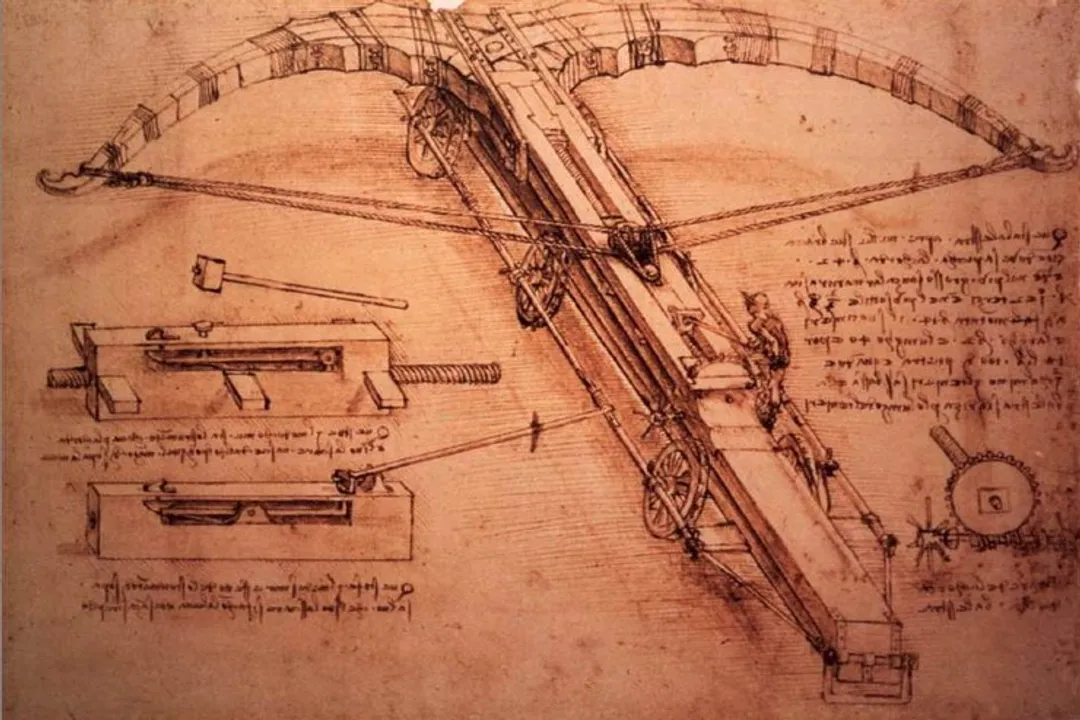
The breadth of Da Vinci’s conceptual work is staggering, touching nearly every field of mechanics known at the time and several that would only become reality centuries later. [1] His notebooks contain detailed schematics for innovations that read like a modern engineering curriculum condensed into one lifetime. [6]
Consider the realm of warfare, where his services were often sought:
| Invention Category | Specific Concept | Primary Function | Status of Realization in Da Vinci's Time |
|---|---|---|---|
| Military | Armored Car (Tank) | Protected infantry assault vehicle | Conceptual design; lacked appropriate engine/transmission [1][4] |
| Military | Giant Crossbow | Large-scale siege weaponry | Designed, likely not constructed due to scale/power needs [1] |
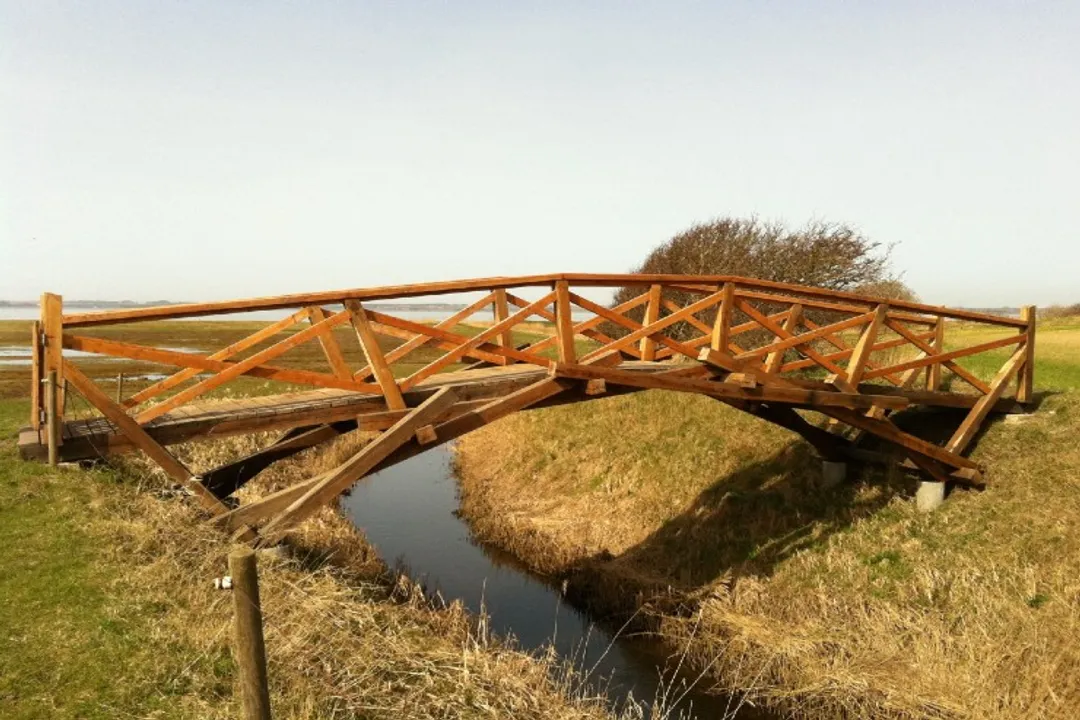
| Civil | Movable Bridge | Rapid deployment bridge for armies | Designs existed; practical construction depended on specific site needs |
| Aviation | Ornithopter | A human-powered flying machine mimicking birds | Detailed aerodynamic studies; non-functional due to power constraints [1][4] |
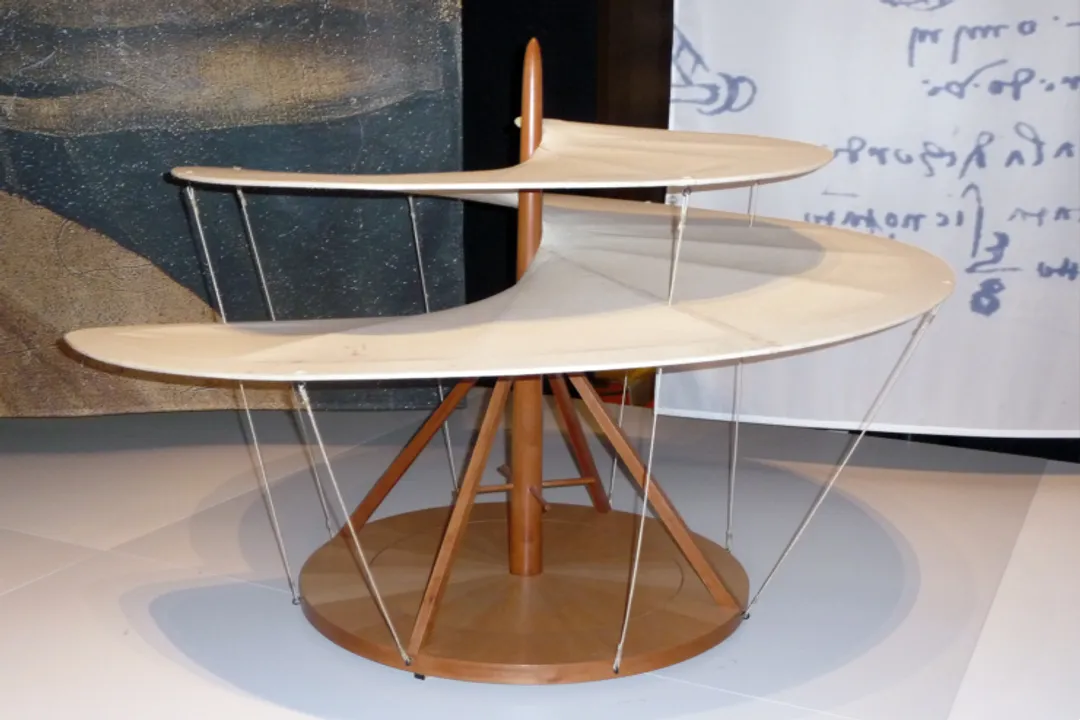
One particularly famous concept is the aerial screw, often considered a forerunner to the modern helicopter. [2][4] His drawings show a rotating device intended to compress air to generate lift. [1] While the principle of screw-based lift is sound—and this idea later resurfaced in the 19th century—Da Vinci's model required immense, sustained power that human muscle simply could not provide. [5] The sketches, however, show an understanding of torque and helical movement far ahead of their time. [6]
# The Limits of Renaissance Power
The recurring theme when examining Da Vinci's unbuilt inventions is not a failure of imagination but a failure of materials and available power. [4] This is a crucial contextual point often missed when assessing his practical impact. A modern inventor benefits from standardized metallurgy, electrical power, and internal combustion; Da Vinci had wood, leather, animal sinew, and human muscle. [1]
If we analyze the power requirements for his most ambitious devices, we can gain some perspective. For instance, a single man operating the crank of his proposed 'tank' would need to produce several horsepower continuously just to overcome the static friction of the wooden structure and its metal axles on rough ground, let alone move it with any speed. [4] This gap between theoretical mechanics and practical physics—specifically the lack of an appropriate energy source—is the true barrier to calling his designs built inventions rather than advanced theoretical machines. [1] It is fascinating to consider that perhaps if Da Vinci had access to a high-yield spring mechanism or a very small, efficient steam engine prototype, his notebooks might be filled with fully functional prototypes instead of just beautiful, detailed drawings. [5]
# Scientific Observation as Invention
While the machines often steal the spotlight, Da Vinci's most tangible and certainly built contributions often fall under the category of scientific observation and applied knowledge, which can also be considered invention in a broader sense—the invention of a better method. [7] He made significant strides in anatomy through dissection, producing drawings of the human body that were startlingly accurate for the time, correcting errors that had persisted since antiquity. [1] His anatomical studies were not merely documentation; they were an invention of a new, empirical method for biological understanding. [7]
He was also deeply involved in hydraulics and civil engineering for his patrons. [1] While a general-purpose bridge design might not qualify as a singular 'invention,' his proposed schemes for diverting the Arno River, though ultimately unsuccessful for political or practical reasons, demonstrate an active engagement with large-scale engineering problem-solving. [4] Furthermore, he seems to have developed practical mechanisms for things like canal locks and improved gears for mills, which, while perhaps not entirely novel in principle, were improved or adapted by him for specific, practical applications. [3] The invention here is often the refinement that made an existing concept viable in a new setting. [2]
# Foreshadowing Future Realities
The enduring legacy of Da Vinci's designs is their incredible foresight—they are blueprints for technologies that materialized centuries later. [4][5] When people ask if he invented anything, they are often really asking if he pre-invented modern technology. The answer to that is a resounding yes, conceptually. [6]
His work on mechanical computation, for example, included designs for mechanical calculators. [1] While primitive compared to Babbage's engine, they show an early attempt to mechanize arithmetic, moving the process from the human mind to a machine. [7] Similarly, his drawings of diving suits and underwater breathing apparatuses demonstrate a deep understanding of the need for air supply management in hostile environments. [1][2]
One analytical perspective that shifts the focus away from physical construction is to regard Da Vinci's notebooks as an early form of design thinking itself. His process—observing nature meticulously, sketching potential solutions, testing those sketches theoretically (via calculations or comparison to nature), and then iterating—is the modern cornerstone of innovation. [7] He essentially invented an iterative, human-centered design process centuries before it was formalized. [7] If we measure invention by the novelty of the problem-solving method, then Da Vinci’s contribution is perhaps the single most important piece of 'intellectual technology' he left behind. [5][7] This methodology, recorded in his mirrored script, teaches us that the true invention is often the structured way of approaching the unknown, not just the resulting artifact. [7]
# The Verdict on Building
To return to the central question, did Leonardo da Vinci invent anything that was built and used during his time? The consensus among historians leans toward very few, if any, of his grand mechanical visions achieving full realization. [3][4] However, this needs qualification. He was a master artist, and his mechanical expertise was often applied to stage effects, theatrical machinery, and courtly festivals. [1] These devices, built under his supervision for temporary display, certainly count as realized mechanical inventions, even if they weren't intended for mass production or military use. [3]
A key point to remember is that his patrons were often more interested in spectacle and military advantage than in funding abstract research into perpetual motion or human flight. [4] If a device helped launch a festival or defend a city wall, it was built; if it required a new metallurgy or a massive shift in manufacturing capability, it stayed in the notebook. [3]
It is a testament to his genius that, even without the benefit of modern materials or mass production, his sketches are so precise that modern engineers can look at them and say, "Yes, if we give him titanium and a small engine, this will work perfectly". [5] He provided the what and the how in theory; history simply hadn't caught up with the with what. [1][4] His legacy, therefore, is that of a magnificent conceptual architect whose influence shaped the idea of invention, propelling the scientific revolution that followed long after his death. [7][9][2][6]
#Videos
Thousands of Pages of Inventions, Ideas and Flying Machines | PBS
Related Questions
#Citations
Science and inventions of Leonardo da Vinci - Wikipedia
The Inventions of Leonardo Da Vinci
Did Leonardo Da Vinci invent anything that was actually built ...
10 of Leonardo da Vinci's Most Important Inventions | History Hit
Did Leonardo Da Vinci invent anything that was never built or made ...
Leonardo da Vinci - His most important inventions - Nico Franz
Leonardo da Vinci | Innovation Lessons | Business Creativity
Thousands of Pages of Inventions, Ideas and Flying Machines | PBS
DaVinci didn't invent anything! - Straight Dope Message Board