Did Michael Faraday invent the transformer?

The origins of the electrical transformer, that quiet workhorse of the modern electrical grid, are often directly credited to the brilliant experimentalist Michael Faraday. While the device we recognize today—the one stepping voltage up for long-distance travel or down for home use—is a refinement built over decades, the fundamental physical phenomenon that makes it possible was undeniably his discovery. [1][5] To ask if he invented the transformer requires looking closely at what he created in the early 1830s versus the practical apparatus that came later. Faraday’s genius lay not just in observation, but in rigorously testing the relationship between electricity and magnetism, a pursuit that yielded electromagnetism, the electric motor, and the principles of induction. [2][5][9]
# Induction Demonstrated
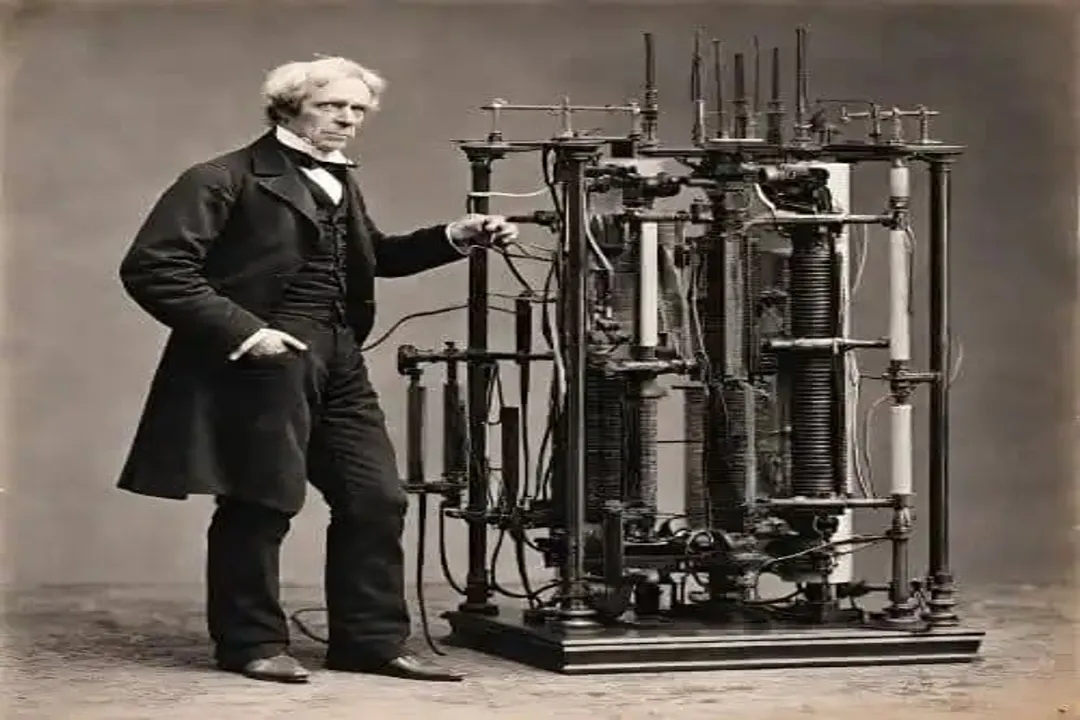
The specific moment often cited as the birth of the transformer’s concept occurred on August 29, 1831. [1] Faraday was deeply engaged in understanding how electricity and magnetism interacted, having already established the possibility of generating current from magnetism. He was working with two separate coils of wire wrapped around a soft iron ring. [1][5] This setup, while appearing simple, was revolutionary because it isolated the two circuits while keeping them magnetically linked via the iron core. [1]
Faraday connected one coil—the primary—to a battery via a switch, while the second coil—the secondary—was connected to a galvanometer, an instrument designed to detect current flow. [1][5] He didn't expect a continuous current to flow; rather, he was searching for transient effects. When he closed the switch, connecting the primary coil to the battery, the needle on the galvanometer momentarily twitched before returning to zero. [1] Similarly, when he broke the circuit, the needle deflected in the opposite direction. [1]
This transient deflection was the key demonstration of mutual induction. [1][5] It showed that a changing magnetic field—created by the switching on or off of the current in the primary coil—was inducing a temporary current in the entirely separate secondary coil. [1] He observed that the magnetic field itself wasn't enough; the change in the field was the essential ingredient for induction. [5] This foundational principle—that one circuit can influence another through a magnetic field without physical contact—is the very bedrock upon which all modern transformers operate. [1][5]
# The Apparatus
Faraday’s iron ring apparatus served as the initial, tangible proof of concept. [1] It was, essentially, an air-cored transformer concept realized using a magnetic circuit—the iron ring—to concentrate the magnetic flux between the two windings. [5] The setup involved two separate conductors physically isolated from each other, sharing only the influence of the magnetic field they generated or encountered. [1]
It is worth noting a subtle distinction when comparing Faraday’s early work to contemporary electrical engineering. Faraday was demonstrating the physics, often experimenting with what we would now call very low frequencies (just the switching action) and likely lower voltages. [5] The modern transformer, however, relies on alternating current (AC), where the current is continuously and rapidly changing direction (e.g., 50 or 60 times per second) to maintain a constant state of induction, allowing for efficient, sustained voltage conversion. [8] Faraday’s immediate demonstration was about proof of concept—that the link existed—rather than a device engineered for continuous power delivery. [1]
When thinking about the sheer elegance of his setup, one cannot help but contrast the intellectual leap required to conceive of two separate circuits sharing energy through an invisible magnetic field with the physical simplicity of the materials: copper wire and an iron ring. [1][5] It highlights a common theme in foundational science: the most profound breakthroughs often emerge from the most focused, minimalist experimentation, long before commercial pressures demand complex optimization.
# Beyond Principle
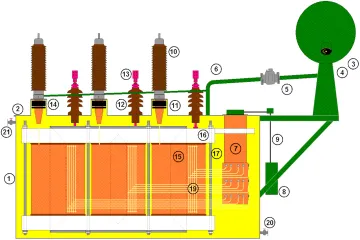
Did Faraday stop there and begin mass-producing devices to change voltages for industrial use? Not exactly. While he showed the principle of mutual induction, he did not necessarily invent the practical, highly efficient induction coil used for generating high voltages necessary for later applications like lighting or power distribution. [4][8]
Faraday focused heavily on demonstrating the laws of electromagnetic induction, which also led him to create his first electric generator—a machine that converts mechanical energy into electrical energy through a changing magnetic field. [5][9] His work established the why and the how of induction, but the application of that induction to create the efficient, laminated core transformers necessary for the coming electrical age took further invention. [4]
This gap between scientific discovery and technological implementation is a recurring theme in the history of technology. Faraday established the physics behind the concept, which is arguably the hardest part. He created the first functional model of what is a transformer in principle, but he did not necessarily perfect the device for widespread utility. [4] Indeed, Faraday himself was famously less concerned with patenting or commercializing his discoveries, preferring to keep his findings open for the advancement of science. [9]
# Post-Faraday Evolution
The practical realization of the transformer as we understand it today, particularly for AC power systems, occurred decades after Faraday's initial work. [4] The mid-1880s saw a frantic race to make electricity distribution viable, leading directly to the development of the transformer as a core component of the AC system championed by figures like George Westinghouse and Nikola Tesla. [4][8]
A significant step forward came with the work of William Stanley. [4] In 1886, Stanley developed what is often cited as the first commercially successful transformer designed specifically for distributing electrical power. [4] Stanley’s design incorporated crucial improvements over the simple ring setup, often featuring laminated iron cores. [4][8] Lamination—using thin sheets of iron insulated from each other—was critical because it dramatically reduced energy losses due to eddy currents that would have plagued a solid iron core used in continuous operation. [4][8]
The transition from Faraday’s 1831 demonstration to Stanley’s 1886 commercial device illustrates the difference between discovering a physical effect and engineering a practical solution for mass use. Faraday proved that induction worked; Stanley figured out how to make it work efficiently using alternating currents and materials science. [4][8]
To put the scale of development in context, consider the different roles the devices play, which helps clarify Faraday’s specific contribution:
| Device Concept | Inventor/Developer | Primary Purpose | Key Characteristic |
|---|---|---|---|
| Principle of Mutual Induction | Michael Faraday | Scientific Demonstration | Proved that a changing magnetic field in one coil induces current in another [1] |
| First Practical Transformer | William Stanley | Commercial Power Distribution | Used laminated cores to minimize energy loss from eddy currents [4] |
Faraday’s discovery provided the what—the physical law—while the subsequent engineers provided the how—the practical, loss-mitigating architecture required for the electrical age. [4] Without the initial demonstration of mutual induction, the later development of the Stanley transformer, or any other induction device, would have been impossible. [5]
# The Legacy of Induction
The lasting impact of Faraday’s 1831 experiment cannot be overstated. His work laid the groundwork for virtually all modern electrical machinery, including motors, generators, and, certainly, transformers. [2][5][9] While he might not hold the patent for the modern, commercially viable AC transformer, he is without dispute the discoverer of the physical mechanism—electromagnetic induction—that defines the transformer. [1]
If the definition of "inventor" means the first person to conceive, demonstrate, and publish the underlying physical law that a device relies upon, then Michael Faraday is the inventor of the principle of the transformer. [1][5] He identified the mechanism allowing magnetic energy transfer between circuits. If the definition requires the creation of the first practical, commercially viable device designed for power conversion using alternating current, then credit must be shared with later engineers who solved the material science challenges associated with sustained operation. [4]
Ultimately, when we look at the power lines delivering electricity to our homes, every surge in voltage stepping up to leave the power station, and every reduction stepping down near a neighborhood, we are observing the continuous, reliable execution of the principle Michael Faraday first observed with his iron ring and his galvanometer over 190 years ago. [1] His contribution remains the most fundamental and indispensable piece of the puzzle.
#Videos
Faraday's first transformer - IGCSE Physics - YouTube
Related Questions
#Citations
August 29, 1831: Michael Faraday invents the transformer - ABC27
Faraday (1791) - Energy Kids - EIA
Michael Faraday - Wikipedia
Stanley Transformer – 1886 - Magnet Academy - National MagLab
Michael Faraday's generator | Royal Institution
Faraday's first transformer - IGCSE Physics - YouTube
Michael Faraday with the first transformer - Facebook
Energy Trailblazers: Faraday, Henry, Stanley and the Evolution of ...
Michael Faraday: The Man behind Motors, Generators, and ...