Why did Robert Fulton invent the submarine?

Robert Fulton’s name is almost synonymous with the steamboat, yet his pioneering work in underwater warfare predates his successful commercial navigation ventures and reveals a darker, more pressing motivation for invention. [3][9] Long before he made waterways navigable by steam power, Fulton was engineering a tool intended not for commerce or transport, but for destruction: the submarine. The fundamental reason Fulton dedicated significant time and effort to designing and building an underwater vessel was the pursuit of a decisive military advantage against the world's dominant naval power of the time. [2][4]
# Military Goal
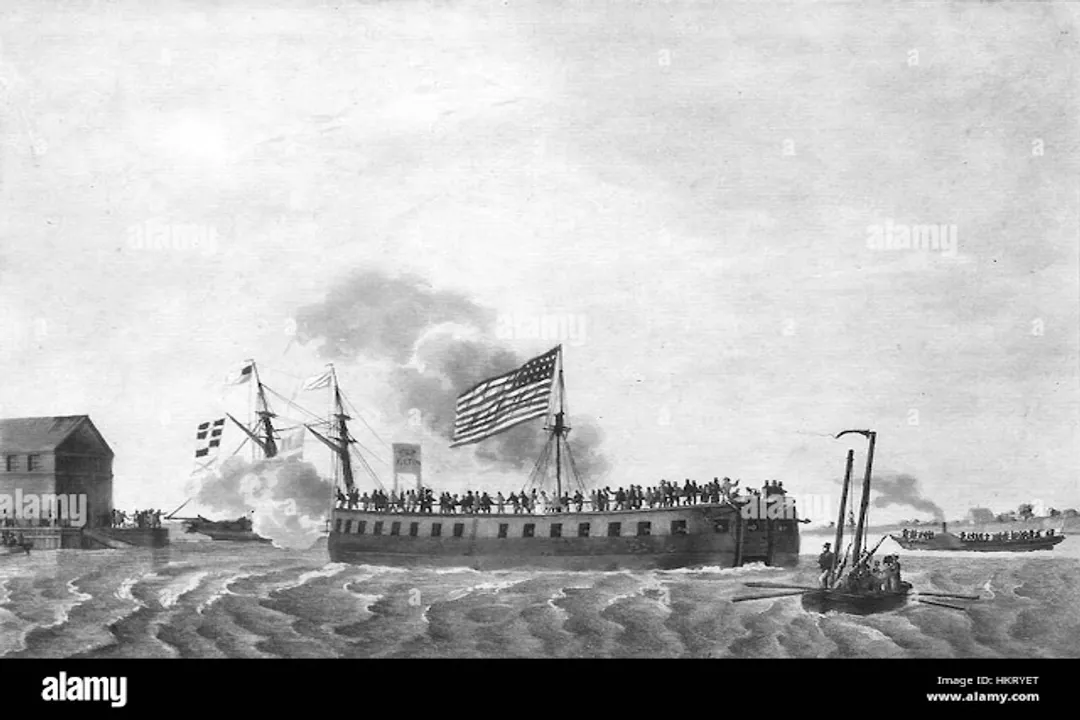
Fulton was deeply concerned with the overwhelming naval superiority of the British fleet throughout the late eighteenth and early nineteenth centuries. [2] He recognized that an open-sea engagement between the fledgling American or French navies and the Royal Navy would likely end in decisive defeat for the former. [4] His answer to this imbalance was not to build bigger surface ships, but to circumvent the existing rules of engagement entirely by attacking from below the waterline. [4] The submarine, which he christened the Nautilus, was conceived as an anti-ship weapon designed to carry explosive charges, or what he termed "torpedoes," directly against the hulls of enemy warships. [1][4]
This ambition represented a radical departure from established naval doctrine. For centuries, naval warfare had been dominated by the tactics of sail, broadsides, and ship-to-ship duels, relying on superior gunnery and seamanship. [1] Fulton was attempting to introduce an element of stealth and asymmetric warfare previously unseen in successful military applications. His entire concept hinged on surprise and the ability to apply concentrated explosive force where the enemy was least protected—the keel. [4] The invention was therefore driven by a clear strategic imperative: creating a decisive, tactical weapon that could negate superior numbers and size.
# French Interest
Fulton did not initially seek to sell this concept to the United States. His earliest and most substantial patronage came from France during the French Revolutionary and Napoleonic periods. [2] In the late 1790s and early 1800s, Fulton presented his plans to the French government, hoping to provide them with the means to cripple the British Navy, which they desperately wished to subdue. [2][6] He viewed submarine warfare as a potential equalizer in the ongoing conflict between France and Great Britain. [2]
The French government did, to some extent, finance his experiments, recognizing the disruptive potential of the idea, even if they remained hesitant about its practicality. [6] This early pursuit in Europe established the core principles of his design—a watertight hull, ballast tanks for submersion, and a method for carrying and deploying an explosive charge against an enemy vessel. [1][4] While his steamboat efforts eventually found better footing in America, the submarine project remained tethered to the high-stakes world of European military engineering.
# The Nautilus Design
The physical manifestation of Fulton's thinking was the submarine Nautilus, built around 1800. [1][2] It was a revolutionary, albeit rudimentary, machine compared to modern standards. The vessel was constructed primarily of wood and iron, shaped somewhat like a whale or a cigar. [1][7] It was designed to carry a crew of three to four men. [1] The engineering challenge Fulton faced was immense: how to control buoyancy and maintain propulsion underwater using the limited technology available at the turn of the century. [7]
Submerging was managed by taking on water into ballast tanks, and surfacing required forcing that water out, often through the use of manually operated air pumps. [1] Propulsion was achieved not by an engine, but by the crew turning a system of hand cranks connected to a submerged propeller. [1][7] This mechanical reliance on human muscle power dictated the vessel's limitations: it could only remain submerged for short periods and move at slow speeds. [1]
It’s useful to consider the psychological and physical demands placed on the crew. While the Nautilus successfully demonstrated submergence and movement underwater—a monumental achievement for the time—it required its operators to work hard simply to stay afloat and move forward. [7] The speed achieved, likely measured in a few feet per second rather than knots, meant that successfully approaching a target ship required meticulous planning and extremely fortunate sea conditions, far from the dynamic maneuvers expected in naval combat. [1]
# Torpedo Application
The submarine itself was merely the delivery system; the true weapon Fulton intended to innovate upon was the torpedo. [4] Fulton envisioned using these explosive devices not as floating mines, but as contact explosives attached directly to the hull of a target ship. [4]
The Nautilus was equipped with a long spar extending from its bow, which carried a charge—an early form of contact mine—capable of detonating upon impact with a ship’s hull. [4] The procedure was simple on paper: approach the target submerged, fix the charge onto the hull using the spar, retreat underwater to a safe distance, and then trigger the charge from a distance, likely via a delayed fuse or pull-wire mechanism. [4]
Fulton also experimented with other mechanisms, including an underwater gun that fired projectiles horizontally below the surface, essentially a specialized torpedo launcher. [1] The focus remained consistently on delivering a devastating blow that could instantly neutralize a massive, expensive warship—a single success would be worth dozens of standard engagements. [4] This clear, singular military application informed every design choice, from the vessel’s low profile to its limited internal space, as commercial comforts or long-range endurance were secondary to the explosive delivery mission. [1]

# Adoption Hurdles
Despite successful demonstrations—including one for President Thomas Jefferson in 1805 where the Nautilus remained submerged for nearly four hours and successfully attacked a target vessel in New York Harbor—Fulton struggled to secure consistent funding and adoption from the U.S. government. [2][6] The invention faced several critical barriers that went beyond mere technical achievement.
One major hurdle was the sheer psychological barrier. Military commanders accustomed to fighting on the surface found the idea of sending men and expensive matériel beneath the waves inherently risky and unproven for sustained military operations. [6] Furthermore, the slow speed and short endurance meant that the Nautilus could not reliably patrol, escort convoys, or participate in fleet maneuvers, limiting its perceived value to a single, high-risk assassination attempt. [6]
This technological gap highlights a fascinating historical friction point: Fulton was promoting a concept of warfare that relied on stealth and asymmetry, while established powers demanded reliability, standardization, and predictable performance commensurate with the cost. [6] While the French government under Napoleon ultimately declined to fully fund the project, the U.S. Navy's hesitation, even as they faced the British later in the War of 1812, underscores how difficult it is to fund disruptive defense technology when the established military culture favors proven methods. [6] The investment required to build even a small fleet of these novel craft seemed too speculative when compared to funding traditional frigates.
# Wider Legacy
Fulton eventually channeled his immense inventive energy into the steamboat, realizing quicker and more substantial commercial success with the North River Steamboat (later known as the Clermont). [3][5] This commercial success cemented his fame, often overshadowing his earlier, more dramatic work in military engineering. [9] However, the submarine remained a critical, albeit less publicized, component of his inventive portfolio. [5]
Fulton’s persistent drive to invent—whether for propulsion or destruction—speaks to an innate engineering curiosity that refused to accept existing limitations. [5] He invented the submarine not because he enjoyed the dark, confined space, but because he was committed to solving a strategic problem: how a weaker naval power could survive against a superpower. [2] Even though the Nautilus did not immediately enter service, Fulton had successfully proven the concept of the submarine and demonstrated the feasibility of underwater attack, setting the groundwork for future naval engineers decades later. [1] His initial failures with the military establishment were less a reflection of poor engineering and more a commentary on the inertia of entrenched military institutions faced with genuinely radical change. [6]
#Videos
Robert Fulton: Submarines, Mines, and Torpedoes - YouTube
Related Questions
#Citations
Robert Fulton And The Nautilus - October 1942 Vol. 68/10/476
Robert Fulton - Wikipedia
Robert Fulton | Biography, Inventions, & Facts | Britannica
Fulton's Torpedo's - Submarine Force Library & Museum Association
NIHF Inductee and Steamboat Inventor Robert Fulton
Robert Fulton, the Nautilus, and Barriers to Innovation
How Steamboats developed...;Fulton's background
Robert Fulton: Submarines, Mines, and Torpedoes - YouTube
Robert Fulton more than a Steamboat inventor