Who invented the textiles?
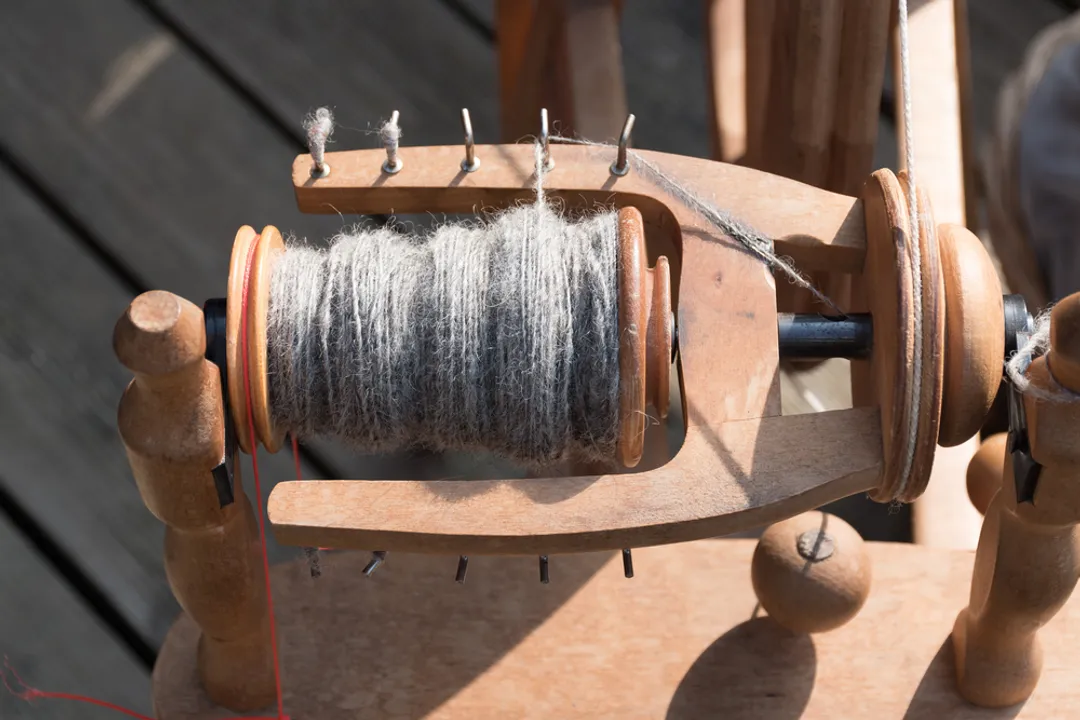
The creation of textiles is not attributable to a single inventor or a specific date; rather, it represents one of humanity's longest, most continuous technological progressions, stretching back to our earliest ancestors. Long before written history documented mechanical patents or factory output, the fundamental concepts of gathering, processing, and interlocking fibers were being established. [1][3] The very definition of a textile—any flexible material constructed by interlacing fibers to form a web or fabric—implies a cumulative knowledge base rather than a singular 'Eureka!' moment. [9] Evidence suggests that the conceptual foundation for textiles, particularly the act of spinning fibers into useable threads, is far older than most people imagine.
# Ancient Beginnings
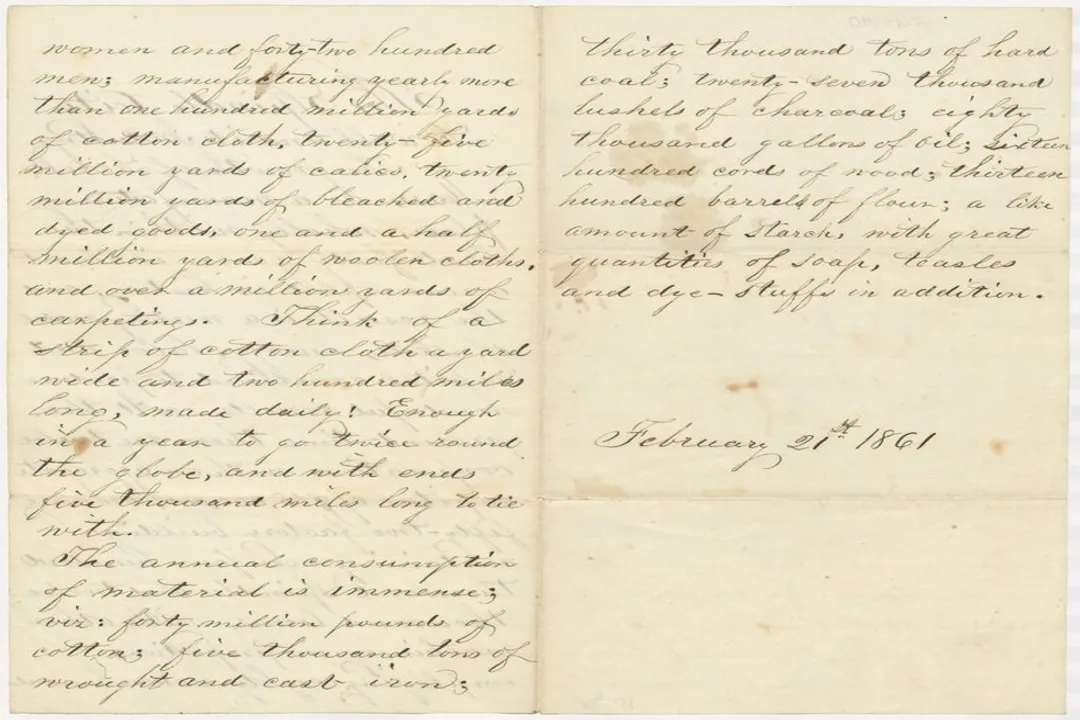
Archaeological findings push the origins of textile creation deep into prehistory, predating agriculture and even pottery in some areas. In a cave in Georgia, researchers discovered dyed plant fibers dating back approximately 30,000 years, providing some of the oldest concrete evidence of spun and perhaps even woven material use by early humans, such as the Cro-Magnon people, for things like clothing or netting. [3] This era marks the true "invention" of textiles: the realization that raw, flimsy strands could be strengthened and combined into something functional.
The journey from a wild tuft of animal hair or plant stalk to a usable thread involved mastering the art of spinning. While the exact moment spinning was perfected is lost to time, it was arguably the most critical initial step. [3] For tens of thousands of years, this was a painstaking, manual process. It wasn't until much later, around 500 to 1000 CE in India, that the spinning wheel appeared, offering a significant mechanical advantage over simple hand-twisting, before eventually making its way to Europe by the 13th century. [1]
# Fiber Sources
Once the technique for creating yarn was established, the next great phase of textile evolution centered on what materials were available and how they were processed. [3] The earliest textiles were shaped by immediate environmental factors. [1] In cold climates, animal fibers, primarily wool sheared from domesticated sheep, became essential. [3] In warmer regions, plant fibers provided the solution.
Flax, a highly versatile bast fiber, was used to create linen, which became a staple fabric in ancient Egypt. [3] Archaeological evidence from Egyptian tombs confirms the importance of linen textiles in daily life and burial rites. [1] Meanwhile, across Asia, another important plant fiber began its ascent: cotton. Cotton cultivation and weaving were well-established in India around 5000 BCE. [3] The luxurious and highly sought-after fiber, silk, originated in China, where its production was a guarded secret for millennia. [3] The development of these distinct primary materials—wool, linen, cotton, and silk—created regional specialties that would later fuel global trade and conflict as industrialized nations sought reliable sources for raw materials. [1][4]
The sheer disparity in the timeline between the initial development of spinning (prehistory) and the later advent of the spinning wheel (the first millennium CE) underscores the incredibly slow rate of material science progress before systematic experimentation took hold. It highlights that for most of human history, textile output was directly proportional to the painstaking labor hours invested by individuals, often women, in preparation. [1]
# Yarn Creation
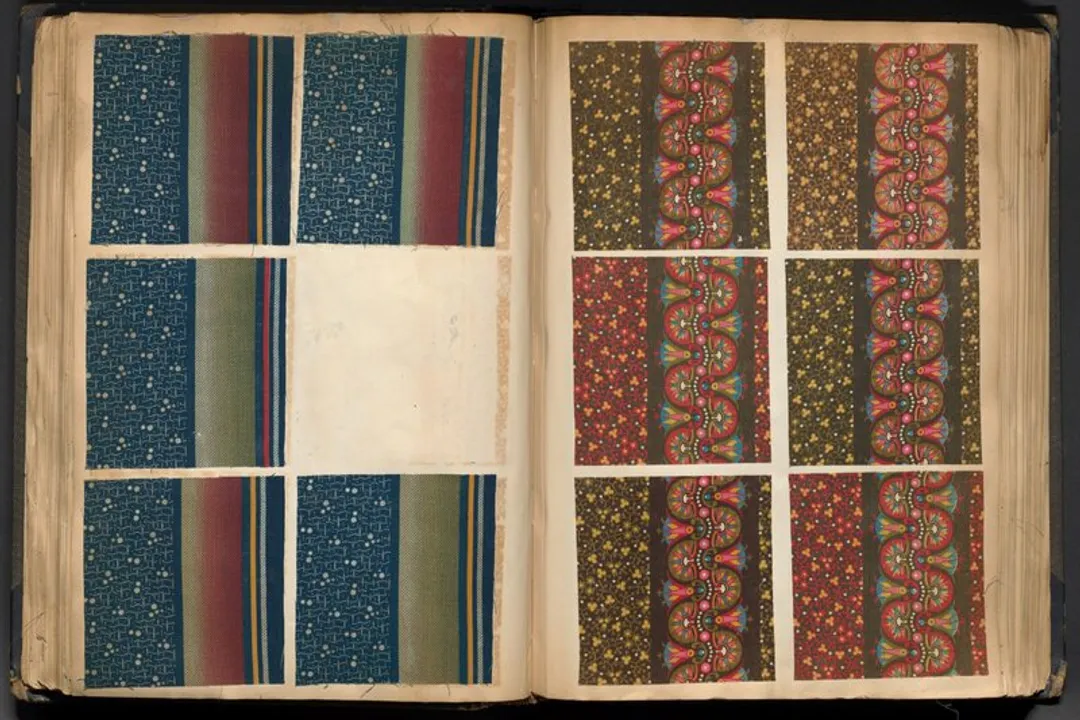
Before the Industrial Revolution, the making of textiles was divided into two distinct, time-consuming phases: spinning the fiber into yarn, and then weaving the yarn into cloth. [3] The spinning phase was often the bottleneck. While the spinning wheel improved efficiency, it was still a human-powered, relatively slow process, often done in cottages or homes.
This manual limitation meant that weavers, even those using somewhat advanced handlooms, often found themselves waiting for sufficient yarn supplies. [7] The true breakthrough in manufacturing ability didn't come from improving the loom, but from radically speeding up the creation of the raw material: the yarn itself. [2]
# Machine Era
The 18th century saw a concentrated burst of mechanical ingenuity, primarily in Great Britain, that permanently shattered the slow pace of textile production. This period, often called the Textile Revolution, wasn't the invention of the textile, but the invention of the means of mass-producing it. [2][7] The key characteristic of these inventions was that they replaced human muscle and dexterity with mechanical power, first water, and soon after, steam. [8]
# Weaving Speed
The process began to accelerate with John Kay's Flying Shuttle, patented in 1733. [1][7] This innovation allowed a single weaver to weave much wider cloth and significantly increased the speed at which a loom could operate. [2] This invention, however, created an immediate problem: the existing spinning methods simply could not produce yarn fast enough to keep the newly efficient weavers busy. [7]
# Spinning Mechanization
The response to the yarn shortage arrived quickly, driven by inventors seeking greater output:
- The Spinning Jenny: Developed around 1764 by James Hargreaves, this machine allowed a single operator to spin multiple threads simultaneously, typically eight to twelve at first, though later models expanded this. [1][7] It was relatively simple and could still be operated in a home setting, bridging the gap between the spinning wheel and factory power. [2]
- The Water Frame: In 1769, Richard Arkwright patented a water-powered spinning frame. [1][8] Unlike the Jenny, which used a horizontal motion similar to hand-spinning, the Water Frame used rollers to draw out the cotton, creating a much stronger, harder-twisted yarn suitable for warp threads. [2][7] Arkwright’s machine necessitated factory settings near water sources and centralized labor, earning him the moniker "Father of the Factory System". [8]
- The Spinning Mule: Samuel Crompton created the Spinning Mule in 1779 by combining the best elements of the Jenny and the Water Frame. [1][7] The Mule produced yarn that was both fine and strong, finally providing the high-quality thread necessary for fine muslins and other delicate fabrics. [2]
The true genius of this era was recognizing that these inventions had to work together. For example, while Arkwright’s Water Frame solved the strength issue, the superior quality it produced could only be fully exploited once the weaving process caught up to its production speed. [2] It took one more major invention to complete the cycle.
# Power Loom
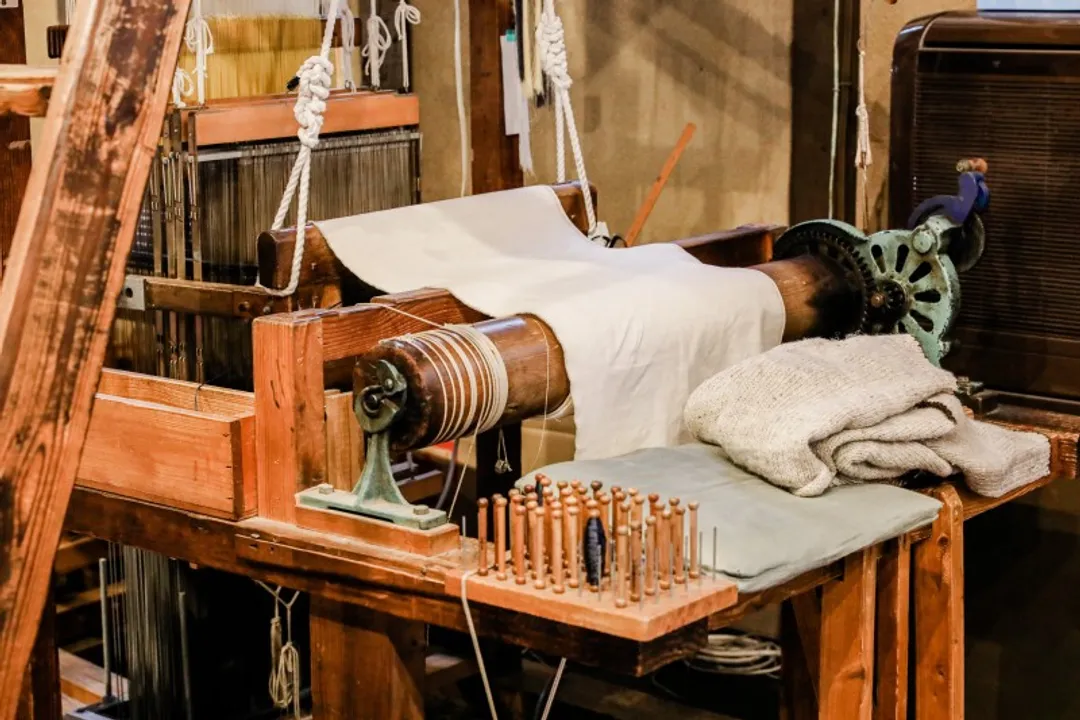
The final piece of the mechanical puzzle was the Power Loom, introduced by Edmund Cartwright in 1785. [1][7] This machine mechanized the weaving process itself, running on water or steam power. With the Power Loom, the entire production line—from raw fiber to finished cloth—was mechanized, leading to the factory system taking over entirely from cottage production. [2]
# Factory Models
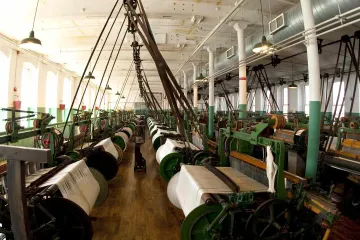
The mechanization of spinning and weaving did more than just speed up cloth production; it fundamentally altered the social and economic fabric of industrializing nations. [6] Previously, textile production was decentralized, based in homes and small workshops, often employing family labor. [4] The new machinery, particularly Arkwright's Water Frame and Cartwright's Loom, required large buildings, significant capital investment for water wheels or steam engines, and a centralized labor force, creating the textile mill. [8]
In the United States, this transformation took hold slightly later than in Britain but with similar intensity. The story often begins with Samuel Slater, an apprentice in a British textile mill who memorized the designs of Arkwright’s machinery, successfully bringing the technology to America. [4] In 1790, Slater established the first successful water-powered cotton mill in Pawtucket, Rhode Island, marking the true start of the American textile industry. [4]
The subsequent growth led to new models of labor organization, such as the Lowell System in Massachusetts in the 1820s. [4] This system relied heavily on young, unmarried women from New England farms, known as "mill girls," who lived in supervised boarding houses while working long hours in the mills. [6] This shift represented a massive social change, drawing large populations into wage labor and urban settings for the first time in many families' histories. [6] Considering the rapid succession of inventions—Kay (1733) to Cartwright (1785)—it becomes clear that the real invention wasn't the machine itself, but the system that could efficiently integrate them, turning localized craft into global industry. The failure to adapt one part of the production chain (spinning) stalled the efficiency of the other (weaving) until the entire sequence was mechanized and powered externally. [2]
# Modern Fabric
The legacy of these historical inventors is not just in the machines they created, but in the establishment of textile production as a major industrial sector. Today, the definition of a textile remains broad, encompassing not just woven cloth but also non-woven materials like felt, or materials made through knitting and crocheting. [9] The materials used have also expanded dramatically beyond natural fibers to include synthetics like nylon and polyester, which were developed in the 20th century through chemical engineering—a field that owes its existence, in part, to the demand created by the mass production techniques established in the 18th century. [1]
The principles established by the early innovators—mechanization, centralization of power, and specialization of tasks—remain evident even in modern, highly automated textile plants. Whether the fiber is natural flax or a lab-grown polymer, the core process of turning it into a usable fabric relies on the foundational mechanical concepts proven by Arkwright and Cartwright. [2][7] The textile industry, therefore, has no single inventor, but rather a line of key innovators who solved the bottleneck problems in the process, making cloth accessible to the masses for the first time. : [1][3][1] https://www.wilkinslinen.com/textiles/look-back-history-textiles/: [2] https://acmemills.com/industry-news-blog/a-history-of-the-textile-revolution/: [3] https://textileheritagemuseum.org/textiles-ancient-times-to-modern-day/: [4] https://www.faribaultmill.com/blogs/the-thread/american-textile-history: [5] https://blog.patra.com/2014/07/03/the-history-of-fabric/: [6] https://exhibits.library.cornell.edu/social-fabric-land-labor-and-the-world-the-textile-industry-created/feature/industrialization: [7] https://blog.moodfabrics.com/a-brief-history-of-textile-inventions/: [8] https://www.scienceandindustrymuseum.org.uk/objects-and-stories/richard-arkwright: [9] https://en.wikipedia.org/wiki/Textile: https://blog.patra.com/2014/07/03/the-history-of-fabric/
Related Questions
#Citations
A Look Back at the History of Textiles - Wilkins Linen
A History of the Textile Revolution - Acme Mills
A Timeline of Textile History
American Textile History - Faribault Mill
The History of Fabric
Social Fabric: Land, Labor, and the World the Textile Industry Created
A Brief History of Textile Inventions - Mood Sewciety
Richard Arkwright | Science and Industry Museum
Textile - Wikipedia