Who invented the gramophone which replaced the cylinder on the phonograph with flat discs?
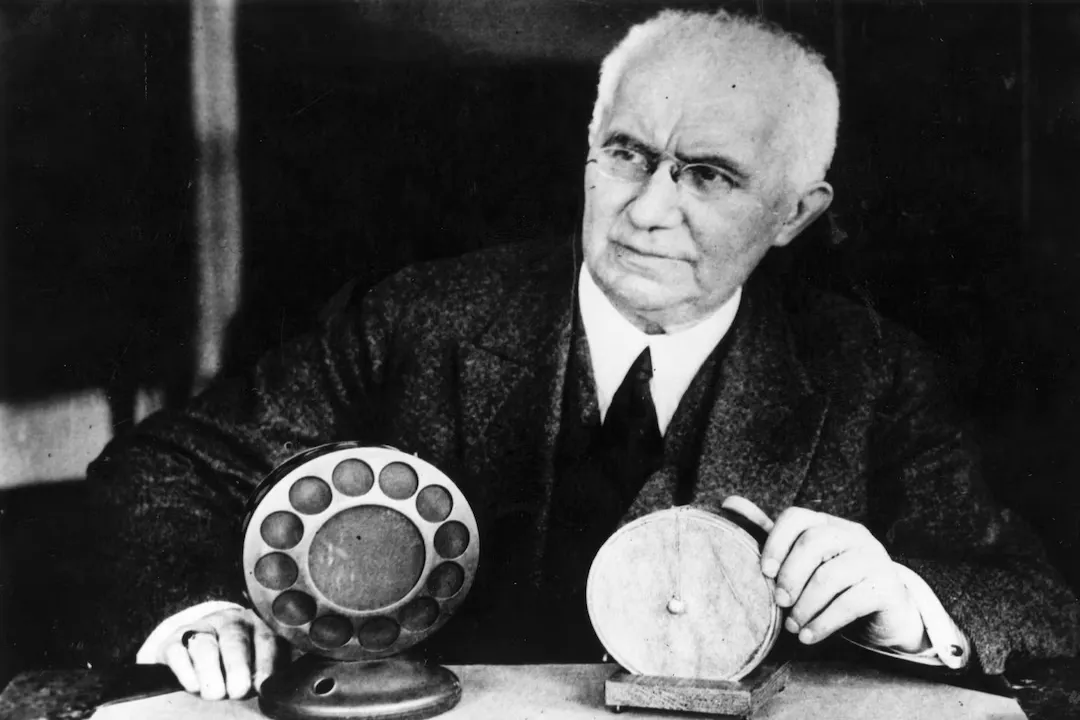
The shift from fragile, difficult-to-duplicate sound recordings to a format capable of mass production marks one of the most significant technological leaps in audio history. This transformation was initiated not by Thomas Edison, whose earlier phonograph relied on vertical-cut wax cylinders, but by Emile Berliner, a German-American inventor. [4][9] Berliner conceived of and patented the device that successfully used flat discs for recording and playback, a machine he aptly named the Gramophone. [1][5]
Berliner’s work on sound reproduction began in earnest after he had already made contributions to telephony. [4] While Edison's phonograph, introduced in 1877, captured sound via vertical indentations etched into a rotating wax cylinder, Berliner recognized the inherent limitations of that system for widespread consumer use. [1][5] The fundamental problem was replication. Making an exact copy of a cylinder involved re-recording the sound onto a new blank cylinder, a slow and often imperfect process that resulted in rapid degradation of sound quality with each generation. [4]
# The Disc Advantage
The key to Berliner's innovation was the move to a flat, lateral-cut disc format. [1][4] Berliner secured his initial patent for a lateral-cut disc recorder in 1887. [1][4][5] Where the phonograph stylus moved up and down (the vertical or "hill-and-dale" groove), the gramophone stylus moved side-to-side across the surface of a rotating disc. [1] This fundamental difference made mass production vastly simpler and more cost-effective. Instead of engraving one record at a time, Berliner’s system allowed for the creation of metal masters from which countless identical copies could be stamped or pressed. This process, similar to printing, ensured that the first copy sounded identical to the ten-thousandth copy, something impossible with the cylinder technology. [4]
This manufacturing capability is perhaps the greatest unstated victory of Berliner’s design. While the early phonograph was a marvel of acoustics, its cylinder format essentially trapped it as a novelty or a device for dictation and personal listening. The flat disc, however, was inherently scalable, paving the way for the entire modern music industry structure where identical copies are distributed globally. The ability to stamp out records in large quantities instantly lowered the per-unit cost and democratized access to recorded music and speech. [1][5]
# Initial Specifications
The very first iterations of the Berliner Gramophone were mechanically simple compared to the machines that followed. [1] The discs themselves were typically made of shellac, a naturally occurring resin, and often measured around 7 inches in diameter. [1] Furthermore, the initial playback speed was relatively slow, often set at 30 revolutions per minute (rpm). [1] This speed dictated the runtime of the recordings, which were considerably shorter than what audiences would later become accustomed to with the 78 rpm standard that solidified shortly after the initial prototypes. [1]
The discs contained the audio information etched into the lateral grooves. [1][4] While Berliner's initial discs were primarily used for dictation and voice recording, the technology was quickly recognized for its entertainment potential. [4] Even though the concept was revolutionary, the early sound quality still had limitations inherent in acoustic recording methods, relying purely on mechanical energy translated through a diaphragm and stylus, without electrical amplification. [1]
# Commercializing Sound
Emile Berliner was not just an inventor; he was also a shrewd businessman who understood the need for corporate structure to realize his invention's potential. [7] He established the Berliner Gramophone Company in the United States to market his device and the associated discs. [1] Simultaneously, he took steps to ensure his invention spread across the Atlantic. [1]
Berliner licensed his patents to others in Europe, most notably to The Gramophone Company in England. [1] This European operation became hugely successful, and the name "Gramophone" itself became almost synonymous with recorded sound in many parts of the world, particularly in the UK and Germany, even as the competing format (Edison’s later disc format, the Diamond Disc, which used vertical grooves) faded. [1]
It is interesting to observe how brand names become generic terms. In the United States, the company evolved, eventually merging and becoming part of what we recognize today as RCA Victor, but in Europe, the original brand name stuck tightly to the technology. [1] Consider this separation: Berliner created the technology (lateral disc recording); his European licensees created the brand identity that dominated the marketplace for decades. [1][2]
# Evolution of the Format
While Berliner invented the concept of the playable flat disc for audio reproduction, the specifications we associate with classic records—like the 78 rpm speed—were solidified by the companies that scaled the technology, such as The Gramophone Company. [1] The initial 30 rpm speed was quickly superseded by the faster 78 rpm standard, which provided better frequency response and longer playback time per side, though the material remained primarily shellac for many years. [1]
The true long-term legacy of Berliner’s work isn't just the disc itself, but the commitment to the lateral groove format, which proved exceptionally durable and adaptable. When recording technology moved from purely acoustic recording to electrical recording (which significantly improved volume and fidelity) and later, when materials shifted from brittle shellac to flexible polyvinyl chloride (vinyl) after World War II, the fundamental geometry—the flat platter rotating beneath a stylus tracing a continuous, side-to-side groove—remained largely unchanged. [1] The move to the long-playing microgroove format (the LP) in the late 1940s built directly upon the physical architecture Berliner established, simply shrinking the grooves and increasing the rotational speed to 33 1/3 rpm to maximize playing time. [1]
The trajectory from Berliner's 1887 patent to the vinyl LPs of the 1950s demonstrates a rare instance where the initial format choice proved so sound that subsequent technological advancements were built onto it rather than requiring a complete replacement of the core physical medium. The very idea that a record should be a flat plate, rather than a cylinder wrapped around a spindle, secured Berliner's place as the true father of the modern record album. His contribution provided the essential standardized platform upon which the entire recorded music entertainment industry flourished for nearly a century. [1][4]
Related Questions
#Citations
Berliner Gramophone - Wikipedia
The gramophone is an invention by the German Emil Berliner from ...
The story of Emile Berliner - The Miller Times
The Man Who Invented Modern Music | Red Bull Music Academy Daily
Emile Berliner Invents the Flat Disc Gramophone
Berliner Gram O Phone | The New York Public Library
Emile Berliner | Research Starters - EBSCO
The Berliner Gramophone: How It Revolutionized Sound Recording