Who invented solar-powered fridges?

Tracing the origin of the solar-powered refrigerator isn't a straight line leading to a single name or date; rather, it’s a layered history reflecting evolving technology, environmental crises, and humanitarian needs. The concept of harnessing the sun's energy to create cold predates modern electronics by decades, showing up first as an industrial curiosity and later evolving into sophisticated, battery-free power systems and simple, life-saving evaporative coolers. It is a story where "invention" can mean the first theoretical blueprint, the first commercial attempt, or the first widely adopted, locally constructible solution.
# Early Concepts
The earliest documented success in using solar energy for refrigeration comes from the late 19th century, focusing on solar thermal power rather than photovoltaics. In 1878, at the Universal Exhibition in Paris, Augustin Mouchot showcased his engine and received a gold medal, notably for producing ice using concentrated solar heat. This established the fundamental principle that solar thermal energy could drive a cooling cycle.
Jumping forward to the 1930s, the conceptual groundwork for a modern, albeit non-existent at the time, solar refrigerator began to form. The credit for conceiving the necessary components for a working solar refrigerator often goes to engineer Otto Mohr in 1935. While Mohr designed the theoretical architecture, actual working models based on these principles took time to materialize, especially as the technology to reliably convert sunlight to electricity was still nascent.
The 1950s saw practical experiments emerge on both sides of the Iron Curtain. The USA installed a flat plate collector system for this purpose, while simultaneously, the USSR was working with a parabolic mirror capable of producing a significant quantity—about 250kg—of ice daily. In France, engineers adapted an absorption machine using a cylinder-parabolic mirror to produce around 100kg of ice per day. These thermal approaches demonstrated viability, often relying on heating a substance to drive the cooling cycle, which contrasts sharply with the later electrical compressor systems. It is worth noting that older, non-electric cooling methods also share this principle of solar-aided heat management; for instance, the Coolgardie Safe, developed in the 1890s in Australia, relied on the same heat transfer dynamics through water evaporation to keep food cool in harsh inland climates.
# Electric Pioneers
The story of the modern, electrically powered solar refrigerator is interwoven with environmental legislation and corporate innovation. The early 1990s were defined by the looming Montreal Protocol ban on chlorofluorocarbons (CFCs), which were widely used as refrigerants and blowing agents known to damage the ozone layer. This created an immediate industry imperative to develop new cooling technologies that were environmentally neutral regarding ozone depletion and greenhouse effects.
A development team at Liebherr-Hausgeräte GmbH in Ochsenhausen, Germany—including engineers like Wilfried King, Herbert Gerner, and Matthias Wiest—were working directly on this transition. In 1993, they launched the CFC- and FC-free KT 1580 model, which was a turning point toward energy efficiency. The next logical step for them was eliminating the need for grid electricity, which contributed indirectly to the greenhouse effect. By 1994, they had developed the KT 1580 Solar, which utilized photovoltaic panels and a battery system to store energy, allowing for about a week of operation without sunlight. This unit was presented at the Climate Protection Trade Fair in Berlin in 1995 and was marketed as being suitable for use in the tropics and completely free of ozone-depleting substances. While highly innovative, with only about 50 units produced, the Liebherr team acknowledged they were perhaps ahead of their time.
A separate, yet parallel, line of innovation came from space exploration. In the mid-1990s, NASA's Johnson Space Center (JSC) began applying its expertise in photovoltaics (PV) to refrigeration, developing systems originally intended for cooling lunar bases. Unlike the Liebherr model which relied on batteries for overnight cooling, NASA’s focus shifted toward eliminating batteries entirely by using phase change material (PCM) to store thermal energy instead of chemical energy.
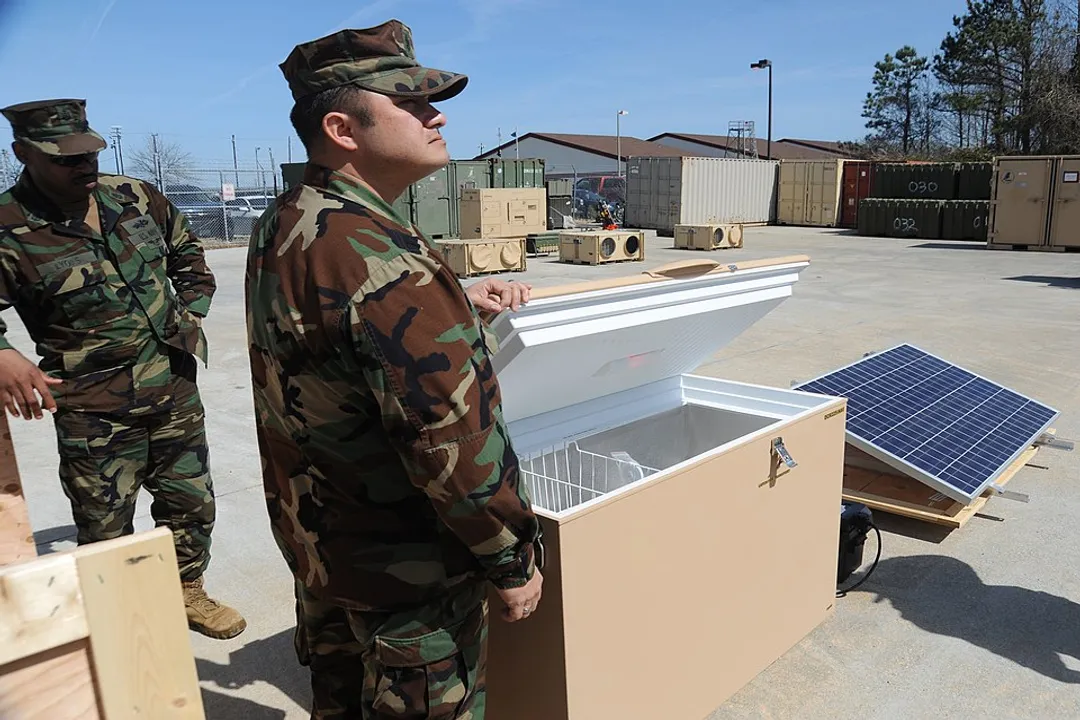
This technology was licensed in 1999 by David Bergeron, a former JSC engineer, who founded Solus Refrigeration Inc. (later SunDanzer Refrigeration Inc.). By the early 2000s, SunDanzer introduced its battery-free PV Direct-Drive model refrigerator. The primary driver here was not just general off-grid power, but specifically the reliable storage of life-saving vaccines in remote areas. This required meticulous engineering to maintain the precise temperature range vaccines need (around 35-46 °F), achieved partly through utilizing a fan for air circulation and the PCM "ice pack" created by the cooling cycle.
The result of this focused effort was significant: in 2011, following trials, the World Health Organization (WHO) prequalified SunDanzer's unit as safe for vaccine storage in hot zones, marking a major milestone for off-grid health infrastructure.

# Evaporation Legacy
When discussing the invention of solar fridges, particularly those aimed at immediate, low-cost solutions in developing nations, the work of Emily Cummins frequently arises, winning her the Oslo Business for Peace Honouree prize. Around 2009, the 23-year-old British inventor gained recognition for a portable refrigerator that maintained temperatures around 6°C (43°F) using the sun's rays to drive evaporation. Her design utilized two concentric cylinders—the inner one metal, the outer one perhaps made of recycled materials—with sand or soil packed between them, which was then soaked with water. As the water evaporated under the sun, it drew latent heat away from the inner chamber, creating the cooling effect.
However, the concept of evaporative cooling predates Cummins’ refinement by many years, highlighting how fundamental, low-tech solutions often get "reinvented" out of necessity. The very mechanism Cummins utilized—a wet, porous material losing heat as water evaporates—is an ancient one. Crucially, the historical record points out that this specific application was previously championed by Mohammed Bah Abba of Nigeria, who received the Rolex Award in 2008 for his similar Pot in Pot Cooling System. The distinction often made by commentators is that Abba's concept, using widely available materials like clay pots, might be considered the more foundational, award-recognized version of the simple evaporative cooler, even if Cummins’ design brought it renewed attention and refinement.
# Technology Split
The evolution of the solar fridge reveals a fundamental divergence in approach, splitting into two main technological paths: the photovoltaic (PV) path and the solar thermal/evaporative path.
| Technology Type | Primary Mechanism | Energy Source For Cooling | Key Advancement/Inventor | Typical Application |
|---|---|---|---|---|
| Solar Thermal | Heating a substance to drive a vapor cycle | Concentrated Sunlight | Mouchot (1878, Ice) | Ice production, industrial cooling |
| PV Electric (Battery) | DC Compressor powered by stored electrical energy | Sunlight to Electricity (Stored) | Liebherr KT 1580 Solar (1994) | General off-grid/tropical use |
| PV Electric (Battery-Free) | DC Compressor coupled with Phase Change Material (PCM) | Direct Sunlight + Thermal Storage | NASA/SunDanzer (2000s) | Precise, reliable vaccine storage |
| Evaporative Cooling | Latent heat absorption via water evaporation | Ambient Heat/Sunlight (Drying Agent) | Mohammed Bah Abba (2008), Emily Cummins (2009) | Simple food preservation, low-tech access |
While the PV electric route—especially the battery-free PCM version—offers high precision and longevity (SunDanzer targets 15 years of operation), it remains dependent on manufacturing sophisticated components and requires a significant upfront investment. This complexity is why such units are often expensive, forming a major obstacle in widespread adoption in the developing world.
The evaporative method, conversely, is praised for its simplicity of construction and use of recycled materials. However, this approach carries inherent environmental dependencies that limit its effectiveness in certain locales. For instance, the cooling effect relies entirely on the latent heat of vaporization, meaning it performs best in dry climates where humidity is low, such as deserts. If the ambient air is already highly humid—as it is in many tropical or coastal regions—the rate of water evaporation plummets, and so does the cooling performance, potentially rendering the device ineffective for keeping milk or meat cold when it is needed most. This contrasts with the PV-electric systems which, while needing sunshine, are less affected by ambient humidity once the compressor is running.
# Modern Application
Today, the solar-powered refrigerator serves distinct markets. For developed nations or remote, permanent off-grid homes, the focus is on efficiency and autonomy, leading to the high-tech PV Direct-Drive solutions. These systems are often characterized by thick insulation and the use of a DC compressor that connects directly to the solar panels, bypassing the costly, heavy, and maintenance-intensive lead-acid batteries common in earlier PV setups.
The most impactful use case, however, remains in global health. Solar refrigerators are essential for maintaining the cold chain for vaccines, which traditionally required fuel-based coolers—often kerosene or gas absorption types—that were costly, smelly, difficult to adjust (sometimes freezing medicine), and produced high carbon dioxide emissions. The WHO-approved solar vaccine coolers, like the SunDanzer unit, offer a plug-and-play simplicity with minimal maintenance, making them ideal for rural clinics lacking expertise or consistent supply lines. UNICEF, for example, serves as the number one customer for these specific units, purchasing 40 percent of the global supply annually.
Beyond vaccines, commercial entities also see application; a 2019 portable unit utilizing a brushless compressor and a lithium battery was introduced that could even charge a phone. The legacy of Liebherr’s KT 1580 Solar, although only seeing low initial sales, lives on as the prototype for consistent energy-saving design thinking within that company. Interestingly, one of those original 1990s units was purchased for a charity project in Burkina Faso in 1998 and, remarkably, remains in operation today, serving as a training example for local technicians. This sustained operation over two decades across different technological eras confirms that the driving motivation—creating reliable cold without a conventional power grid—has remained constant, even as the methods for achieving it have radically changed from simple evaporation to complex, battery-free thermal management.
#Videos
The invention of the solar fridge! - YouTube
Related Questions
#Citations
The cold that came from the sun - history of the solar refrigerator
The invention of the solar fridge! - YouTube
History of Solar-Powered Refrigerator
Solar Powered Refrigerator - Invention City
Solar Refrigerators Store Life-Saving Vaccines - NASA Spinoff
Solar Fridge Wins Young Inventor Nobel Recognition - Energy Matters
Young inventor's solar-powered fridge changes lives in Africa
Solar-powered refrigerator - Wikipedia
Student Invents Solar-Powered Fridge