Who invented gears on a bike?
The question of who deserves credit for inventing gears on a bicycle is less like pointing to a single lightbulb moment and more like tracing a complex river system that starts with many small trickles and converges over decades into a powerful, modern flow. It’s a story filled with forgotten patents, racing snobbery, and distinct philosophical divides over the best way to handle terrain. The answer changes significantly depending on whether you mean any variable ratio system, or the specific derailleur mechanism that dominates road cycling today. [1][2]
# Pre-Chain Ratio
Before we arrive at the sophisticated derailleurs of the 20th century, we must look back to the earliest chainless bicycles. The high-wheelers, or penny-farthings, relied on a direct drive, meaning one pedal stroke equaled one wheel rotation. [2][5] This inherent one-to-one ratio made climbing hills incredibly taxing, forcing the rider to stand and strain at a very low cadence. [5] While this offered speed on the flat, it severely limited the utility of the machine. [2] Even before the chain drive arrived, innovators were exploring ways to change this relationship. As far back as 1868, a wheel was described that could create varying reactions to the pedal's rotation relative to the front wheel’s rotation, allowing the pedal to go around twice while the wheel went around once, or vice-versa. [3] In 1871, James Starley produced the Ariel, which is likely the first geared bike ever built. [3] Others, like Dr. Mathieu, used a two-speed system built by Barberon & Meunier around 1870, which some view as a very early precursor to the derailleur concept. [3]
# Starley Foundation
The true foundation for modern geared bicycles was laid not with the gear itself, but with the frame design that made changing gears practical. The earlier, direct-drive machines had the pedals attached directly to the front wheel axle. [5] The transition began in earnest with the advent of the safety bicycle. [2] John Kemp Starley is credited with developing the Rover safety bicycle in 1885, which featured equally sized wheels, a steerable front wheel, and, crucially, a chain drive to the rear wheel. [3] This design positioned the rider between the wheels, vastly improving balance, and allowed the gear ratio to be managed via sprockets and a chain, moving the capability to alter gear ratio out of the wheel hub itself and into the drivetrain. [5][2]
# Nineties Patents
Once the chain drive was established, the race to integrate multiple gears began in earnest, resulting in a flurry of activity in the late 19th century. Between 1877 and 1906 in London alone, 750 patents for variable speed gearing were filed, though most riders remained satisfied with their simple single speeds due to manufacturing difficulties. [3]
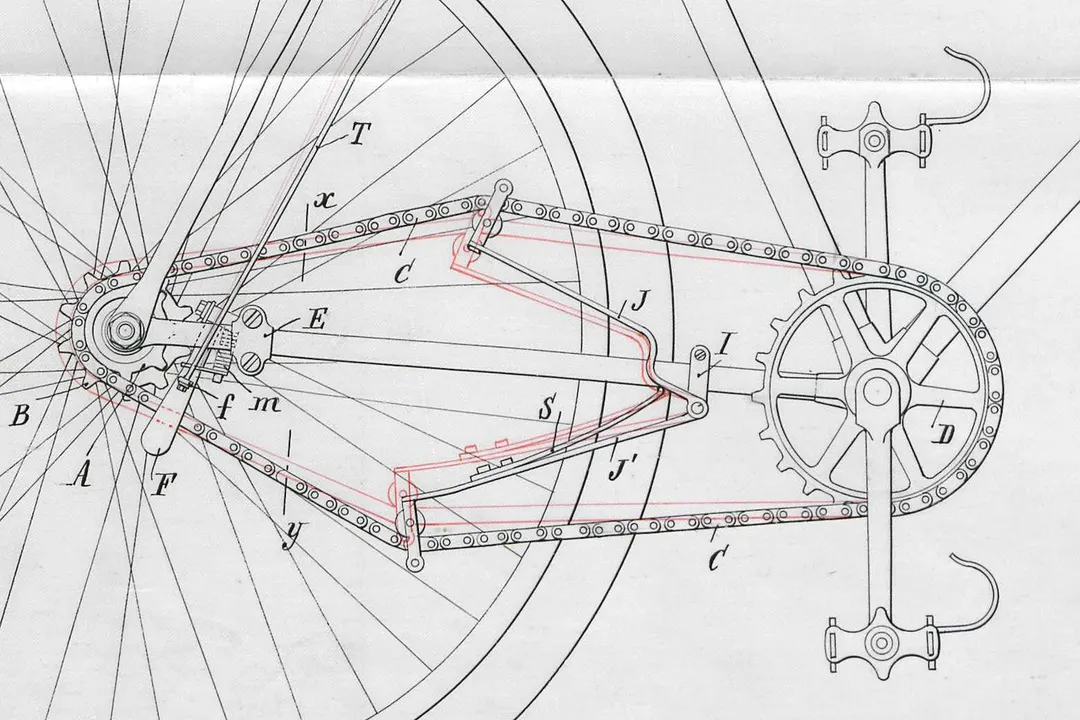
The earliest explicit patents for a derailleur—a device designed to derail the chain from one sprocket to another—appeared in the 1890s:
- Jean Loubeyre (Paris): He is the first candidate, having patented a two-speed derailleur called La Polyceler in France in 1895. [1][3] This design, however, used fixed sprockets without a freewheel and is considered a technological dead-end, as there is little evidence it was manufactured in any meaningful quantity. [1]
- Edmund Hodgkinson (London): His Gradient derailleur system, patented in the UK in 1896, moved the cassette of sprockets sideways while keeping the chain straight. [1][3] Hodgkinson did put his device into production, but it struggled to compete against the emerging hub gears and he sold the patents by 1904. [1]
- Charles Montague Linley (London): Using the brand name The Whippet, Linley patented the New Protean in 1899, featuring a two-speed freewheel and a fork-type derailleur, even incorporating early shifting ramps. [1]
It is fascinating to look at these three contemporary inventors, all vying for the title, yet none achieved lasting commercial success. [1] This highlights a common theme in innovation: having the initial idea is often less challenging than overcoming manufacturing hurdles and market inertia. The fact that riders sometimes had to physically remove their rear wheel, flip it around to access a second sprocket mounted on the opposite side (the flip-flop hub), demonstrates the tediousness of early gear changes. [2][7]
# Hub Detour
While the derailleur concept was floating around in patent offices, the market temporarily favored a different solution: internal hub gears. [2] Appearing in the early 1900s and dominating until about 1930, these self-contained units housed all the necessary gearing components within the rear hub shell. [2] For commuters and casual riders, they offered weather protection and relative simplicity. [7] However, for racing cyclists, hub gears were generally spurned because they added considerable weight and made repairs difficult, contrasting sharply with the lightweight demands of competition. [7] This preference for light weight meant that racers often stuck to the difficult, manual systems or even continued riding single speeds. [2]
# Velocio Vision
The philosophical drive needed to push the derailleur past its early failures came largely from one man: the French tourist and writer Paul de Vivie, who wrote under the pen name "Vélocio". [1][5] Born in 1853, Velocio was convinced that geared bikes were the future, even when existing mechanisms were awkward and unreliable. [5] He campaigned relentlessly for more gears, favoring the derailleur over the epicyclic hub gear for its perceived flexibility and robustness. [1] Velocio gathered a group of like-minded enthusiasts known as l’École Stéphanoise (the St-Étienne School), who rode prototypes of multi-geared machines up steep local climbs. [1] He even tested his own two-speed derailleur, Le Cyclist, in 1905. [5] Velocio provided the advocacy and the vision that kept the derailleur concept alive during its awkward adolescence. [5]
# Panel Chemineau
If Velocio was the visionary, his friend Joanny Panel was the pragmatist who made the vision manufacturable. [1] Panel took one of de Vivie’s many prototypes and turned it into a practical, mass-producible item, resulting in the 'Le Chemineau' in 1912. [1] This machine is perhaps the true genesis of the modern derailleur system. It featured key elements that define derailleurs even today: the chain was moved sideways across a cluster of sprockets, it incorporated both a guide pulley and a tension pulley on a sprung arm, and it was operated via a cable pulled by a lever. [1] While it took over a decade for this technology to gain traction, Panel’s Le Chemineau set the standard for derailleur design for many years to come. [1]
# Racing Acceptance
Despite the functional existence of devices like the Le Chemineau, professional road racing remained stubbornly attached to simplicity. The Tour de France founder, Henri Desgrange, reportedly claimed variable gears were "only for people over the age of 45". [7] Until 1937, derailleurs were banned from the Tour de France; riders who wanted different ratios had to stop, dismount, and physically change the rear wheel to the other side to switch sprockets. [2][8] When derailleurs were finally permitted in 1937, the shift was not immediate; riders still had to physically reach down by the wheel to move the chain with a lever. [2] The true mechanization followed quickly when Simplex introduced the first cable-shifted system in 1938, using cables and pulleys instead of solid rods to move the chain. [2][8] This was a major step, as it allowed gear changes while riding. [2]
# Gran Sport
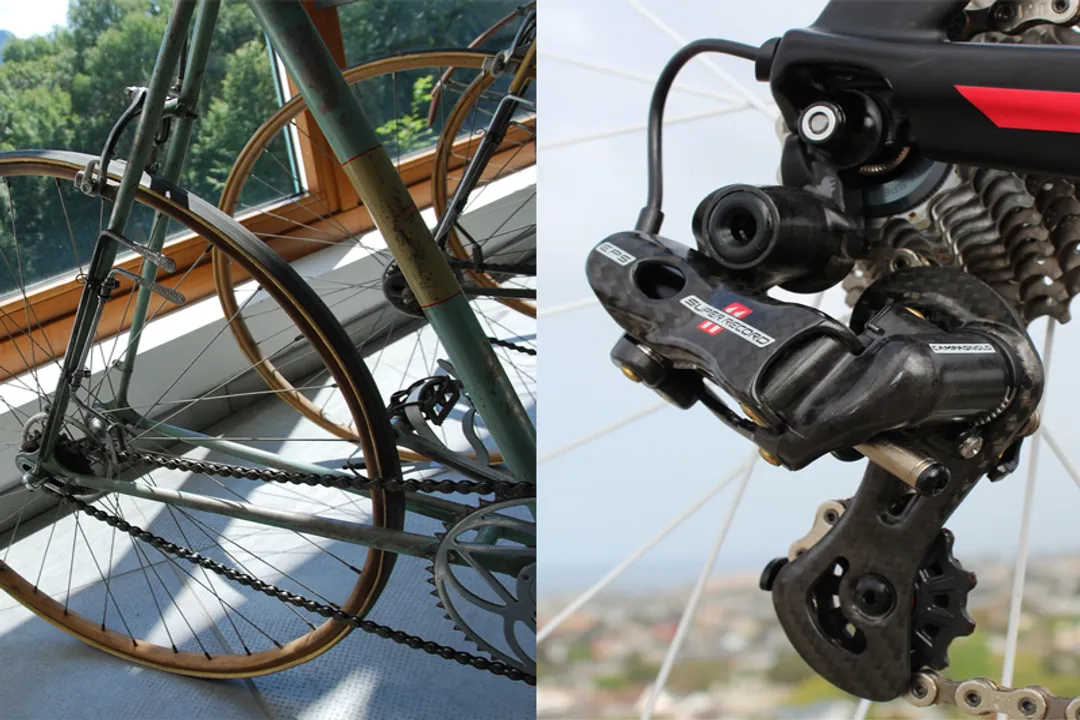
For many years, shifting was a matter of friction; the rider had to learn the bike's sounds and feel to know when the chain was properly seated on the next sprocket. [2] The next technical revolution arrived in 1949 when Campagnolo released the Gran Sport. [2][3][8] This was a highly refined, cable-operated parallelogram rear derailleur. [8] The parallelogram mechanism was the game-changer: it allowed the chain guide cage to move left and right while remaining parallel to the cassette cogs, resulting in smoother, more reliable shifts than earlier, less consistent designs. [6][2] While the small company Nivex might have developed the parallelogram design slightly earlier, Campagnolo’s commercialization of the Gran Sport dominated the market for decades, establishing the core design language for rear derailleurs well into the modern era. [6]
It is worth pausing here to observe a significant point in gear evolution. Professional gear choices during the 1950s through the 1980s reveal a very different understanding of "easy" climbing gear than we have today. [7] For instance, Bernard Hinault, a great of the 1970s and 80s, would ride a maximum gear in the low 50s teeth (front ring) paired with a 12-tooth smallest rear cog for top speed. [7] His lowest climbing gear might be a 24-tooth rear sprocket, paired with a 42-tooth front ring—a ratio of about 1.75:1. [7] Today, a professional might run an 11-30 cassette paired with a 52/38 chainset, where the lowest climbing gear is a 30-tooth sprocket paired with a 38-tooth ring, giving a ratio of about 1.27:1. [7] This demonstrates that relative to their available equipment, riders were running much harder gears than modern cyclists consider necessary for a steep climb, highlighting that advancement isn't just about more gears, but about shifting the entire range lower and wider over time. [7]
# Index Revolution
The age of pure friction shifting, where the lever only dictated the position and the rider fined-tuned the chain, lasted into the 1980s. [2] The shift away from this manual finesse was driven by Shimano, the Japanese component giant. [2] In 1985, Shimano introduced Indexed Shifting (first seen in their Positron system, then refined with SIS—Shimano Indexing System). [6][8] Instead of relying on friction, the shifters now clicked into pre-set positions, moving the derailleur a precise, fixed distance with every click. [2][8] This introduced system integration: a Shimano indexed shifter needed a Shimano derailleur to work correctly, as they were engineered to translate the exact cable pull per click into the exact movement needed to align with the next cog. [2] This effectively ended the "mix-and-match" component era. [2]
This concept of fixed-click shifting revolutionized accessibility, but the need to reach down to the down tube remained a constraint, requiring a hand to be removed from the steering bar. [3] This lack of stability was particularly dangerous in tight racing situations. [3] The solution—integrating shifting into the brake levers—was conceived earlier by innovators like Joel Evett in 1975, whose idea was reportedly passed over by major manufacturers like Campagnolo. [6] However, it was Shimano who brought the concept to market in 1990 with STI (Shimano Total Integration) levers, combining the brake and shifter into one unit operated by the hands remaining firmly on the bars. [6][3] While Campagnolo countered with its Ergo-Power system, Shimano’s STI rapidly established the modern cockpit layout, prioritizing safety and stability during shifts. [6]
# Modern Drivetrains
The development curve accelerated rapidly after the standardization of indexed shifting. Manufacturers began focusing on adding more sprockets to the rear cassette, moving from 6- to 10-speeds, and then to 11-speeds by the late 2000s. [2][7]
The concept of electronic shifting, which replaces mechanical cable tension with electronic signals, was pioneered by Mavic in 1992 with their Zap system. [6] Although Mavic proved the concept of electronic actuation, their early systems suffered from lag and reliability issues, particularly because the rear shift relied on pedaling load to fully complete the movement. [6] Shimano later succeeded where Mavic faltered, introducing their wired Dura-Ace Di2 system in 2009, which offered precise, consistent electronic shifting without cable degradation. [2][6] Campagnolo followed soon after with their Electronic Power Shift (EPS). [2]
A second major paradigm shift since the STI integration was the move toward one-by (1x) drivetrains, primarily in mountain biking, which eliminates the front derailleur entirely. [6] SRAM, a major player that entered the road market later, introduced its wireless eTap system, successfully realizing the concept Mavic attempted with wireless Mektronic, but without the interference issues. [6] SRAM’s wireless approach also challenged the traditional logic of shifting, assigning one paddle to shift easier and the other to shift harder, regardless of which side of the bike they were on, rather than dedicating one side to the front and one to the rear. [6]
The invention of gears on a bike is thus a story of multiple 'inventions': the initial variable ratio concept, the chain drive that made it practical, the derailleur patent that offered chain movement, the Velocio/Panel realization that made it workable, the Campagnolo parallelogram that made it race-worthy, and the Shimano index system that made it user-friendly. [1][8] Every major component manufacturer, including Shimano, SRAM, and Campagnolo, has contributed fundamentally to what a cyclist experiences today. [8] The journey from James Starley’s geared Ariel to today’s electronic, wide-range setups shows that gear innovation is less about finding an answer and more about perfecting the interface between human power and the road across every conceivable terrain. [5] The constant push by manufacturers to gain a competitive edge—often by circumventing existing patents, as Rotor has done with hydraulics—ensures that this evolution will continue, perhaps towards a truly infinite variable ratio gearbox someday. [6][7]

Related Questions
#Citations
When were bicycle gears invented? | BikeRadar
The History and Evolution of Bike Gears
James Starley - Wikipedia
A brief and fascinating history of road bike gears
Science of Cycling: History of Drives & Gears | Exploratorium
The drivetrain wars: A history of shifting - Velo
Who invented the derailleur? - Disraeli Gears